Showing posts with label games. Show all posts

Monday, 30 October 2023

Sentence Builder Bingo


I'm always on the lookout for more ways to drill and practise vocabulary and structures.  During the summer holiday I had the idea of using sentence builders to play bingo with.

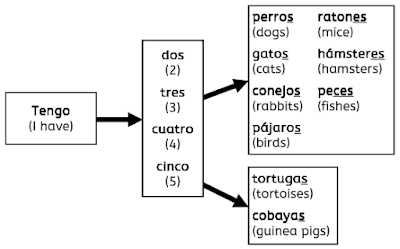
One unit of learning that I have used it with is Pets, in particular saying that you have more than one pet.  I used the bottom half of this sentence builder:


and drew up the above grid as my checklist so that I knew which sentences I had said.

Altogether with this sentence builder it's possible to make 36 sentences.  I asked Year 4 to choose 5 sentences and write them in their books.  Then I read out the sentences one by one in a random order.  I repeated each one twice, just in case, and then went straight on to the next one.  The children needed to listen carefully and constantly check their sentences, ticking off any sentences they had that I said.  When they had ticked off all 5 of their sentences they had to call out "Bingo" and then to check I asked them to read their sentences back to me.  I used my grid to check they were right.

We then continued until most children had heard their sentences.  Some children were frustrated at the end because they had missed one of their sentences and so didn't get bingo.  I did point out, though, that they had heard and identified 4 out of their 5 sentences, so not to get hung up on just one.

The classes that I tried this with said that they enjoyed it.  I liked it because they got to hear over 60 sentences all in one go.  

You may well have been playing this game for ages!  I don't remember having heard it from anyone else.

Monday, 1 November 2021

Making faces and pointing


On Thursday I'm going to be practising 4 colours with Year 1 (age 5-6) and adding two new ones.  I've made this slide to help us with our listening practice.  The idea is that I say a colour, and they have to work out which one it is and then make the appropriate face or point in the right direction.  I think that this could be adapted for different topic areas and that you could also use chunks or sentences rather than images.

Not to be confused with this pointing game!

Wednesday, 15 July 2020

Doozy


I've mentioned before that I subscribe to Richard Byrne's blog Free Tech for Teachers.  I recommend you follow it as well, particularly if you use Google Classroom, as there are lots of posts and useful information about that.  This morning Richard has written a post about an online quiz generator called Doozy.

You can use Doozy to build quizzes that require students to type in their answer, or multiple choice quizzes.  

I've had a go at making a quiz where you have to type the answers in.  It's all about regular -AR verbs in Spanish, and you can try it out by clicking here.

You don't have to create an account to use Doozy, so if you create content you'll have to think of a way of keeping a record of the links for the quizzes you've made.

You can play by yourself, or send the link to friends and play along with them, or you can be the quizmaster - this generates a quiz in a similar way to Kahoot that can be played by a group of people at the same time.  The quizzes can also be played over Zoom, Google Hangouts, Messenger and Houseparty - Doozy is a new application which has been developed since the beginning of lockdown.

I haven't yet had the opportunity to play as a team or against others, but if you challenge yourself, you answer the questions and then at the end you have to mark your own answers.  In the language learning context this provides useful feedback to the student.

Doozy provides a useful and different alternative to other online activity generators, such as educandy, which have been widely used during this period of home learning.

Have a go and see what you think.

Wednesday, 10 July 2019

Dots and boxes


Last week my Year 7 daughter told me about an activity she'd done in a maths lesson.  It was basically a game of Dots and Boxes, but it had the added bonus of each square containing a positive or negative number.  Each time they won a box, they had to add the number in the square onto their total, largest total winning.  My daughter's friend had got more boxes, so would have won in a traditional game, but my daughter went for all the positive numbers so that she had a much bigger total at the end.

This idea of having something in the box has been taken on by the languages community.  (Thank you Rachel on SecMFLMatters!)  The boxes have in them target language words or English words, or a mixture of the two.  To win a box, you have not only to put on its last side, but you also have to say the correct target language or English word.

At my school it's transition week, where all the children from Reception to Year 5 are meeting their new teachers.  This has left Year 6 at a bit of a loose end.  This afternoon we sat in the Year 1 classroom, at the tiny chairs and tables, and I gave them their exercise books and a blank Dots and Boxes grid.  They chose a word for each square and then some of them played the games.  They particularly enjoyed how it's possible to steal a square from your partner if they don't know the word.


I took this picture of a game between one of the hard-working boys and his very idle friend.  They enjoyed playing it, and it's the most work I've seen the latter do in 6 years!!

They've given me the grids they made and I've said I'll make them into resources for Light Bulb Languages and put their names on, as a little legacy.

Sunday, 23 September 2018

Educandy.com

For easy interactive activities I have been mourning the demise of Sugarcane, which ceased to be in June this year.

This morning on the Modern Language Teachers' Lounge Facebook group, I found out about educandy, a new interactive game creator from the Linguascope team.

I have created an account and created my first activity.

I clicked on "My Activities" and then on the red icon to create a set of matching pairs:

I then entered my pairs of words or "questions and answers".

When I had done this, I could scroll down and see the selection of games that I could play using this word set:

When I scrolled down further, I could see the code for this set of games, its URL and also the embed code:

The code for this activity, as you can see, is 15b.  Students can enter this code in the box in the top right of the home page and go straight to the activity:

It's also possible to embed activities:

I have been trying all this out on my laptop, and it has been very straightforward.  I have also had a go at the games.  The only downside for me is that the text on the games is small (very small in the case of the crossword clues) and therefore not very suitable for using on the interactive whiteboard.  A big positive, though, is that there is an educandy app available for both Android and Apple.  Students input the reference code and are taken straight to the choice of activities that you have designed.  This is what is looks like on my Android tablet once I have entered the code.  As you can see, I had to enter zeros for the missing digits in my code.  The games are clearer on the tablet screen.


All in all, educandy looks like a promising resource, especially if, like me, you have a Sugarcane-shaped hole in your life that needs filling. It's easy to use, quickly and easily produces activities that are clear and fun to play.  Have a go!


Thursday, 1 June 2017

May's most popular posts


You might have noticed that I've been blogging a lot more this month than usual.  I have set myself the challenge of publishing a post a day for a month.  Previously I had published 244 in 8 years.  That's an average of about 30 a year!  I started the month on 8th May, and am seeing if I can get to 8th June.  Watch this space!

These were the most popular posts in May:

1.  Starting to write in a new language
2.  Sugarcane
3.  Kagan Rally Table
4.  Reading about France and French Culture
5.  Flowcharts

If you'd like to be notified when I publish a new post, please sign up for an email subscription.  Have a look on the right of this post, under the picture of me!

Saturday, 20 May 2017

FlipQuiz

A member of the LiPS (Languages in Primary Schools) Facebook group, Ana Woodward, shared her find of this website yesterday.

FlipQuiz can be used to make interactive, "Jeopardy" style quizzes for children to play in class in teams.  You need to sign up for an account, which is free, and then you can start to make your quizzes.  You enter pairs of questions and answers, or it could be English and target language / target language and English.  You can also add an image to each pair as well.  FlipQuiz then generates the game board for you, which you can also customise with different colours and images.

If you sign up for the free account, you have to keep the scores yourself.  The Pro account will keep score for you.

My first flip quiz is about opinions of fruits and vegetables, which I am doing with Year 3 Spanish at the moment:


I think this would be a good alternative to Blue Numbers for reviewing a topic.  It can be used for single items of vocabulary, for short phrases and for longer sentences.  It would also be useful practising translation in Key Stages 3 and 4.

Saturday, 13 May 2017

Sugarcane


* UNFORTUNATELY, AS OF JUNE 2018, SUGARCANE IS NO MORE *

Sugarcane is an online, interactive activity generator.  You fill in a "Data Set", or grid, with the information that you would like to be included in the game, and then select the kind of game that you'd like.    Here is part of my data set about French numbers 1 to 12, from which I created several different games:

The content that you input can be as simple or as complex as you would like.  You'll need to create yourself an account if you'd like to keep your data sets and games.

The games can be played on tablets, computers or interactive whiteboards.  When you have finished playing a game, you get a score which you can then try to beat on the next round!  My classes like the matching games against the clock, taking turns on the whiteboard.

I think my favourite game is "What's Connected".  This is an example of a screen of the game with a data set of Spanish nouns and articles:

You have to find all boxes that are connected to the word at the top.  For example, for this one, you would need to click on una, la and 'window'.  For this to be effective you need to have several columns in your data set.

If you'd like to have a look at the data sets and games that I have already created, have a look at the Light Bulb Languages profile.

Saturday, 4 February 2017

Veo Veo


My Key Stage 2 Spaniards and I have been having fun over the last few weeks with a new game - Veo veo.  It's the Spanish equivalent of I Spy, and works in much the same way as Which card?

Veo veo has a rhyme to start it off:


I played the game using animals, as above, with Year 3 while we were learning cave-painting animals.  We practised the rhyme together (Escuchad y repetid).   Then I chose an animal and started off the rhyme.  Once I had said "¡Un animal!" the children took it in turns to guess which one I was thinking of.  The one who guessed correctly then took over the game and started off with "Veo veo".  I also played it with Year 5 this week using weather phrases and they were very motivated by it.

I Spy isn't quite as interesting in French as it doesn't involve a dialogue, but it's still worth a try:


Friday, 3 February 2017

Trapdoor and Cluedo


Trapdoor is one of those language activities which is really useful and very beneficial to learners, but which takes ages to explain!

The above is a simple version designed for lower Key Stage 2.  If you're doing one for Key Stage 3 or upwards, you could have three or four options each time.  Trapdoor is a pair activity which models good sentence structure, which will stand the children in good stead when they come to write their own sentences later.

You will need:
One copy of the grid for each child
Children organised into pairs

Method:

  1. Child A chooses an option from each pair, but doesn't tell Child B what they've chosen.  Let's say for example that in the top sentence Child A chooses Me gusta / la limonada / me encanta / la pizza.
  2. Child B starts to read the first sentence, choosing one of the options each time as they do so.
    "Me gusta el queso..."  Now Child B hasn't chosen the correct option from the second box, so Child A says "Trapdoor!".  Child B has to go back to the beginning and start the sentence again.
  3. Repeat the process until Child B can say both sentences correctly according to Child A's choices.
  4. Child A and Child B swap roles and begin the activity again.

Cluedo is a game which works along similar lines.  The above is an example of a Cluedo grid, which, again, can be as simple or as complex as you like.

This activity is teacher-led, at least to start with.  Children need to listen to each other and to you, and to think carefully about the answer.

You will need:
A copy of the grid on the whiteboard 
Optional: a mini-copy of the grid for children to use to help them

Method:
  1. The teacher chooses one option from each column, but doesn't tell the children.  I usually note my choices in my planner as I have been known to forget what I chose!  For example, let's say I've chosen boca / enorme / roja.
  2. The children take it in turns to guess your three choices by reading the whole phrase or sentence.  You can tell them how many parts they have got right, but not which parts.
    Child 1 says "una nariz pequeña y gris".  They have got no parts right so I say "Cero".
    Child 2 says "una oreja enorme y marrón".  They have one part right so I say "Uno".
  3. Keep going until someone works out all three parts and you are able to say "Tres".


Sunday, 6 November 2016

Northern Primary Languages Show


Yesterday, 5th November, was the inaugural Northern Primary Languages Show at York St John University.  I was invited to speak, and gave a presentation about games that you can play in your languages classroom.  I only had 45 minutes, so I presented 33 games that children can play sitting down at their tables.  I had to draw the line somewhere!  Here is a copy of my slides.  You can find all the resources (and more) on Light Bulb Languages and some of the games are described in more detail in this blog post.  Please get in touch via the comments if you have any questions about any of the games.


Ready to play? from Clare Seccombe

In addition to presenting, I was lucky to be able to attend some of the other sessions.  Here are my sketchnotes:


I also saw some French books that look interesting:

Cache-cache cochons


C'est à moi, ça


Tout en haut (does anyone know it this is available in Spanish?)


Finally, last month I got to visit Nathalie Paris's Bibliobook (mobile library full of books in foreign!) and heard her talking about some stories that she likes to use.  Here is the sketchnote from that day, which I've finally finished!


Wednesday, 5 August 2015

Kagan structures for Spanish


There was some discussion recently on the Languages in Primary School Facebook group about the book Cooperative Learning and French, with quite a few group members purchasing it for some holiday reading.  I found the Spanish equivalent (pictured above).  I made notes as I read it and then amused myself on rainy days in Spain by sketchnoting those notes.  I sketchnoted in an A4 sketch book, and so have uploaded the pages to Youblisher for ease of reading.

There are a lot of activities that are transferable to the primary classroom and of course to other languages.  This book has photocopiable resources for carrying out the activities in basic Spanish.

Click on the picture below to take you to the complete sketchnote.

Spanish Cooperative Learning and Multiple Intelligence Activities

Thursday, 27 November 2014

Adaptable Games


At the most recent meeting of the Sunderland ALL Primary Hub we discussed games that can be adapted to any language that we teach in our Languages lessons.  Here is our list - we hope you find something that you didn't already know about.  Many thanks to the Hub members and to Erzsi Culshaw, whose blog is a rich source of such games.

1.            Which card?
Shuffle your flashcards so the children don’t know what order they are in.  Hold the pile close to you so that the children can’t see them!  The children have to work together, listening and thinking, to find out which card is on the top of your pile.

C'est quelle carte?         Which card is it?
Oui, c'est....                   Yes it is....
Non, ce n'est pas....       No it isn't.....

¿Qué carta es?              Which card is it?
Sí, es...                          Yes it is...
No, no es....                  No it isn't.....

2.            Pelmanism
Children have a pack of small cards, one set of pictures and one set of the corresponding words.  They put them all face down on the desk and take it in turns to turn over two cards, to see if they get a matching pair.  The child with the most pairs wins.  Children can create their own Pelmanism games with sets of blank cards.  You can also make memory games like this with online game makers such as this one.

3.            Kim's game
Show, for example, the 11 colours on the IWB.  Using either custom animations or the duplicate screen function on PowerPoint, you can make one disappear when you press the button.  The children have to say which one is missing each time.  To increase the challenge, all the others change position when one disappears.  You can also use this as a class vs teacher game.  One of the children has to predict which one they think will disappear.  If they are right then the class gets a point.  If they are wrong, the teacher gets the point.  I have never been beaten!

Qu'est-ce qui manque?          What is missing?

¿Qué falta?                             What is missing?

4.            Fly past
You can use the motion path animation on PowerPoint to make pictures etc fly from one side of the screen to the other.  The children have to watch very closely to see which one it is, and then call out the answer.  Increase the challenge by having two fly across the screen together.  There are some French examples with numbers here (scroll down a little).

5.            Slaps
Stick your flashcards to the board or display the images on the IWB if you are feeling brave.  Two children come up to the board and stand one at each side.  You say one of the words and the children have to be the first to slap it.  Injuries are less likely if each child has a fly swat to slap the word with.

6.            Noughts and Crosses
This is a great team game that takes no time at all to set up.  Draw the noughts and crosses grid on the board, and number the squares.  I usually use 1-9, but of course if the children know higher numbers you can use those too.  I don't order number the squares in order, so they have to think more about the number they are choosing.  Divide the class into two teams.  I usually nominate a team captain, who has to give me the team's answers.  They can discuss the answer, but I will only listen to the team captain.  The team captains choose which team will be the O and which will be the X.  The first team tells you in the target language which number square they are going to go for.  You show them a flashcard or ask a question and the team has to come up with the answer.  If they are right, they get their O or X in their chosen square.  Three in a row wins, of course.

Quel numéro?                                          What number?
Pour le numéro...., comment dit-on...?    For number...., how do you say...?

¿Qué número?                                         What number?
Para el número...., ¿cómo se dice.....?     For number..., how do you say....?

7.            Snakes and ladders
Use a standard snakes and ladders boardgame.  It can be played in teams or pairs.  The children throw the dice, but can only move their counter to the appropriate square if they answer a question correctly.

8.            Parachute games
All the games that you usually play with the parachute can be adapted for languages.  Fruit Salad, for example, works well.  You can also use the coloured sections and a toy on top of the parachute to practise colours - simply tilt the parachute so that the toy rolls onto the right colour.  This document will give you lots more ideas.

9.            Dance mats
Clear a space on the floor and lay down one flashcard. Your volunteer stands behind it.  Say the word and they jump to the card.  Add another card and say the two words, and they have to jump to the two words in the right order.  Add more cards and continue to build up the sequence.  They have to jump in the right order each time.  This could easily be played in pairs, where the children give each other the instructions.

10.          Heads down thumbs up
Played in the normal way, but each of the children touching the thumbs has a flashcard.  When they are ready, the children sitting down use the flashcard words instead of the children's names to find out who 'got' them.

11.          Chef d'orchestre / Secret signal
This is excellent for practising the same words, sounds, phrases, sentences or question forms over and over again.  One or two children leave the room.  Meanwhile, you choose someone to be the secret signaller.  They show what signal they will give to get the class to change what they are saying.  The one or two children come back in, and it is their job to spot who is giving the signal.  The whole class chants the same thing over and over again until they see the signal, then they change to the next thing. This keeps going until the signaller is spotted.  You will need to have on the board the sequence of words or phrases that they are going to say.

12.          Bingo
This can be played with any words or numbers, and there are many ready made grids that you can use.  For a really quick game, the children can choose their own words and write them in a list.  Bingo with a twist is:

13.          Strip Bingo
Not as exciting as it sounds!   Each child has a strip of paper and on it they write or draw probably about 6 of the words that you are practising.  You begin to call the words.  The idea is to tear off the words when they hear them, but they can only tear one off if it is on the end of their strip.  They may have to wait to hear a certain word again before they can tear it off.  The advantage of this over normal bingo is that they will hear the words several times.  It does, however, create more litter than normal bingo!

14.          Pass the parcel
You will need a bag or similar receptacle and some objects or flashcards to put in it. For example, if you are practising colours you can put in some coloured pencils.  Play some music, or all sing a song together, while the bag is passed around.  The person who is holding the bag or when the music stops or when the song finishes gets to take something out.  Either they say the word or they put it in the middle for everyone to see, and everyone works together to say the word.  

15.          Corners
Put a different word, picture or phrase in each corner of the room.  Call out one of the words and the children have to run to the correct corner.  The children in the wrong corners are out.  Alternatively, the children choose a corner to run to and then you call out the corner that is out.

16.          Round the World
Select a child to start the game.  They stand behind the chair of their next door neighbour.  The teacher asks a question to both of them.  The first one to answer correctly goes to stand behind the chair of the next child.  If the original child is not the one to get the correct answer, they sit in the second child’s seat.  The aim of the game for each child is to get as far around the classroom as they can, answering as many questions as they can.

17.          I went shopping and I bought
The first child says one word or phrase, for example “Rojo”.  The second child says that word and then adds a second, for example “Rojo, azul”.  The third child says those two colours and then adds a third, and so on.  The challenge is to remember as long a chain of language as possible.

18.          Chinese Whispers
Divide the children into two teams, and put your flashcards or words at one end of the classroom.  Whisper one of the words or phrases to the first children in each line, who then have to pass it down the line in the usual Chinese Whispers way.  The last child in each team goes to the flashcards or words and shows which one they heard, and therefore which one their team has been whispering.  The children will need to concentrate on their speaking and their listening for their team to win this game.

19.          Mystery Voice
One child is blindfolded.  A second is chosen to say a word or phrase, but they disguise their voice.  The blindfolded child has to guess who is speaking.  They could be asked to repeat their word or phrase, and could disguise their voice in a different way.

20.          Hide and Seek
One child leaves the room.  They will be the seeker.  Meanwhile you and the rest of the class decide where to hide a toy.  The child comes back into the room and begins to look for the toy.  Instead of saying “cold”, “warm” and “hot”, the children chant a word or phrase, whispering it when the seeker is “cold” and getting louder as they get "warmer".

21.          Detectives
One or two children leave the room.  They will be the detectives.  Meanwhile, the teacher gives out 6 small toys to other members of the class, who hide them in their hands.  All the children put their hands under the tables.  The detectives come back in, and must question 6 members of the class in total to see if they have the toys.  When the 6 suspects give their the answers, they hold up their hands, and the detectives will be able to see if they have one of the toys.

22.          Pictionary
A useful game for practising vocabulary, particularly nouns and verbs.  

A particularly useful game for intercultural understanding.  Read more about it here.

24.          Cluedo

The teacher thinks of a sentence, choosing one of the options from the columns each time.  The children then need to work together, listening carefully to others’ answers and thinking hard, to find out what the sentence is.  Each time one of them gives an answer, they must give the whole sentence.  The teacher can tell them how many parts they have correct, but nothing more.

It’s up to you how closely you want to follow the format of the original TV programme, but there’s a lot you can do with a sentence with a gap in it.

J’ai un chien ___________________.       I have a __________ dog.

Mi perro es ____________________.      My dog is ___________.

26.          Board games
A homemade boardgame will help children to practise the words and phrases from a certain unit.  Put words or pictures on some of the squares, and the children will have to say those words or a sentence containing those words to be able to move on in the game.

27.          Drawing Game
Say one of your words in the language and give the children 10 seconds to draw it. Then say a second and give them 9 seconds to draw it.  Then a third, and they have 8 seconds to draw it, and so on until they have 2 seconds to draw something.  Then they have to tell you all the things that they have drawn.  The hastily done drawings may well be difficult to decipher!

28.          Sit down quickly!
All the children stand up.  You show one flashcard at a time.  If you say the correct word to go with it, the children stay standing.  If, however, you say the wrong word, they have to sit down as quickly as possible.  The last ones to sit could be out.


If we have missed any of your favourites, please feel free to add them in a comment!

Wednesday, 12 February 2014

Des chiffres et des lettres

With Year 4 French I have been working on the numbers up to 31.  We've been playing a simplified version of the numbers round of Countdown, or, rather, of Des chiffres et des lettres.  Here's what we did:

1.  Someone chooses a number between 21 and 31, which is our number to aim for.  It's written on the board.
2.  Someone rolls two dice, adds the two numbers together and says the number in French.  The number is written on the board.  This is repeated to give another number.
3.  Someone rolls one die and says the number in French, and it's written on the board as before.  This is repeated once more.
4.  The children now have a big number that they're aiming for, and four other number numbers to use to make it.  The children use adding, subtracting and multiplying (dividing if you're feeling brave) to use the four numbers to make the target number.
5.  If they can get the answer, they have to explain it in French using the numbers and plus, moins, fois and so on.

Year 4 loved it, though some of their times tables were a bit suspect!

Sunday, 2 June 2013

#MFLSAT York

Yesterday was the latest MFL Show and Tell in York, affectionately and hashtaggingly known as #MFLSATY.  I have blogged about previous #MFLSATs (Oldham, Nottingham and Cramlington), all of which were excellent and from which I and scores of other language teachers came away buzzing with new ideas enthusiasm.  York did not disappoint.

I have already blogged my presentation about Trash or Treasure, and here are some other golden nuggets from the day. 

Marie O'Sullivan talked to us about using songs in the classroom, and we had a go at telling the time in German to the EastEnders theme tune.  Marie recommended the Lyrics Gap website, which has songs with ready-made gap fill exercises and the opportunity to create your own activities in the Teacher Area.  For German she showed us AlexTV, where familiar songs in English are given the German treatment.

David McDermott spoke about learning mats.  Learning mats are a portable learning device (!) and having them avoids having to change wall displays too often.  David likened a learning mat to the picture on the lid of a jigsaw box, which shows you the completed picture for reference.

One of David's examples that I particularly liked was an A3 laminated sheet where half was blank for writing and the other half contained the objectives and success criteria.

Learning mats can also contain useful words for responding in speaking activities à la Group Talk.  The subject for discussion can then be stuck in the middle of the mat on a Post-It.

Isabelle Jones gave us some ideas for making revision more interesting and effective.  She suggested revisiting core language, false friends, suffixes and prefixes, singing songs which illustrate specific linguistical points and exploring jokes in the target language.  You can see all this and more on Isabelle's blogpost about the event.

Mary Cooch showed us a Google Street View webquest which she has embedded in Moodle and which was inspired by the work of Vincent Everett.  Students look at the Street View of a village in France and have to find people and landmarks in order to collect clues to solve a mystery.

Compiling an activity like this must take a huge amount of work, and we are very lucky that it is available for us to use.  If you have to try the Moodle version it's here, while Vincent's original version is here

Amanda Salt recommended the videos El Caso de Lorenzo and El Viaje de María, as well as the app Decide Now, which, sadly, isn't available for Android.

Claire Hampson had us singing songs about French verb endings à la Abba.  Claire likens understanding and using verbs correctly to a packet of seeds.  You can't just put a packet of seeds in the ground and expect them to grow, just as you can't pluck a verb from the dictionary and put it in your sentence and expect it to be OK.  Seeds, like verbs, needs to be unpacked and changed and nurtured before they will grow properly.  Claire showed us a picture of some verb flowers that her students made. Each had 6 petals, one for each person of the verb.  I really like this idea for a display for Primary, and will incorporate it into my Y6 Spanish scheme for next year.


Claire uses Ameritz for backing tracks.  She also records her students singing, uploads it to the school blog and then sticks a QR code into the students' books so that they can listen and share their work at home.


Alicia Hamilton told us how to Make Learning Visible, using a Tarsia discussion wheel as her starting point.


At the beginning of the lesson, students draw an arrow on the desk, with the lesson start time at one end and the finishing time at the other end.  They are given 24 lexical items on a vocab sheet and have to highlight what they already know.  Then they plot this point on their arrow along with how many of the words they know, and set themselves a target for the end.


In groups they put the discussion wheel together.  Then they refer back to their vocab sheet and highlight what they know now.  The groups can then play games together with the discussion wheel cards to practise the new language.  They can play dominoes, follow-me, one student removes a card from the wheel and others have to spot which one it is, teacher calls out an English word and the one who can say the TL word wins that card.  At the end of each activity students refer back to their vocab sheet for more highlighting.


After that the students practise the vocabulary by identifying it in a text, using it in sentences or writing a paragraph using a certain number of the items.  An important part of the lesson is the learning conversation at the end: What did you learn?  How did you learn it?  What helped you?  What would you do next time?  Who taught you this language?  It hands a lot of the learning over to the students.


There wasn't time in the end for the Tarsia genius bar, but everything you need to know is here.


Hope you find something that inspires you amongst this!  I could also mention KidBlog.org, Group Talk Poker, Kirikou et la Sorcière, using Google Forms to make interactive quizzes, poo in Catalonia and more!

Monday, 11 February 2013

Blankety Blank!


The #ililc3 Show and Tell was another fantastic occasion with many and varied items for our learning and entertainment.

My love of BBC1's Pointless has been well-documented, and so it seemed only right and proper that my contribution should have a game-show theme - a short game of Blankety Blank.  If you are unfamiliar with Blankety Blank and its work, or need a refresher of the rules, here's how to play:


Main game
  • 6 panellists, 2 players
  • Show Player 1's question.  Panellists write their answer on their mini-whiteboard.
  • Player 1 says their answer. 
  • Ask each panellist to show their answer, and the player wins one point for each match.
  • Repeat for second player.  The player with the most points goes on to Supermatch.

Supermatch
  • Show the word.  
  • The player chooses three panellists to give an answer, then chooses their answer from those three, or may choose to go with their own answer.
  • Reveal audience answers to see how much they win.
If you would like to have a go yourself, you can download the PowerPoints that I used at the Show and Tell here and here.  Enjoy reading the questions that we didn't use, but I would recommend that you change them before unleashing them on a class!  If you click on the action button on the "Premier Jeu" screen, it will take you to the questions which will scroll through very quickly.  To stop them and therefore pick a question at random, just press S.  Press S to start the scrolling again.  To return to the Supermatch, click on the small action button at the bottom of the question screen.

Strictly speaking, a game of Blankety Blank will only use 8 people, so you may think it would not be suitable for a whole class.  But if you slightly change the rules it would be easy to get all the class involved.  Give each student or pair of students a mini-whiteboard and get all of them to write an answer for each question.  Then use a random name selector such as your Mug of Misery™ to select the six who are going to provide their answer for the contestant.  And of course there are plenty of topic areas that you can use for the questions.

Enjoy!

Tuesday, 25 September 2012

Jeux de mains

I have just started the "Playground Games" section of the French KS2 scheme of work.  This topic presents an ideal opportunity to bring in some intercultural understanding by learning some French clapping games.

To start the topic there is a lovely video from SchoolsWorld TV (used to be Teachers TV) where you can see French children playing hopscotch, skipping and football.  My Year 3s loved seeing the handwritten numbers on the hopscotch.  There is also another video from the same source which has some French clapping games.

When looking for a clapping game for Year 3, the main difficulty I had was finding something simple enough. Just like in English, many of the French ones have language that is too complex.

I have done the "Choco-choco-la-la" clapping game before in Spanish, which I found in this excellent document, which also has other games in German, Romanian, Italian and Greek.  It always goes down a storm, and the jumping version tires them out!

I put a request on Primary Linguanet, and received lots of good replies.  Primary Linguanet trumped Twitter on this particular occasion!  Here are the two that I used:


alphabet (clap thighs, clap hands together, clap both hands with partner)
X X A A (clap partner's right hand twice, clap partner's left hand twice)
X X B B  (clap partner's right hand twice, clap partner's left hand twice)
X A X B (clap partner's right hand, clap partner's left hand and repeat)
X alphabet (clap thighs, clap hands together, clap both hands with partner)

You can also find this one on Mama Lisa's World, with a sound recording.


Trois petits chats (clap for trois petits, clap partner's right hand for chats)
Trois petits chats (clap for trois petits, clap partner's left hand for chats) 
Trois petits chats, chats, chats (clap for trois petits, clap partner's right hand, then left hand, then both hands for chats)

This one has lots and lots of verses, including the next two which are:

Chapeau de paille
Chapeau de paille
Chapeau de paille, paille, paille

Paillasson
Paillasson
Paillasson, son, son

You can see this one on Mama Lisa's World too.


Here are some more links for playground games and other games for children:

French
Group games for playing outside
Playground games with videos
Playground games from different countries
Playground games from the olden days!
French clapping rhymes (read the comments too)
Tiens voilà main droite, a clapping rhyme, from Momes.net


Spanish
Games for children from El Huevo de Chocolate
Spanish clapping games
Spanish traditional games
Choco-choco-la-la with video
More Spanish clapping games
Finger rhymes and other rhymes with actions
Playground games
More playground games
Clapping rhymes including A sailor went to sea sea sea


I'm going to whisper the next bit: *I think secondary students might enjoy some of these too!*

Thursday, 20 September 2012

Ecoutez Répétez


Last Sunday morning @Langwitch asked via Twitter if anyone had any ideas for choral repetition that weren't "Repeat if it's true".

I replied with a few suggestions, and @spsmith45 and @bellaale suggested that a blogpost would be useful.  So here it is.

When I did my PGCE in secondary languages in 1994, the communicative method was all the rage and choral repetition was an integral part of it.  The idea was that by repeating the vocabulary the students would absorb almost by osmosis the sound-spelling rules for the language.  Well that didn't work.  They knew lots of words, but the sound-spelling rules were never made explicit and so they didn't transfer the knowledge to new language.  These days, thank goodness, the explicit teaching of phonics is a fundamental part of the process, and students have, therefore, the key with which to unlock the door of pronunciation.

Choral repetition is, however, just as important as before, especially for younger or beginner learners.  It is one of the teacher's roles to give the learners a good model of pronunciation, to give them the opportunity to practise making the sounds and to help them to learn the meanings of the words.  It is unfair to ask an individual to repeat a word by themselves when they have only just met it.  They are likely to be lacking in confidence and (especially with secondary students) embarrassed.  Repeating chorally as a whole class provides them with a safety net - nobody can hear them making mistakes.  

So here are some ideas for choral repetition.

In my classroom the choral repetition is always introduced with "Ecoutez répétez" or "Escuchad y repetid", after which the children know exactly what they will have to do.  Judging the right amount of repetition is an art.  You often need to do more than you would think.  If the children start to say the words with me rather than wait for me to say them first, I know that it is time to start moving on.

Visual stimuli for the repetition:

  • flashcards (my personal preference as they are so versatile)
  • images on a PowerPoint or IWB file
  • use realia
Ideas for varying the repetition:


  • repetition in silly voices  I dabble with the whisper, the squeak, the growl and the robot.
  • repetition high and low  This works especially well with numbers, where you will end up saying the odd numbers in a high voice and the even numbers in a low voice.
  • vary the speed and volume  Saying the word slowly really accentuates its sounds.
  • practise each word with an action  Then you do the actions while the students say the words.
  • music and rhythm  Some things stick better if you give them a little tune ("amarillo" and "plátanos" are good words to sing!) or if you repeat them to a rhythm.
  • chef d'orchestre  One student leaves the room.  When they come back in, the whole class will start repeating the vocabulary.  One student, who you chose when the first student left the room, will give a signal to the rest of the class to tell them that they need to change to the next word or phrase.  The first student needs to work out who is giving the signal.  This is good for words or phrases that are difficult to find actions for and which you need to repeat lots of times to build confidence and embed them in the memory, such as questions.
  • repeat the correct one  Hold up a flashcard and say "¿Es un gato o un perro?" (or appropriate vocabulary!)  The class repeats back the one that is correct.
  • repetition in pairs  Practise the words as a whole class to build confidence.  Then give each pair a list of words or of the stimulus pictures and get them to say the words to each other.  If the speaker makes a mistake then they have to start again.  Up the challenge by timing each other! (Thanks to @pixiejojo for the idea.)
  • Let the students complete the word  You say the first half of the word or phrase and the students complete it.  (Thanks to @trekkiep for the idea.)
  • memorise  Create a grid on the board where you group the vocabulary according to gender, number etc..  It works well with weather in French (il+weather, il fait+weather, il y a+weather) and with things like places in town where you can group them as le, la and l'.  Repeat the words line by line, gradually removing one at a time so that you end up pointing to blank spaces.  (That's something my trusty OHP was particularly useful for.)  You'll then be able to point at a blank space on the board and have them say the right word.  Always looks good, this one, when you're pointing seemingly randomly at a board and a colleague comes in!
At the moment I am doing "Places in Town" with Y5 French and Y6 Spanish.  We have been working this week on sentences such as "A Sunderland il y a une poste et un marché, mais il n'y a pas de poissonnerie."  We repeated the first sentence lots of times, discussed what it all meant and then read it out loud together.  The children were then able to help me to piece together some more sentences using the same structure.  Living writing frames are also good for this.  Write each word or short phrase on a separate card, and make a line of students at the front holding the cards.  Repeat each card to build the sentence.  Continue repeating, gradually turning over one card at a time until you are repeating the sentence from a row of blank cards.  You can then start to change parts of the sentence by swapping certain cards and repeating again with the new word or phrase.

As a postscript, it appears that saying a word lots of times allows students to think of ways of helping them remember which is which.  One of my Y5s now remembers "une boulangerie" by thinking of "blue lingerie". Really.