Showing posts with label grammar. Show all posts

Thursday, 13 November 2025

Minimum core content for Key Stage 2 Languages


ChatGPT's take on my musings about the core content!

The Curriculum and Research Review 2025 (CAR) was published last week on 5th November.  I have already written at some length about what it means for primary languages.

The first of the two recommendations for primary languages was:

a minimum core content for French, German and Spanish would provide greater clarity and consistency, especially for non-specialist teachers.  Covering commonly occurring phonics, vocabulary and grammar, this should align closely with the content and teaching approaches at secondary and thus build more securely the foundations of knowledge for success at Key Stage 4 and beyond more securely.  This should support a smoother transition into Key Stage 3. .... With a shared understanding of what constitutes 'substantial progress' in a language, secondary schools would be better equipped to build on students' prior learning.

The Government has agreed to put this into place.  I have been pondering what this "minimum core content" will comprise.  The second sentence of the above quotation is, I think, important: "Covering commonly occurring phonics, vocabulary and grammar".  I would argue that it needs to be more far-reaching than this and not just vocabulary, grammar and phonics.

Here are my thoughts so far on what I think should be in the minimum core content:

Intercultural Understanding (IU)

Children need to have an understanding of the language that they are learning and how it fits into the global picture.  We need to encourage curiosity about world languages and where they are spoken, and we need children to appreciate that other languages may be different, but they are not bad, wrong, or strange.  All languages are valid.  I think that children should be able to:

  1. recognise that there are hundreds of languages spoken across the world, and that most people are not monolingual
  2. name other world languages and say where they are spoken
  3. explore and investigate language families and their roots
  4. talk about the languages spoken in their school and their classroom
  5. name the countries which speak the language that they are learning
  6. know some basic facts about the countries where that language is spoken
  7. explore and investigate special days and celebrations in some of those countries
  8. find out about social conventions and daily life in some of those countries
Writing systems

I have written before about writing systems (for example here) and the importance of children's familiarising themselves with the writing system of the new language prior to attempting any writing in it.  I think that children should be able to:
  1. write diacritics accurately
  2. name the different diacritics in the language that they are learning
  3. understand the difference that those diacritics makes to the individual letter or word (this of course links nicely to phonics)
  4. write accurately any punctuation marks of the new language that differ from English
  5. understand the rules for capitalisation in the language that they are learning
Dictionary skills

If children want to be able to personalise their speaking and writing and extend what they want to say outside of the parameters of the core content, it is important they know how to use a bilingual dictionary effectively, whether it be online, paper-based, or a more simple bilingual glossary.  This will also of course cross the curriculum to English, and the two subjects will be able to work hand in hand on alphabetical order and finding the correct definition.  The ability to use a dictionary effectively will also support new Year 7s, especially if they are learning a language that they didn't study at primary school.

Should we push for an online bilingual or even multilingual dictionary for Key Stage 2, where children can work between English and their curriculum language, but also between other "foreign" languages?  What a great resource that would be!

Language Learning Strategies

In my opinion, Key Stage 2 is the time to embed what it means to be a language learner, and what children can do to optimise their learning time and their understanding.  For example, I think that children should be able to:
  1. look at the face of the person speaking and listen attentively
  2. compare the new language with English or with other languages that they know
  3. use context and tone of voice to deduce meaning
  4. use different techniques to memorise language
  5. use physical responses and gestures/actions to aid in the learning process
Phonics

It's worth noting first of all that phonics in French is much more complex than it is in Spanish or German.  I teach just Spanish currently, and have usually covered all the important phonemes by February of Year 3.  After that it is constant repetition and practice, as I introduce all new vocabulary phonics first.

There are many more phonemes for French, but having said that, the last time I taught French (2022-2024) I managed to cover the following phonemes in 2 years:

j, /ə/, u, i/y, ê/è/ei/ai, r, on, un, ô/au, é, ou, ss/ç, s/z, in/im/ain, an, ch, oi, eu, silent h, and silent final letters

We repeated many of these multiple times, and gradually introduced the phonemes as we met them in new vocabulary.  So I think it would be doable over four years, as long as the phonemes were carefully planned into the scheme of work units.  I can't think of many other phonemes that would need to be included for French.

For Spanish: a, e, i, o, u, b/v, ce/ci/z, -d, ge/gi/j, silent h, ll, ñ, qu, r, rr, gue/gui

I don't know enough German to be able to put a list here.

Thinking about the sentence in the quotation from the CAR above that says "this should align closely with the content and teaching approaches at secondary", I anticipate that activities such as dictation and reading aloud, new arrivals to languages GCSEs, will make their way into Key Stage 2 in a more formal way to aid phonics practice.

Vocabulary

It is generally agreed that by the end of Year 6, children will have reached level A1 of the Common European Framework.  The estimated vocabulary size is between 500 and 1000 words to reach this level.  Given the time restraints to which we are subject in Key Stage 2, 500 seems reasonable.  This would work out at about 125 words per year over Key Stage 2, or an average of 3 or 4 new words per week.  This seems doable.

It is likely that the vocabulary list will be informed by word frequency, as has happened in the secondary sector,  and which is also a feature of some primary schemes of work now.  The verbs will be important - you can't make a sentence without them after all - and the chosen nouns will need to be relevant to the experiences and interests of children age 7-11.  I think that this will be a good opportunity to include here the themes and topic areas which might be commonly included in lower Key Stage 3 but are too immature for them, as well as the lists of words that would be useful for new Year 7 students to have under their belt in order to hit the ground running in secondary.  Other aspects of vocabulary, such as days and months, link well to other topics in the primary curriculum such as Romans.

My suggestions for vocabulary are:
  1. basic greetings and saying your name
  2. titles e.g. Señora, Monsieur
  3. common first names from the target-language speaking countries
  4. some commonly used classroom instructions, to support target language use in secondary
  5. saying how you feel (answering the question How are you?)
  6. numbers to 100 (admittedly more complex for French than for Spanish and German)
  7. colours
  8. other basic adjectives, e.g. of size and shape
  9. days of the week
  10. months of the year
  11. items in the pencil case (very important for younger children!)
  12. animals / pets
  13. members of the family
  14. planets (links to Year 5 Space topic)
  15. opinions (saying what you like/don't like/love/hate)
Grammar


The ASCL Transition Toolkit (link to Spanish overview) was put together by ASCL, the British Council and the Association for Language Learning.  When we were compiling it, we took the brief statements in the Programme of Study and unpicked them to see what would actually be involved.  I use the toolkit every year to inform the secondary schools what my Year 6s have done, and I think that it makes a good starting point for these discussions.  I also unpicked the grammar from the Programme of Study and put it in these mind maps.

It's worth noting at this point that the terminology of certain grammatical points is different in the English curriculum and the Languages curriculum, for example articles vs. determiners and possessive adjectives vs. possessive pronouns.  This reset of the curriculum might be the opportunity for some more joined-up thinking across the curricula for "native" and "foreign" languages.

My suggestions for grammar to cover these points are:
  1. notion of grammatical gender
  2. nouns (patterns, how they are affected by grammatical gender)
  3. determiners (definite and indefinite articles + numbers)
  4. plural forms
  5. adjectival position
  6. adjectival agreement
  7. question words
  8. conjunctions (and, but, however)
  9. intensifiers (very, quite)
  10. subject pronouns (although not used a great deal in Spanish)
  11. first three persons (I, you, he/she/it) of the high-frequency irregular verbs to be, to have, to do/make, to want, to go
  12. first three persons of commonly used regular verbs such as to play, to speak, to listen, to eat, to drink, to like

Do you agree with this list?  
What would you add?  
Would you take anything out?  

Let me know in the comments.

Friday, 7 June 2024

Adaptable Activities for your Language Lessons


I'm delighted to announce the publication of Adaptable Activities for your Language Lessons.

This pdf download contains 120 different activities that can be adapted to any language and to most ages of learner.  There are activities for listening, speaking, reading, writing, grammar and phonics.

So if you've ever found yourself in a planning rut, wanting to try out something new but not sure what, then this is the publication for you!

Available now in my Sellfy shop: https://ideaseducationltd.sellfy.store/


Monday, 30 October 2023

Sentence Builder Bingo


I'm always on the lookout for more ways to drill and practise vocabulary and structures.  During the summer holiday I had the idea of using sentence builders to play bingo with.

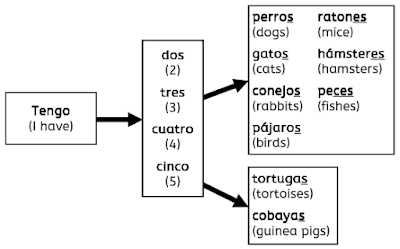
One unit of learning that I have used it with is Pets, in particular saying that you have more than one pet.  I used the bottom half of this sentence builder:


and drew up the above grid as my checklist so that I knew which sentences I had said.

Altogether with this sentence builder it's possible to make 36 sentences.  I asked Year 4 to choose 5 sentences and write them in their books.  Then I read out the sentences one by one in a random order.  I repeated each one twice, just in case, and then went straight on to the next one.  The children needed to listen carefully and constantly check their sentences, ticking off any sentences they had that I said.  When they had ticked off all 5 of their sentences they had to call out "Bingo" and then to check I asked them to read their sentences back to me.  I used my grid to check they were right.

We then continued until most children had heard their sentences.  Some children were frustrated at the end because they had missed one of their sentences and so didn't get bingo.  I did point out, though, that they had heard and identified 4 out of their 5 sentences, so not to get hung up on just one.

The classes that I tried this with said that they enjoyed it.  I liked it because they got to hear over 60 sentences all in one go.  

You may well have been playing this game for ages!  I don't remember having heard it from anyone else.

Sunday, 18 June 2023

What's connected?


The other day, while looking for something else, I reminded myself of the sadly-no-more interactive activity maker Sugarcane.

My favourite of their activities was What's Connected.  Here's an example:


Once you had entered your data set, it would choose 12 random words from it and then ask you to find links amongst them with the word at the top.  There were usually 3 different links to be found.  For example, the links here with ventana are una, la and window.  The more columns you had in your data set, the more links were possible.

I've been pondering making some versions of this activity to use as starters, as it makes students think about the detail of the words and phrases that they have been learning and the relationships between them.  The first unit of work that I thought of to use was my Year 4 unit involving opinions of food and drink in Spanish.  

First of all I created my data set in the form of a table in MS Word:


Then I needed to make a random selection.  I started off my putting the data set into a Flippity Randomiser but found that the selection it generated wasn't really random enough!  So instead I pasted the data in a list into an online random picker, which worked better.  I also used this to select the "lead word".

I created a template in PowerPoint and entered the information.


I'm thinking of asking the children to write on their mini whiteboards any links they can find, before showing them the answers.  All the children should be able to find at least one link.

This format would also suit adjectival agreement as well as verb paradigms and tenses.  Can you think of an area of language that you would like an activity like this for?  Let me know in the comments.


Friday, 9 June 2023

Point à la ligne: dictation in primary languages


Dictation is back on language teachers' radar for a couple of reasons.  Firstly, it features in the latest revamp of the GCSE specifications for MFL, which will be first taught in September 2024.  Secondly, last Sunday saw a world record breaking mass dictation on the Champs-Élysées.  I must admit when I first heard this news on Monday morning I was very jealous of the participants, and wished I could have been there!  I used to do a lot of dictations in French at secondary school, in preparation for the O level exam, and loved them.  I took French O level in 1985, which was actually the last year that students had to do a dictation.  That year we were also the first cohort to do a listening comprehension (from the reel-to-reel tape!)  I don't think we had had any practice of this beforehand.

I've had a look at some of my secondary school French books.  It's interesting to note the standard of the language that we were expected to write at that time, which was the spring term of 3rd year, a.k.a. Year 9 (age 13-14).  I had started learning French in the first year of middle school, age 8, and already knew quite a lot when I started secondary school at age 12 (in Year 8 - very odd three-tier system in Surrey in those days!), but it wasn't the same for all my classmates who had come from different middle schools.


And no, in the first dictée above, I don't have any idea what the reference to washing buildings is all about!  You can see that dictations were always negatively marked.  You started off with 20 marks (usually) and then as the person sitting next to you was checking what you had written, they would take off one mark for each error that you made.  I think we were allowed half a point for a missing or wrong accent.  Then our teacher checked them all and gave us our final mark.

I never experienced dictation in Spanish, having only started learning that language in the 6th form (age 16).  O level in Spanish was just listening comprehension for the listening component.  However it can be seen from the examples above just how much more complex dictation is in French compared to Spanish.  My first error was one of adjectival agreement - route is feminine, and therefore I should have written route fermée.  However, fermé sounds exactly the same as fermée, making it more than just an exercise in sound and spelling; it comprises also an important grammatical component.  It would be much more straightforward in Spanish, where the phoneme-grapheme link is much more transparent, and the difference between cerrado and cerrada can be clearly heard.

The pronunciation of French with its myriad of silent letters and homophones combined with its grammar makes dictation a difficult task.  There is a lot to think about.  With Spanish, on the other hand, as long as you know the phonemes and their corresponding graphemes, especially those that make Spanish different to English, you can make a pretty good attempt at it.  In fact the errors that our students make are likely to be similar to the errors that native speakers make when they first start writing.


This is part of a letter that was written to me by a 7 year old Spanish girl to whom I had taught English in Spain during my year abroad.  It can be seen that she wasn't sure which words had silent h and which didn't.  For example e recibido should read he recibido; te voy ha decir should be te voy a decir.  She also confuses b and v, which have the same sound, thus me ba muy vien should read me va muy bien.

Our students might experience similar difficulty with: 
  • the three 'th' sounds, represented by the three graphemes ce, ci and z
  • the "spitting sounds", represented by the graphemes ge, gi and j
  • ll and y, which mostly have the same sound
  • the hard 'k' sound, which can be represented by c and by qu
  • differentiating between r and rr
  • remembering the ñ!
  • remembering which vowels have written accents
Year 11 students will be expected to do dictation in their GCSEs from 2026.  This means that all our primary children, who will be taking GCSEs from 2028 onwards, will, presumably, be starting to do dictations in Year 7, as Key Stage 3 begins its preparation for Key Stage 4.  It makes sense, then, for us to start doing some simple dictation-style activities in primary.

There are three main types of dictation for us to consider:
  • dictation of single phonemes (in the form of a gap fill)
  • dictation of single words (more like a traditional spelling test)
  • dictation of a short text
It's interesting to see that the proposed questions at GCSE are a combination of these.  The first is Foundation Tier and the second is Higher Tier, and these are the sample questions from Pearson, who have released the first specification for the new French GCSE.


So there is some gap fill of single words and also some whole sentences, but nothing on the scale of the paragraphs that we used to have to do for O level.

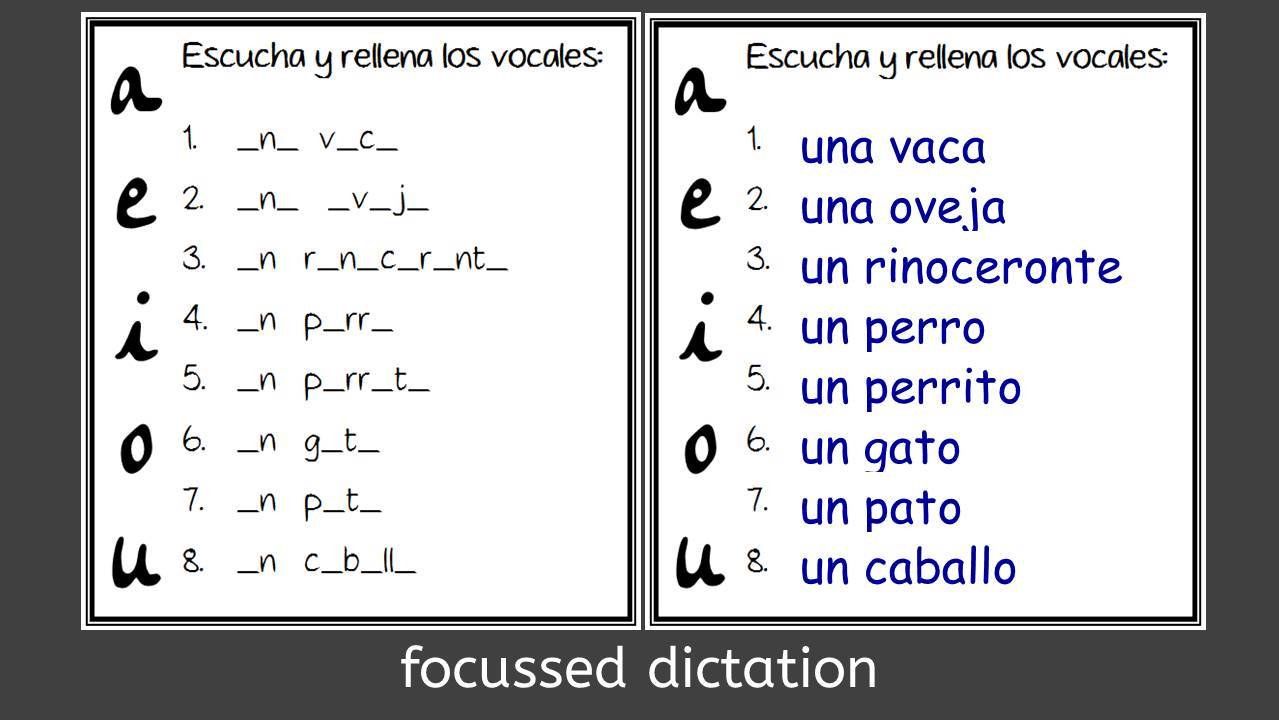
As we do a lot of work on phonics in Key Stage 2, a good place to start is with individual phonemes and graphemes in the form of a gap fill.  This is a listening activity that I have done recently with Year 2.  All that they had to write was the correct vowel - A or O - to complete the word.  The listening and therefore the dictation was very focussed.


I have also done a similar activity with Year 4, but this time using all the vowels, and they could also use their grammatical knowledge to help them to distinguish between the five sounds.  The challenge is for the children to hear 'ee' and think i not e!


Something else that I think is worth our while is using the target language terms for the punctuation in dictations.  This will only serve to reinforce the work that the children are doing in English.  Here is an activity that I have put together today for one of my Year 4 classes, who are getting really good at giving opinions of food and drink, but still need to do a little bit more work on differentiating between me gusta and me gustan.  They are also very ambitious and have been asking how to say "He likes" and "We like".


The children will listen first without writing, then listen again and write in the correct opinion(s) for each sentence.  Then after we have checked the opinions they will listen again and add in the correct punctuation.  I am hoping that completing these sentences will provide them with some useful models for when they start their extended piece of writing soon.

Now to think of some activities that will suit my French beginners!

If you would like to read more about dictation, I recommend:
Let me know how you have tackled dictation in Key Stage 2!

Monday, 7 November 2022

Writing from a grid


Last week my Year 5 Spaniards needed a bit more practice of adding up Euros and cents, and also a reminder of how numbers under 30 are just one word (we've been focussing on 31-99 recently).

I arranged some Euro coins in a grid (above) which then generated 6 different sums of money for us to add up.  If space allows on the PowerPoint slide, you can also add up the diagonals as well.

It would be easy for the children to make a grid like this to help themselves or their partner to practise, as long as you have some fake Euros to use.

There are other things that could be practised in this way too, I think.


This one, for example, is a stimulus for 6 sentences (or 8 sentences if you count the diagonals) using tengo, indefinite articles and y.  The red sentence would be: Tengo un libro, un sacapuntas y una barra de pegamento.

Children can stick the grid in their books and write the sentences underneath.

Can you think of a way you could use this grid idea?


Tuesday, 5 July 2022

Skills icons


Recently I was shown the excellent work of the history lead of a local primary school.  They had chosen to design an icon for each of the seven history skills (Constructing the past, Sequencing the past, Continuity and change, etc..)  Their plan is to display the relevant icon at the beginning of each lesson, and then to discuss with the children how they will be learning, and to recall when they have used that skill before.

It got me thinking that we could use a similar system in Key Stage 2 Languages, to alert children to the skills that we are using and discuss how we are learning.  I introduced the topic in the Languages in Primary Schools Facebook group, where it turned out that some colleagues have used such icons in other subjects and have also dabbled with them in Languages.  We also discussed the skills that we would want to include.

I have used Canva to create sets of icons for French, German and Spanish.  The skills included are:

  • Listening
  • Speaking
  • Reading
  • Writing
  • Phonics
  • Grammar
  • Culture
  • Knowledge About Language
  • Language Learning Skills
(For Knowledge About Language [KAL] and Language Learning Skills [LLS] see the objectives of the Key Stage 2 Framework for Languages.)

My plan for the icons at the moment is to put them onto the first screen of my lesson PowerPoints, the "Today we are going to..." screen, to explain how we are going to achieve our lesson objectives, and perhaps also on my worksheets.

I displayed them in my lessons today, and it enabled me to say not only what we were going to be doing, but also to tell them which skills we were going to be using.  I suspect that quite a lot of the time, the children aren't aware of the different skills that we use and why.

If you would like a copy of the icons (available as shown in the image above and in a reversed format for displaying on a dark background) then click on these links:
If you would like to use them (and I'm not saying you have to) I'd love to hear about how you have used them.

UPDATE 08.07.22:

Thursday, 27 January 2022

Redondo y Cuadrado


When I taught Key Stage 2 French, my favourite way of introducing and practising grammatical gender was using the book un triangle by Néjib.  You can read about the book and what I did with it here.

With my Year 5s I've just started Unit 13 of my scheme of work for Key Stage 2 Spanish, which is all about description.

We started off by reading the poem Redondo (Round) by Gloria Fuertes, and talking about why the adjective is spelled in three different ways.

Then I showed the class the Spanish words for ten more round things.  We gave out the Spanish dictionaries, and the children worked in pairs to look up the new words, find out if they were masculine or feminine, and decide whether we would need redondo or redonda to describe them.


We put the answers in the form of a new poem inspired by the one by Gloria Fuertes.


While we were working on this activity, I had an idea inspired by un triangle and its family of books.  The next week, I introduced the class to the adjective cuadrado, which they had first met in Year 2.


I gave them the challenge of finding in the dictionary the Spanish words for things that are square and putting them into a line of poetry following the example above, and working out whether they would need the masculine or feminine form of the adjective.  The children worked in pairs on their poems and used this guide to help them.  I also showed them the book un carré by Néjib, to show them how the thing didn't have to be something square exactly, but something that had a square as a part of it.


There is also a column for a small picture, so that they could justify why they had chosen a certain word, and show me how it was square.  

The following week the children copied up and illustrated their excellent poems, and I now have the difficult task of working out which ones to put forward for the next issue of Write Away! next month.  Here's one of them as an example of the poems the children created.

 
The resources will be on Light Bulb Languages soon.

Sunday, 14 March 2021

Language World 2021: sketchnotes


This year's Language World was an all-online affair, which made the feel a bit different, but the sessions were of just as good a quality.  Here are my sketchnotes from the sessions that I attended:

Turn that frown upside down: practical tips to motivate learners in Key Stage 3 and beyond
Claire Wilson


British Council Language Trends 2021 - interim results
Vicky Gough and Ian Collen


The 20 Keys: Giving Grammar a new lease of life
Elena Díaz


Using CLIL and MFL strategies to maximise the curriculum for EAL learners
Jane Driver


International Partnerships and Exchanges
Vicky Gough and Brian Stobie


Multilingualism, language learning and social cognition
Professor Li Wei


Language learning: Learning from the past
Professor Nicola McLelland, Dr Simon Coffey, Dr Lina Fisher


A rich curriculum for all: the pressured yet pivotal position of languages
Dr Michael Wardle, HMI


The missing link: transition between KS2 and KS3
Suzanne O'Farrell, ASCL


Challenges and rewards in the CLIL unit design process
Dr Marie Petersen


Making connections between languages with translation skills for easier KS2-KS3 transition
Helen Stokes


Saturday, 27 February 2021

My Resources Shop


I had the idea for Pocket Cards a long time ago, but didn't know how I would go about selling them.  Then I happened upon Sellfy.com as a way of doing that.  My first products were the French and Spanish Challenge Cards in 2014, followed quickly by the Pocket Cards.  I pay a monthly fee to Sellfy, but took on the Pro contract when they were offering a permanent 50% off, so it doesn't cost too much, and I only have to pay Sellfy 2% commission on sales.  The only downside of choosing Sellfy is that the shop isn't as visible as, say, TES or Teachers Pay Teachers, so forgive me if I do some publicising of my products on this here blog and on my social media accounts.

You'll know that literally thousands of my resources are available absolutely free on Light Bulb Languages.  I have chosen to charge for the resources in my Sellfy shop because they took considerably longer to make.

Here's a list of everything that is available in my shop.  Enjoy browsing! 

FRENCH

SPANISH

OTHER

Poésie: 25 poems in French for beginner learners

More information here

Poesía: 25 poems in Spanish for beginner learners

More information here 

Everything you need to know about minibooks

More information here

Box of French: les super-héros

More information here

Box of Spanish: ¡superheroes!

More information here

Everything you need to know about Tarsia

More information here

On commence!  French lesson starters

¡comenzamos! Spanish lesson starters

More information here

Everything you need to know about calligrams

More information here

On commence! French Christmas starters

¡comenzamos!  Spanish Christmas starters

130 Activities for the Languages Classroom

More information here

On commence! French number starters

¡comenzamos!  Spanish number starters


ma petite grammaire: part 1 nouns and adjectives

More information here

mi gramática: part 1 nouns and adjectives

More information here

ma petite grammaire: part 2 verbs, adjectives and conjunctions

mi gramática: part 2 verbs, adjectives and conjunctions

French Grammar Challenge Cards

More information here

Spanish Grammar Challenge Cards

More information here

French Challenge Cards

More information here

Spanish Challenge Cards

More information here

French Challenge Cards – Christmas edition

Spanish Challenge Cards – Christmas edition

Box of French: Je suis préhistorique !

More information here

Box of Spanish: ¡Soy prehistórico!

More information here

Box of French: J’aime les sports !

More information here

Box of Spanish: ¡Me gustan los deportes!

More information here

French Minibooks for Primary Learners

Spanish Minibooks for Primary Learners

More information here 

French Minipuzzles vol.1

Spanish Minipuzzles vol.1

French Pocket Cards

set 1

set 2

set 3

set 4

set 5

set 6

set 7

More information here

Spanish Pocket Cards

set 1

set 2

set 3

set 4

set 5

set 6

set 7

More information here


Sonidos Españoles (phonics)

More information here

Box of Spanish: ¡A comer!