
I had a great time at this year's Language World conference in Manchester. I spent yesterday and today in the company of old friends and new friends, attending inspiring sessions and generally putting the world to rights.
My session yesterday was Harnessing the Hive Mind. If you couldn't be there (for various reasons!) here it is for you now:
What is
the 'hive mind'? According to the OED, it's “a
notional entity consisting of a large number of people who share their
knowledge or opinions with one another, regarded as producing either uncritical
conformity or collective intelligence”. My
working definition for our context is here:


A lot of us in the primary sector are lone practitioners, and a lot of us can’t access CPD for various reasons, so using your online community, your personal learning network, is often the way to go.
This image represents my personal learning network. You will be hearing about how I have used them to
harness the hive mind. Members
of LiPS (the Languages in Primary Schools Facebook group) are going to get the biggest mentions, hence the image.


Rather
than list things that you could do, I’m going
to tell you the story of how I’ve harnessed the hive mind during the last year
or so in four different ways. Hopefully
this will give you some ideas of things that you could do or ways that you
could contribute.
Joe Dale
(@joedale on Twitter) and Noah Geisel (@SenorG) started the MFLTwitterati podcast, of which there are
now 10 episodes. I found Episode 4 (April 2019) particularly interesting. Have a
listen to the takeaway section, which features US Spanish teacher
Martina Bex and her online Spanish magazine, Revista Literal.

I had a look at Revista Literal, and here’s an example of one of the pages. The students’ writing is printed out and has a vocab list at the side, so that it becomes a reading resource as well as a celebration of writing. I could immediately see how this model could be adapted for primary languages, to celebrate the writing that our children do, to raise awareness of the standards that children are reaching in Key Stage 2, and to give children the opportunity to write for a real audience.


I blogged about it the same day and shared the post to Twitter and to the LiPS Facebook group to see what others thought. Reactions were overwhelmingly positive.
So, to start things off I put together a short survey on Google forms, which I blogged about and then shared the links for as before. The responses indicated the direction that the magazine was to take – which Key Stages it should be for, how often it should be published, if the pieces of work should be originals or retyped, if children’s illustrations should be included, and if background information from teachers should be included. After this there was a vote to establish the name of the magazine. GDPR and safeguarding was a minefield to navigate. Twitter friends especially were very helpful in this regard.


Then on 1st
May last year I fractured my wrist. I couldn’t do
much, especially drive, so I couldn’t go to school. But I could do one-handed typing, so I worked
on the paperwork and asked people for feedback on that and the design, logo and
layout. I put
together the web page and so was able to put out a call for the first
submissions in May.
I
published Issue 1 at the beginning of June. The contents
and guest language appear on the opening page.
The pages are numbered using the guest language. The structure is based on Revista Literal, with vocabulary lists at the side of the page, and photographs (from pixabay.com) where the children
don’t provide illustrations.

Teacher’s Corner follows the children’s work. Teachers tell the story of how the pieces of work came to be. They say how long the children have been learning the language and how long their lessons are, then describe the sequence of the teaching and learning leading up to this piece of work. They describe the support that the children had, and say why they particularly like the pieces of work that they have submitted.

The final
part of the magazine is Puzzle Corner, where the puzzles are about languages
and you get the answers to the previous one from the previous issue.

Phrases
of the day were conceived to give language teachers some meme-type picture resources to
use and to display. The first ones were
phrases that I chose, but then I asked people via Twitter, LiPS and Secondary MFL Matters if there were any they’d find useful. I did them in French, Spanish and German using the Canva
app. I published one a day in each of the three languages from
11th March last year until 5th July.
They’re all on the website (see the links on the homepage) if you want to download and use any of them. There are a lot of
classroom instructions and phrases, and also examples of plurals,
adjectival agreement and so on.

The
phrases of the day morphed into the #LanguageLinks, which started on 5th July last year, and there’s been a new one every day since, on the Light Bulb Languages
Twitter, Facebook page and also on the new Instagram page. Every week or so I upload a batch to the website. They’re in French, Spanish, German and
Italian.
The links
are something I’d thought about for a while, and which I had blogged about, in
the context of improving English vocabulary. I find it
difficult to teach another language without comparing the words and structures
in the new language with English. For example,
colours are often one of the first things that we teach new learners, and with my classes I look for clues, tips and
hints that will help us to remember the words.
One of the most common ones is remembering blanco/blanc by thinking of
the English word blank. Quite often
these clues, tips and hints lead us to high quality English vocabulary that I
recommend to my students that they use.
In recent weeks we have mentioned azure, stupendous and phantom.
This also
links very well with the curriculum for English, where there is a big emphasis
at the moment on improving and building English vocabulary. The links are designed to stimulate
interest in other languages while building English vocabulary and showing links
to help students to remember the new words.


The L2
word on each poster is a translation of the first English word. Then the second English word is linked to the
L2 word (sometimes they are cognates but not always). The two English words are always linked in
some way.
Lots of
people have sent me their ideas for links, for which I’m very grateful as my
own ideas are starting to run a bit dry.
If you have any ideas I’d love to hear them! I’ve also been sent a lot of pictures of the
posters on display in different schools and colleges, which is great.
In
November last year I saw this tweet from Samara Spielberg, who is a teacher in
New York. She asks
colleagues to write short texts which incorporate certain set phrases, verbs
and structures. Then her students read and analyse them before using them as a
model for their own work.

The following is a
close-up of one of the texts that Samara made. I could
see straightaway that this was something that could be adapted for Key Stage 2, with
different teachers contributing texts to make a teaching resource.
I had
just started gender with my beginner Year 4s, and decided to crowd-source
some texts for them to use as a writing stimulus.

I put together a sample text with the key language that I wanted to use, and asked colleagues via my blog and via LiPS to contribute.


This is the resulting resource which I worked on with my Year 4s. We looked at the genders of all the nouns mentioned and used a glossary to find out the meanings. We then used the colour coding to help us to collaboratively build a text on the board. Then I let them loose with a dictionary to write their own. They had to make a list of their nouns and genders first, and then build them into their text.

This is an example
of the work produced. The majority of the
children enjoyed using the colour coding to help them to build their
sentences. Colouring blocks like this
was more successful than writing in colours, mainly because yellow writing doesn’t show
up!
I did a similar thing
for French. All these resources are on Light Bulb Languages.

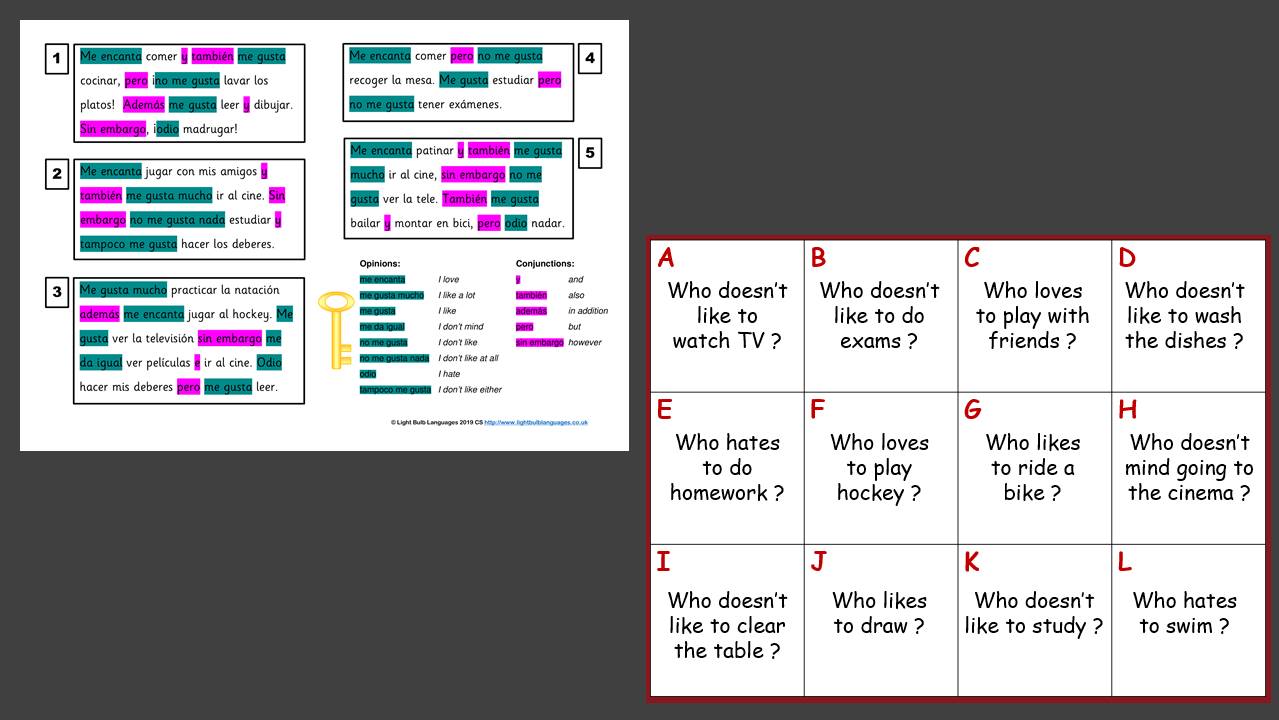
This is one
to practise opinions of infinitives for Year 6. We did this activity with it. There are
lots of other possibilities for texts like this – if you can think of one you’d
like, let’s do it!

Deep dives won’t have escaped your attention. As they’re new this academic year there’s been a lot of brainstorming and sharing on the forums and on social media.

In
September a number of us received this in a marketing email from
ilanguages. I posted it in LiPS as I
thought it would be of interest to members of the group in the light of the new
Ofsted framework. Jane Birtwhistle and I
decided to post one of the questions each day for people to contribute their
responses so that we could all help each other out. Over the seven days of the seven questions
there were a lot of really helpful contributions. Of my three schools, two of them at the time
were expecting Ofsted imminently, and the third, an outstanding school, was potentially
going to get one of the special visits for languages, history and
geography. So these responses were very
useful for me. I went through the
responses and pulled them together in a document, which I posted back into
LiPS. It meant that each member would
have the basics which they could then shape to their own school. The document covered the 3 Is and more. All the posts can be viewed by searching the hashtag #ofsteddeepdive in LiPS.
I made the information specific to my school and shared it with my headteacher. This all led to a positive few weeks for me at school. We had a “meet the governors” day, where a team of the governors spent the day in school talking to the children and also the leaders of various subjects and projects and so on. Because my headteacher knew I had been doing this work into the 3Is and other aspects of leading the subject, she asked me to come to speak to the governors about Spanish. During the meeting, the governors asked me about CPD, and came to the conclusion that other staff would benefit from some input on languages. So in January I did a staff meeting for Spanish. This is the message I shared about it on LiPS afterwards.

This is a brilliant example of what people can do when they all put their heads together. More than one person has said that in their school languages are leading the way with this. Maybe it looks like it's just me blowing my own trumpet but this could be you!

So as you
can see I’ve had no qualms about using my online contacts and personal learning
network for my own ends, but I have shared the outcomes with others as well.
What can
you do? How can you harness the hive
mind to enrich your offering to your students or to make a resource that will
be of use to lots of colleagues?
When spider webs unite, they can tie up a lion – together we are invincible!


