Showing posts with label phonics. Show all posts

Thursday, 13 November 2025

Minimum core content for Key Stage 2 Languages


ChatGPT's take on my musings about the core content!

The Curriculum and Research Review 2025 (CAR) was published last week on 5th November.  I have already written at some length about what it means for primary languages.

The first of the two recommendations for primary languages was:

a minimum core content for French, German and Spanish would provide greater clarity and consistency, especially for non-specialist teachers.  Covering commonly occurring phonics, vocabulary and grammar, this should align closely with the content and teaching approaches at secondary and thus build more securely the foundations of knowledge for success at Key Stage 4 and beyond more securely.  This should support a smoother transition into Key Stage 3. .... With a shared understanding of what constitutes 'substantial progress' in a language, secondary schools would be better equipped to build on students' prior learning.

The Government has agreed to put this into place.  I have been pondering what this "minimum core content" will comprise.  The second sentence of the above quotation is, I think, important: "Covering commonly occurring phonics, vocabulary and grammar".  I would argue that it needs to be more far-reaching than this and not just vocabulary, grammar and phonics.

Here are my thoughts so far on what I think should be in the minimum core content:

Intercultural Understanding (IU)

Children need to have an understanding of the language that they are learning and how it fits into the global picture.  We need to encourage curiosity about world languages and where they are spoken, and we need children to appreciate that other languages may be different, but they are not bad, wrong, or strange.  All languages are valid.  I think that children should be able to:

  1. recognise that there are hundreds of languages spoken across the world, and that most people are not monolingual
  2. name other world languages and say where they are spoken
  3. explore and investigate language families and their roots
  4. talk about the languages spoken in their school and their classroom
  5. name the countries which speak the language that they are learning
  6. know some basic facts about the countries where that language is spoken
  7. explore and investigate special days and celebrations in some of those countries
  8. find out about social conventions and daily life in some of those countries
Writing systems

I have written before about writing systems (for example here) and the importance of children's familiarising themselves with the writing system of the new language prior to attempting any writing in it.  I think that children should be able to:
  1. write diacritics accurately
  2. name the different diacritics in the language that they are learning
  3. understand the difference that those diacritics makes to the individual letter or word (this of course links nicely to phonics)
  4. write accurately any punctuation marks of the new language that differ from English
  5. understand the rules for capitalisation in the language that they are learning
Dictionary skills

If children want to be able to personalise their speaking and writing and extend what they want to say outside of the parameters of the core content, it is important they know how to use a bilingual dictionary effectively, whether it be online, paper-based, or a more simple bilingual glossary.  This will also of course cross the curriculum to English, and the two subjects will be able to work hand in hand on alphabetical order and finding the correct definition.  The ability to use a dictionary effectively will also support new Year 7s, especially if they are learning a language that they didn't study at primary school.

Should we push for an online bilingual or even multilingual dictionary for Key Stage 2, where children can work between English and their curriculum language, but also between other "foreign" languages?  What a great resource that would be!

Language Learning Strategies

In my opinion, Key Stage 2 is the time to embed what it means to be a language learner, and what children can do to optimise their learning time and their understanding.  For example, I think that children should be able to:
  1. look at the face of the person speaking and listen attentively
  2. compare the new language with English or with other languages that they know
  3. use context and tone of voice to deduce meaning
  4. use different techniques to memorise language
  5. use physical responses and gestures/actions to aid in the learning process
Phonics

It's worth noting first of all that phonics in French is much more complex than it is in Spanish or German.  I teach just Spanish currently, and have usually covered all the important phonemes by February of Year 3.  After that it is constant repetition and practice, as I introduce all new vocabulary phonics first.

There are many more phonemes for French, but having said that, the last time I taught French (2022-2024) I managed to cover the following phonemes in 2 years:

j, /ə/, u, i/y, ê/è/ei/ai, r, on, un, ô/au, é, ou, ss/ç, s/z, in/im/ain, an, ch, oi, eu, silent h, and silent final letters

We repeated many of these multiple times, and gradually introduced the phonemes as we met them in new vocabulary.  So I think it would be doable over four years, as long as the phonemes were carefully planned into the scheme of work units.  I can't think of many other phonemes that would need to be included for French.

For Spanish: a, e, i, o, u, b/v, ce/ci/z, -d, ge/gi/j, silent h, ll, ñ, qu, r, rr, gue/gui

I don't know enough German to be able to put a list here.

Thinking about the sentence in the quotation from the CAR above that says "this should align closely with the content and teaching approaches at secondary", I anticipate that activities such as dictation and reading aloud, new arrivals to languages GCSEs, will make their way into Key Stage 2 in a more formal way to aid phonics practice.

Vocabulary

It is generally agreed that by the end of Year 6, children will have reached level A1 of the Common European Framework.  The estimated vocabulary size is between 500 and 1000 words to reach this level.  Given the time restraints to which we are subject in Key Stage 2, 500 seems reasonable.  This would work out at about 125 words per year over Key Stage 2, or an average of 3 or 4 new words per week.  This seems doable.

It is likely that the vocabulary list will be informed by word frequency, as has happened in the secondary sector,  and which is also a feature of some primary schemes of work now.  The verbs will be important - you can't make a sentence without them after all - and the chosen nouns will need to be relevant to the experiences and interests of children age 7-11.  I think that this will be a good opportunity to include here the themes and topic areas which might be commonly included in lower Key Stage 3 but are too immature for them, as well as the lists of words that would be useful for new Year 7 students to have under their belt in order to hit the ground running in secondary.  Other aspects of vocabulary, such as days and months, link well to other topics in the primary curriculum such as Romans.

My suggestions for vocabulary are:
  1. basic greetings and saying your name
  2. titles e.g. Señora, Monsieur
  3. common first names from the target-language speaking countries
  4. some commonly used classroom instructions, to support target language use in secondary
  5. saying how you feel (answering the question How are you?)
  6. numbers to 100 (admittedly more complex for French than for Spanish and German)
  7. colours
  8. other basic adjectives, e.g. of size and shape
  9. days of the week
  10. months of the year
  11. items in the pencil case (very important for younger children!)
  12. animals / pets
  13. members of the family
  14. planets (links to Year 5 Space topic)
  15. opinions (saying what you like/don't like/love/hate)
Grammar


The ASCL Transition Toolkit (link to Spanish overview) was put together by ASCL, the British Council and the Association for Language Learning.  When we were compiling it, we took the brief statements in the Programme of Study and unpicked them to see what would actually be involved.  I use the toolkit every year to inform the secondary schools what my Year 6s have done, and I think that it makes a good starting point for these discussions.  I also unpicked the grammar from the Programme of Study and put it in these mind maps.

It's worth noting at this point that the terminology of certain grammatical points is different in the English curriculum and the Languages curriculum, for example articles vs. determiners and possessive adjectives vs. possessive pronouns.  This reset of the curriculum might be the opportunity for some more joined-up thinking across the curricula for "native" and "foreign" languages.

My suggestions for grammar to cover these points are:
  1. notion of grammatical gender
  2. nouns (patterns, how they are affected by grammatical gender)
  3. determiners (definite and indefinite articles + numbers)
  4. plural forms
  5. adjectival position
  6. adjectival agreement
  7. question words
  8. conjunctions (and, but, however)
  9. intensifiers (very, quite)
  10. subject pronouns (although not used a great deal in Spanish)
  11. first three persons (I, you, he/she/it) of the high-frequency irregular verbs to be, to have, to do/make, to want, to go
  12. first three persons of commonly used regular verbs such as to play, to speak, to listen, to eat, to drink, to like

Do you agree with this list?  
What would you add?  
Would you take anything out?  

Let me know in the comments.

Friday, 7 June 2024

Adaptable Activities for your Language Lessons


I'm delighted to announce the publication of Adaptable Activities for your Language Lessons.

This pdf download contains 120 different activities that can be adapted to any language and to most ages of learner.  There are activities for listening, speaking, reading, writing, grammar and phonics.

So if you've ever found yourself in a planning rut, wanting to try out something new but not sure what, then this is the publication for you!

Available now in my Sellfy shop: https://ideaseducationltd.sellfy.store/


Monday, 11 March 2024

Dictation across the key stages #LW2024


On Saturday I attended day 2 of this year's Language World conference.  I gave a presentation about dictation, giving lots of ideas to use from Key Stage 2 (age 7-11) all the way up to Key Stage 4 (age 14-16) and beyond.

It was much easier to make a video for you in order to share it than to paste all the slides into this blogpost!  Here is the video:


Other links:


Friday, 8 September 2023

Listening Chests


One of my schools was extended recently and has increased from single form entry to 1.5 form entry.  This year, for the first time, there are 45 children in Year 2 and 45 in Year 1.  Also for the first time, there is a mixed age class - Year 1/2 - alongside Year 1 and Year 2.  Previously I have always taught "pure" Year 1 and Year 2, so now have had to formulate a new scheme of work with 2 cycles, to cater for the mixed class.  I'm teaching it to all of Key Stage 1.

I'm beginning with a brand new Pirates unit, using my maxim of "the usual in an unusual way".  The children in current Year 2 can already count to 10 and know 6 colours, but the new Year 1s only started Spanish this week.  This term we will be learning greetings, saying your name, numbers to 10, and 11 colours, using Pirates as the theme.  Therefore the Year 1 children will learn what they need to, and the Year 2 children will recap some learning and learn something new, using a different context to before.

I've had to think of some different activities to usual for this reason.  One of them is Listening Chests.


I'm going to give each pair of children one of these cards with treasure chests on.  Definitely 4 chests for Year 2, 3 for Year 1 and we'll see how the mixed class gets on.

Let's use colours as an example, and 3 chests.  Ask the children to tell you which chest the colour red is in.  Then you say 3 colours: amarillo, rojo, azul.  You said rojo second, therefore the colour red is in the middle chest.  The children listen and point to the chest where the colour is.

This can be used for all sorts of different language areas.  I can see it being useful for phonics: show children a grapheme, then say 3 different phonemes or words, and they have to say which chest the grapheme is in.

You also don't need a special chests card to do this activity.  It could be as simple as the children quickly drawing 3 boxes on their mini whiteboard and using those instead.  A low tech and low prep activity.

If you are interested in my Pirates unit for Key Stage 1, I have already uploaded the first resources:


Friday, 9 June 2023

Point à la ligne: dictation in primary languages


Dictation is back on language teachers' radar for a couple of reasons.  Firstly, it features in the latest revamp of the GCSE specifications for MFL, which will be first taught in September 2024.  Secondly, last Sunday saw a world record breaking mass dictation on the Champs-Élysées.  I must admit when I first heard this news on Monday morning I was very jealous of the participants, and wished I could have been there!  I used to do a lot of dictations in French at secondary school, in preparation for the O level exam, and loved them.  I took French O level in 1985, which was actually the last year that students had to do a dictation.  That year we were also the first cohort to do a listening comprehension (from the reel-to-reel tape!)  I don't think we had had any practice of this beforehand.

I've had a look at some of my secondary school French books.  It's interesting to note the standard of the language that we were expected to write at that time, which was the spring term of 3rd year, a.k.a. Year 9 (age 13-14).  I had started learning French in the first year of middle school, age 8, and already knew quite a lot when I started secondary school at age 12 (in Year 8 - very odd three-tier system in Surrey in those days!), but it wasn't the same for all my classmates who had come from different middle schools.


And no, in the first dictée above, I don't have any idea what the reference to washing buildings is all about!  You can see that dictations were always negatively marked.  You started off with 20 marks (usually) and then as the person sitting next to you was checking what you had written, they would take off one mark for each error that you made.  I think we were allowed half a point for a missing or wrong accent.  Then our teacher checked them all and gave us our final mark.

I never experienced dictation in Spanish, having only started learning that language in the 6th form (age 16).  O level in Spanish was just listening comprehension for the listening component.  However it can be seen from the examples above just how much more complex dictation is in French compared to Spanish.  My first error was one of adjectival agreement - route is feminine, and therefore I should have written route fermée.  However, fermé sounds exactly the same as fermée, making it more than just an exercise in sound and spelling; it comprises also an important grammatical component.  It would be much more straightforward in Spanish, where the phoneme-grapheme link is much more transparent, and the difference between cerrado and cerrada can be clearly heard.

The pronunciation of French with its myriad of silent letters and homophones combined with its grammar makes dictation a difficult task.  There is a lot to think about.  With Spanish, on the other hand, as long as you know the phonemes and their corresponding graphemes, especially those that make Spanish different to English, you can make a pretty good attempt at it.  In fact the errors that our students make are likely to be similar to the errors that native speakers make when they first start writing.


This is part of a letter that was written to me by a 7 year old Spanish girl to whom I had taught English in Spain during my year abroad.  It can be seen that she wasn't sure which words had silent h and which didn't.  For example e recibido should read he recibido; te voy ha decir should be te voy a decir.  She also confuses b and v, which have the same sound, thus me ba muy vien should read me va muy bien.

Our students might experience similar difficulty with: 
  • the three 'th' sounds, represented by the three graphemes ce, ci and z
  • the "spitting sounds", represented by the graphemes ge, gi and j
  • ll and y, which mostly have the same sound
  • the hard 'k' sound, which can be represented by c and by qu
  • differentiating between r and rr
  • remembering the ñ!
  • remembering which vowels have written accents
Year 11 students will be expected to do dictation in their GCSEs from 2026.  This means that all our primary children, who will be taking GCSEs from 2028 onwards, will, presumably, be starting to do dictations in Year 7, as Key Stage 3 begins its preparation for Key Stage 4.  It makes sense, then, for us to start doing some simple dictation-style activities in primary.

There are three main types of dictation for us to consider:
  • dictation of single phonemes (in the form of a gap fill)
  • dictation of single words (more like a traditional spelling test)
  • dictation of a short text
It's interesting to see that the proposed questions at GCSE are a combination of these.  The first is Foundation Tier and the second is Higher Tier, and these are the sample questions from Pearson, who have released the first specification for the new French GCSE.


So there is some gap fill of single words and also some whole sentences, but nothing on the scale of the paragraphs that we used to have to do for O level.

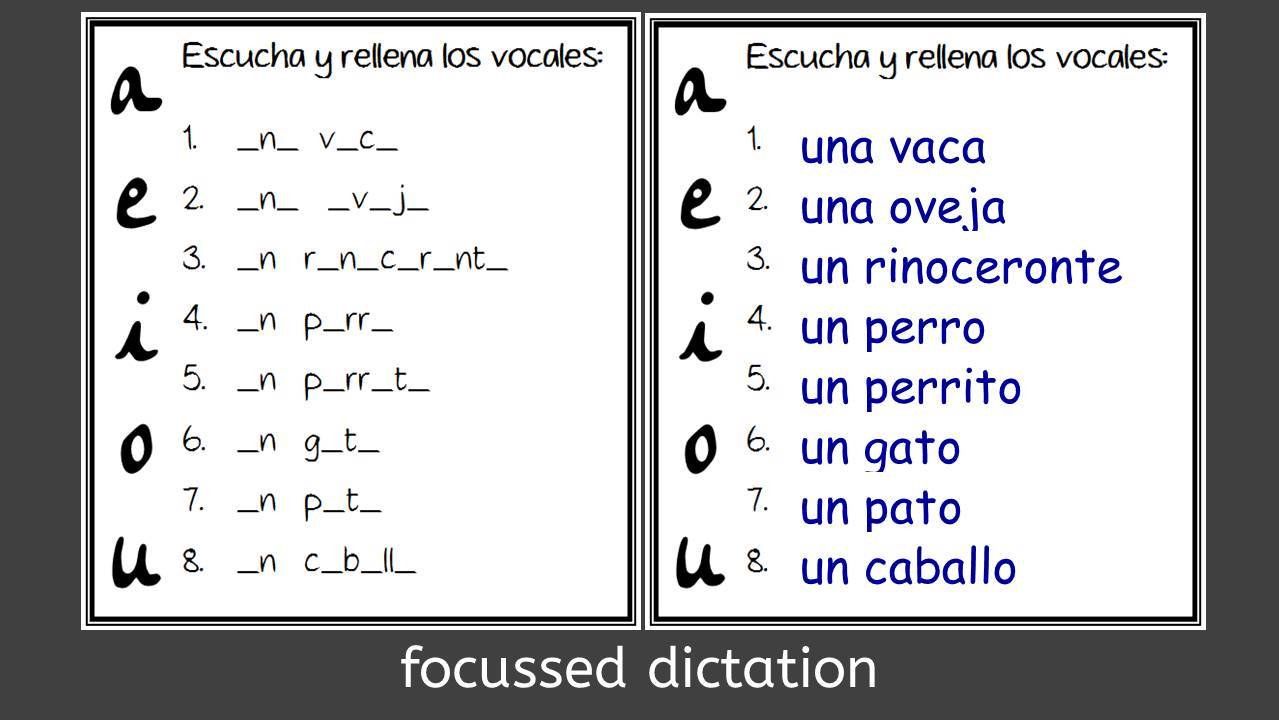
As we do a lot of work on phonics in Key Stage 2, a good place to start is with individual phonemes and graphemes in the form of a gap fill.  This is a listening activity that I have done recently with Year 2.  All that they had to write was the correct vowel - A or O - to complete the word.  The listening and therefore the dictation was very focussed.


I have also done a similar activity with Year 4, but this time using all the vowels, and they could also use their grammatical knowledge to help them to distinguish between the five sounds.  The challenge is for the children to hear 'ee' and think i not e!


Something else that I think is worth our while is using the target language terms for the punctuation in dictations.  This will only serve to reinforce the work that the children are doing in English.  Here is an activity that I have put together today for one of my Year 4 classes, who are getting really good at giving opinions of food and drink, but still need to do a little bit more work on differentiating between me gusta and me gustan.  They are also very ambitious and have been asking how to say "He likes" and "We like".


The children will listen first without writing, then listen again and write in the correct opinion(s) for each sentence.  Then after we have checked the opinions they will listen again and add in the correct punctuation.  I am hoping that completing these sentences will provide them with some useful models for when they start their extended piece of writing soon.

Now to think of some activities that will suit my French beginners!

If you would like to read more about dictation, I recommend:
Let me know how you have tackled dictation in Key Stage 2!

Thursday, 23 March 2023

Presenting new language - an update years later!


In February 2010, I wrote a blogpost here about presenting and practising new vocabulary.  At the time I had been in the primary classroom for a term and a half.  Now, 13 years later, I can see that my practice has morphed into something different, and something that I think is more effective.


This paragraph explains it a little more:


Reading and reflecting on this article has caused me to modify the way that I introduce new vocabulary and then get the children to move towards saying it out loud.

Here is what I now do, and I am definitely seeing the benefits, with better pronunciation and recall from both my more experienced Spanish learners and my beginner French learners.
  1. I present the new vocabulary via Physical French/Spanish Phonics.  My PowerPoint slides show the words, the sounds that make them up, and image to show what it means.  We sound the words out, repeating each one at least 3 times.  We don't blend them at this stage, although I do hear some learners quietly saying the words.

  2. On a new PowerPoint slide I put all the words in a numbered grid, along with the images to again show meaning.  I say the words firstly in order and then randomly, and ask the children to point to them on the screen.  Engagement is always good and it is a quiet activity.  Here's an example of a grid:


    The pointing game could be used as an alternative for this, and would be a useful resource for further practice later.

  3. Next we use the numbers for listening practice.  I say the word and the children have to tell me which number it is.  It's also a good way to practise numbers!  We cycle through all the words probably two or three times.

  4. Next it's time for the children to start saying the words.  We use "don't repeat until I click".  I say the words in order, but the children aren't allowed to repeat them back until I click my fingers.  I give them a good few seconds to mentally rehearse the words first.

  5. Finally we do some choral repetition in the usual way.
We repeat some of these steps the following lesson, and gradually reduce the amount of practice that we have to do.

Do you have any other go-to activities that you do at this initial "getting to know the words before saying them" stage?


Sunday, 11 December 2022

The place of the pillar of phonics in the Key Stage 2 Languages curriculum


Yesterday morning I delivered a 15 minute keynote session at the Teachmeet MFL Icons online event.  It was a great event to be a part of - packed with short, snappy presentations which covered all sorts of different topics.  This is my presentation in text form. The event is now available to watch online.

The national curriculum for Key Stage 2 (KS2 - age 7-11) Languages is not very long and it’s not as detailed as perhaps we would like. Its purpose of study and the aims sections are the same as for Key Stage 3 (KS3 - age 11-14), but the subject content is different.

In KS3 there is no explicit mention of phonics, although some of the attainment targets need knowledge of phonics and the sound spelling link to be able to do them. For example, students are required to “transcribe words and short sentences that they hear with increasing accuracy” and “speak coherently and confidently, with increasingly accurate pronunciation and intonation”. It is, however. mentioned explicitly in the KS2 national curriculum, implying that the main groundwork needs to be done in primary so that students can hit the ground running and achieve in KS3 and beyond.


The above is from the KS2 subject content introduction, and the orange highlights are mine.

First, we can teach any modern or ancient language (so we don’t teach MFL in KS2, but rather FL or just "Languages"). The ancient languages are excused the speaking and therefore the phonics. So children who do Latin in KS2 will be well prepared for modern European languages in KS3 in some ways, but not in others. The second point says “Teaching should provide a balance of spoken and written language”. Historically primary languages were more about speaking and tended to neglect writing, but writing is now a fundamental part of what we do. This is important for phonics, as it shows it’s just as important to be able to say the new sounds as it is to read them and represent them in writing accurately. The aims of the curriculum state that children have to use their knowledge of "phonology, grammatical structure and vocabulary" to enable them to understand and communicate. This is the first mention of the 3 pillars, and something that does not appear in the KS3 curriculum.


Above are the attainment targets that relate to phonics in the KS2 curriculum. It’s all about beginning and developing an understanding of the sounds in the new language and looking into the sound-spelling link. We start to develop accurate pronunciation and intonation, both so that children can speak accurately and be understood, and so that they can read aloud accurately. We are encouraged to use authentic resources such as songs and rhymes to help us to explore phonics, and to help us to make the sound spelling link. Songs and poems are mentioned briefly in KS3 but not with a view to explicitly exploring phonics.

The “3 pillars” of vocabulary, grammar and phonics was a term first coined by Ofsted in 2020, following the 2016 Teaching Schools Council Pedagogy Review of secondary languages.  They are now at the heart of the Ofsted inspection framework for languages.  If you’ve seen the leaked Ofsted aide-memoires for KS2 and KS3 languages, you’ll know that they are riddled with mentions of phonics. These 3 pillars have equal weighting and equal importance in the curriculum. The word “pillar” suggests that the three are separate entities, so be taught and learned in isolation, However we know that the three are inextricably linked and interwoven, and that you can’t teach one without touching on the others.


The more I’ve supported other schools with their curricula, the more I have come to realise that the 3 pillars are the Intent of our curriculum. They are what you set out to teach. The four modalities (Listening, Speaking, Reading and Writing), Language Learning Strategies (LLS) and Knowledge About Language (KAL) alongside culture are your Implementation – what you are going to use to teach your intent. Then your Impact is how you assess how well you’ve taught your intent.

So the first answer to the question I posed at the beginning is that the pillar of phonics is firmly embedded in the KS2 curriculum, where the onus is very much on primary teachers to cover phonics systematically and thoroughly, in all four years, so as to enable children to be successful once they enter KS3.

It’s important then that KS3 teachers are aware of what phonics their new Year 7s have covered in KS2. They need to ask, and KS2 teachers need to tell! Transition is so important. Year 7 teachers can’t make assumptions about what the children have done and how they might have done it. It will help them to hit the ground running if they can continue in KS3 the way that they learned in KS2, even if they are going to be gradually weaned off it.  The ASCL Transition Toolkit (available for French, Spanish, German and Chinese) is a good way to start off the conversation.  

If primary schools use a bought-in scheme, then phonics will be included in that scheme somehow, and each scheme will do phonics its own way.  Physical French Phonics and Physical Spanish Phonics are widely used by specialists and non-specialists alike. The idea is that each phoneme has a corresponding image, which in turn shows the child the action they have to do. The action then reminds them of the sound. Once the children are familiar with the actions and sounds, after lots and lots of repetition, you can use the actions as a quick and easy prompt to correct errors or misconceptions. The books are full of great resources and information. They would be useful for KS3 too, and people even use them with adults.


Phonics are best embedded in each lesson, particularly at the initial presentation and practice of vocabulary stage. I choose to teach them explicitly right from the start, not leaving it to chance that the children will notice what I want them to notice. Time is precious in the primary languages classroom, after all. I have started using phonics to introduce new vocabulary, so that the children are seeing the written word at the very first stage and therefore not using English phonics to approximate a spelling of the word in their head, and so that we draw attention to the tricky sounds right from the beginning.  Then when it comes to practising the vocabulary with flashcards and images and so on they have already seen the words and are familiar with the sounds. The next stage will be putting the vocabulary into phrases or sentences by way of a sentence builder or similar. Because they are happy with the pronunciation they can focus on the grammar and structure. So the first pillar, phonics, leads to more successful learning of the second pillar, vocabulary, which in its turn leads to increased confidence with grammar and structure.

When I teach phonics I break the words down into their phonemes, and we then practise sounding the words out before having a go at blending them. I often take the phonemes we have been practising and put them into new, unseen words to show that the phonemes are transferrable. For example bonjour gives us the sounds to work out mouton. The thing we want of course is for children to see a phoneme in a new word and know straightaway which sound it makes. For French in particular (Spanish is so much more straightforward!) I have cards with the graphemes on that we have been practising. I hold up a card and the children have to make the sound.

I hope then that you can see the important place that the pillar of phonics has in the KS2 curriculum, and how this work can and should be built on in KS3 and beyond. Of course there is much more that I could say but hopefully it has started the conversation.

Want to read more?  Here are the other blogposts I have written about phonics.

Tuesday, 5 July 2022

Skills icons


Recently I was shown the excellent work of the history lead of a local primary school.  They had chosen to design an icon for each of the seven history skills (Constructing the past, Sequencing the past, Continuity and change, etc..)  Their plan is to display the relevant icon at the beginning of each lesson, and then to discuss with the children how they will be learning, and to recall when they have used that skill before.

It got me thinking that we could use a similar system in Key Stage 2 Languages, to alert children to the skills that we are using and discuss how we are learning.  I introduced the topic in the Languages in Primary Schools Facebook group, where it turned out that some colleagues have used such icons in other subjects and have also dabbled with them in Languages.  We also discussed the skills that we would want to include.

I have used Canva to create sets of icons for French, German and Spanish.  The skills included are:

  • Listening
  • Speaking
  • Reading
  • Writing
  • Phonics
  • Grammar
  • Culture
  • Knowledge About Language
  • Language Learning Skills
(For Knowledge About Language [KAL] and Language Learning Skills [LLS] see the objectives of the Key Stage 2 Framework for Languages.)

My plan for the icons at the moment is to put them onto the first screen of my lesson PowerPoints, the "Today we are going to..." screen, to explain how we are going to achieve our lesson objectives, and perhaps also on my worksheets.

I displayed them in my lessons today, and it enabled me to say not only what we were going to be doing, but also to tell them which skills we were going to be using.  I suspect that quite a lot of the time, the children aren't aware of the different skills that we use and why.

If you would like a copy of the icons (available as shown in the image above and in a reversed format for displaying on a dark background) then click on these links:
If you would like to use them (and I'm not saying you have to) I'd love to hear about how you have used them.

UPDATE 08.07.22:

Wednesday, 10 November 2021

Physical Spanish Phonics


When I trained as a secondary MFL teacher in 1994-95, phonics were not mentioned.  We were not trained how to teach the sound-spelling link, and, indeed, it wasn't expected.  Those were the days when students were supposed to just absorb the different phonic and pronunciation rules.  It was clear, especially when preparing Year 10 and Year 11 students for the oral components of their modular GCSEs, that this didn't work.

Then in 2000 I was invited to be part of a working group in Sunderland LA, looking at the findings of the Invisible Child report by David Buckland, Jeff Lee and Glenis Shaw.  David Buckland came to spend a day with us to discuss it.  (NB the date of the CILT publication of the report says 2001, but we were definitely already discussing it in January 2000.)  

In the group we formulated listening strategies, to break down and demystify the often impenetrable audio recordings that we find ourselves obliged to use, and reading strategies, in particular the analysis of texts.  We also decided that phonics, the sound-spelling link, was very important for building confidence for the "invisible children" and in fact for all.  I still have the posters that we compiled for French, Spanish and German, to display in classrooms, for example this one for that Spanish sound that we can't write in English!

Since then, I've always endeavoured to include some phonics in my lessons.

Phonics are an integral part of the Key Stage 2 programme of study for Languages.  What exactly does it expect us to do?
  • (in the aims of the programme of study) "... continually improving the accuracy of their pronunciation and intonation"
  • (in the subject content introduction) "using their knowledge of phonology, grammatical structures and vocabulary"
  • "explore the patterns and sounds of language through songs and rhymes and link the spelling, sound and meaning of words"
  • "develop accurate pronunciation and intonation so that others understand when they are reading aloud or using familiar words and phrases"
I had always tried my best to achieve these objectives, even going so far as to create my own resource for Spanish.  But I was never completely happy with how it was going in class.

In the Languages in Primary Schools Facebook group, there had been a lot of chat about a publication called Physical French Phonics, which was proving popular for teaching French phonics, something that is of course a lot more complex than Spanish.  

Then last year, Jenny Bell, Sue Cave and Jean Haig published Physical Spanish Phonics, which I have to say has revolutionised the way I teach phonics, and has vastly increased the children's knowledge of sounds and their confidence with pronunciation.

The idea is that you have a image which represents a sound, and which also gives you an idea of what that grapheme sounds like, for example someone biting into an apple for the "a" sound.  Then that picture and phoneme/grapheme are accompanied by an action.  I then take one of our words (the months, most recently, for Year 4) and represent each sound using the images.  We then look at the images, say the sounds and do the actions for each individual sound before then blending them to make the word.

This approach has been particularly successful for the very low ability children, who often get left behind and who might find the sound-spelling link most difficult.  Using this process they can easily sound out and then blend the words.  It is also clearly contributing to a significant increase in confidence for all the children.

With Year 4 I have been using Physical Spanish Phonics to sound out and blend the months, prior to putting the months into our sentence builder which puts together birthday sentences:

By the time the children see this, they already know the numbers (from the previous Year 4 unit), the word mi (from Year 3) and the word es (from Year 3).  So knowing the sounds of the months, which we have just practised in isolation with the sounds and then by reciting them in order, is confidence-building, and allows us then to move quickly into the meaning and structure of the sentences.

I gave my Year 4s a challenge this morning, after we had practised the months and their sounds some more.  I showed them the words viña, ceño, jabalí and cerezas, accompanied by the Physical Spanish Phonics images, and asked them to work with their partner to work out how to say these words, none of which they had ever seen before.  Their pronunciation was beautiful.

I asked Year 4 to tell me what they thought of working on phonics in this way:
  • "It helps a lot."
  • "It helps me to work out words easily."
  • "If I get stuck I can look at the pictures."
  • "It makes me concentrate."
  • "If you're joining in with everyone and you're a bit lost you can look at the pictures and listen to the others."
  • "I take it in a bit more."
  • "When I do the actions I can say the words better."
If you're looking for a way to teach phonics in Key Stage 2 or even early Key Stage 3, I definitely recommend Physical Spanish Phonics.  I really like how the actions allow you to see exactly who is putting in the effort, and how the actions also give you a shorthand to use to correct mispronunciations in a quiet and non-threatening way.  To refer back to the programme of study, it helps me to explore, develop and continually improve the children's pronunciation. Why not give it a try!


Monday, 16 September 2019

Sonidos Españoles


It's finally here!  I've been working on Sonidos Españoles, a new Spanish phonics resource, since July.  Finding all the words and creating the 180+ illustrations has taken a long time! 

There are six PowerPoints, each practising 3 or 4 sounds, and also some resources to support and practise the sounds further:

Part 1: a, o, h, ll
Part 2: ñ, e, i, u
Part 3: ce, ci, z
Part 4: cu, qu, v, b
Part 5: ge, gi, j
Part 6: r-, rr, gue, gui, güe, güi


Each part begins with a sentence which contains all the sounds to be practised in that part.  Then there are 6 words containing each sound to practise with.  Each part also finishes with a little story to practise the sounds in the context of sentences rather than single words.  Audio has been provided by a native speaker - thank you Susi!

I hope you like it and enjoy using it.  I've already been using it with my new Y3s and Y4s and they seemed to like it!

There is a 25% discount with code SONIDOS until Friday 20th September :)

Thursday, 29 March 2018

Words and Pictures?


When I was preparing my presentation about writing for Language World, I re-read Patterns and procedures: focus on phonics and grammar by Heather Rendall.  Those who attended the presentation will remember that I quoted Heather a couple of times.

Heather says that learners will store an image of what a new L2 word looks like as soon as they hear it, and, especially if they are beginner learners, they are likely to use their pre-learned system of English phonics to do so.  It is likely that English will interfere with learners storing an accurate image of this new word.  

Heather goes on to say that:
"Every word has three attributes: a meaning, a sound and a spelling.  Target language nouns will also have a gender.  All four attributes should be presented immediately and simultaneously and repeatedly."

I trained as a teacher in the mid-1990s, when the communicative method was all the rage.  The thinking at the time was that you should introduce learners to the spoken word first, and to the written word considerably later.  Seeing the written word too soon apparently confused the learner.  In addition, phonics was something they apparently absorbed by some kind of osmosis.  This proved to be largely impractical and unsuccessful, and at the turn of the century I was part of a local working group who looked at the systematic teaching of phonics and much more focussed attention on the written word.

As a primary practitioner, I always present new language using a visual focus, which enables me to present the new language without the need for English until we spend a little time checking understanding.  This image shows one of the A5 flashcards that I use:
The picture indicates the meaning of the word, learners will hear the sound of the word when I say it, and the pink stripe at the bottom of the card indicates its gender.  Of Heather Rendall's four attributes, it is therefore missing the spelling.  This flashcard is for una plaza - a word with a phoneme/grapheme that is specific to Spanish.  It's likely that, despite some extensive work on phonics over three years, the Year 6 learners who hear this word will store the image platha in their heads.

An alternative is to keep the image but add the written word:
The fourth attribute is now present at the expense of the gender, which could, I think go somewhere else on the card as a coloured dot.  I wouldn't want to colour-code the words as that would make them less visible from the back of the room.  The image has to be smaller if the text is present and ideally I would like the text to be bigger too.  If I presented the words via PowerPoint slides then the words and images would both be bigger, but I really prefer the versatility and immediacy of low-tech flashcards.  So the exact design of a flashcard with all four attributes leaves me in a quandry - what to include and how?  It's possible that I would want two sets of flashcards - one with text to present the new words and a second with picture only to aid recall.

Do you introduce the written word at the same time as the sound and meaning?  What are your thoughts?


Friday, 16 February 2018

The Interference of English

Some time ago I wrote about the importance of spelling.  I asked if it was more important to spell accurately or to get your message across with some errors.  I included a list of the words in French, Spanish and German that are commonly misspelled by students.

Over the last few weeks I have been looking more closely at the issue of spelling in the new language.  While it's true that a considerable number of spelling errors are a result of carelessness, many others can be ascribed to the interference of English.

By the time students start to learn a new language in Year 3, they have undergone four years of rigorous training in English spelling and phonics.  The new language has different letter clusters and sequences, but the students can, often unconsciously, replace these patterns with more familiar English spelling patterns.  The four formative years of learning English spelling is enough to build a muscle memory, so that it feels more natural, for example, for a student to write rough than rouge, as the -ough letter cluster occurs in some frequently-used English words and the -ouge cluster is unfamiliar to English native speakers.

Spelling errors of any kind are exasperating for the languages teacher, especially when they are of the je m'apple variety which turn up again and again.  A systematic learning of phonics is one of the keys to ensuring more accurate spelling in the new language, but do we also owe it to our students to anticipate the sorts of errors that they are likely to make due to the interference of English and practise these words in a more focussed way?  

It is worth noting that this interference may also come from other languages that the student has learned, for example if they are in Year 7 and starting a language that is not the one they studied in Key Stage 2.  Any new language will have combinations of letters that are entirely unfamiliar to the beginner student and which they will need to practise in order to build their confidence and to start to build the new muscle memory.

We already draw direct comparisons with English in order to teach grammatical structures such as adjectival word order and the genitive, so should we now extend this to spelling?

Many thanks to the members of the Secondary MFL Matters Facebook group who joined in the discussion about this recently and who also provided many of the examples below:

FRENCH:
French word
often misspelled as
reason?
amusant
amusement
written to make the word look more like the more familiar English ‘amusement’
anniversaire
anniversarie
written to make the word look more like the more familiar English ‘anniversary’
blanc
blank
students remember the meaning of blanc by associating it with the English ‘blank’ but this in turn means that the word is often written to make the word look more like the more familiar English
bleu
blue
written to make the word look more like the more familiar English.
copain
complain
-m- probably added because of the influence of the English ‘companion’
danse
dance
written to make the word look more like the more familiar English
déteste
detest
written to make the word look more like the more familiar English
équitation
equation
the word is obviously unusual looking (and hard to spell/say for an English-speaking learner) so it is corrected to the nearest known English word
heures
hueres
-ue- is much more common in English than -eu-
histoire
historie
written to make the word look more like the more familiar English
il
ill
the nearest known English word
intéressant
interestant
written to make the word look more like the more familiar English
je m’appelle
je m’apple
the nearest known English word
magique
magic
written to make the word look more like the more familiar English
maison
mansion
written to make the word look more like the more familiar English
manger
manager
the nearest known English word
montagne
montange
-gne words often cause problems for English-speaking learners, as -nge is a much more common letter sequence in English than -gne.
natation
nation
the nearest known English word
neuf
nerf
apart from the obvious phonic influence, some of the influence will come from the well known Nerf guns….
oui
qui
these three vowels are never seen together in English.  It’s much more common to have q+u and then another vowel. 
rouge
rough
English words ending -ough are quite common, hence the change to the nearest known English word.
vacances
vacancies
written to make the word look more like the more familiar English
vingt
vinght
-gt is not an English word ending, but there are quite a few words (eight, knight etc) that end with -ght, hence the correction

SPANISH:
Spanish word
often misspelled as
reason?
centro comercial
centro commercial
written to make the word look more like the more familiar English
difícil
diffícil
written to make the word look more like the more familiar English
favorito
favourito
written to make the word look more like the more familiar English
fútbol
fútball
written to make the word look more like the more familiar English
geografía
geographía
written to make the word look more like the more familiar English
me encanta
me enchanta
the nearest known English word
seis
sies
rigorous application of the “i before e except after c” rule!
tecnología
technología
written to make the word look more like the more familiar English
vamos
vamous
few English words end with -os, so this is often written with an -ous ending, which is more familiar, from words such as famous
veinte
viente
rigorous application of the “i before e except after c” rule!

GERMAN:
German word
often misspelled as
reason?
es ist windig
es ist winding
-ig as a word ending is not seen in English, so it is corrected to resemble the much more common -ing ending
Katze
Catze
written to make the word look more like the more familiar English
langweilig
langweiling
-ig as a word ending is not seen in English, so it is corrected to resemble the much more common -ing ending
lernen
learnen
written to make the word look more like the more familiar English
nicht
night
the nearest known English word
Schwimmbad
Schwimmenbad
the extra -en- is added to make it resemble more closely the English ‘swimming pool’.
zwei
zwie
rigorous application of the “i before e except after c” rule!