Showing posts with label secondary. Show all posts

Monday, 10 November 2025

The Curriculum and Assessment Review: reflections from a primary languages practitioner


The Curriculum and Assessment Review (CAR) was first commissioned by the Government in July 2024.  The review panel, convened and led by Professor Becky Francis, published their interim report in March 2025, and we were told that the final report would be published "in the autumn".  As we headed towards the October half term holiday the publication date became "very soon".  I was pretty convinced that it would come out on a Sunday in half term, based on past experiences with such things, but was proven wrong, and the review was published on Wednesday November 5th 2025.

Much has been made in the media of the significant changes and new additions to the curriculum proposed by the review.  The recommendations for Languages could be said to be quite insignificant compared to the sometimes quite sweeping changes proposed for other subjects.  I've read the review through a Languages lens (and through the eyes of a teacher of primary languages for 17 years) to see what the implications are for us as teachers of Languages, particularly in the primary sector.

Primary languages have a secure place in the curriculum

In the months leading up to the publication of the CAR I had received messages and had had discussions with professional colleagues about the potential fate of primary languages.  It was rumoured that they would be scrapped.

I was very pleased and relieved to see, therefore, these words on page 24 of the review:

We strongly affirm the value of all the subjects in the national curriculum and basic curriculum.  Each plays a vital role in equipping young people with the knowledge and skills they need to navigate the world, while engaging and contributing to our society and culture, and pursuing their individual aspirations. Whether academic, creative, vocational or physical, every subject contributes to a rich and balanced education. ..... The current subject architecture provides a strong foundation, introduces subjects to young people at the appropriate stage, and allows them to pursue their interests once they have experienced the full range of subjects.

In addition, on page 34 it says:

Subject-specific knowledge remains the best investment in preparing young people for these challenges and opportunities: Science and Maths will remain crucial, as will an understanding of communication and culture, through the humanities, languages, and the arts.

And on page 44:

We also seek to guarantee access to a broad and rich primary curriculum, including subjects such as Citizenship, Languages, and Music.

It goes on to say on page 30 that:

Access to the national curriculum should remain an expectation and an entitlement for all children and young people, including those in specialist and alternative provision.

I'm pleased to see that it is reinforcing the fact that all subjects on the national curriculum, Languages in Key Stage 2 in my case, should be taught to all children.  So Language learning should happen regularly, and all children should be accessing it.  The CAR stresses the importance (for example on pages 30 and 33) of inclusion and not limiting children's life chances by denying them the opportunity to access certain parts of the curriculum.

The Government, in its response to the CAR, agrees that Each subject in the national curriculum plays a vital role in a child's education. (page 8)

It's a little disappointing that Languages are still the only subject not taught in Key Stage 1 (see pages 18 and 19 of the review which shows the national curriculum overview).  The argument has always been that starting at age 7 brings us in line with our European neighbours.

Time for primary Languages

The Executive Summary of the review says: 

The statutory guidance for the current national curriculum* says that it is 'just one element in the education of every child'; it was not intended to take up an entire school day.   (page 9)

*Aims of the national curriculum, section 3.2

One of the difficulties facing Languages in Key Stage 2 is fitting it into the school week.  The Language Trends reports each year ask how long lessons are in different schools.  In many primary schools Languages lessons are 30, maybe 45, minutes long, but it is generally agreed that in order to make the "substantial progress in one language" required by the national curriculum lessons should be one hour a week.  

I was unaware that the national curriculum should fit into the school week with room to spare, simply because all subjects are squeezed, and every available minute is used to fit all the subjects in.  I don't know of any primary schools where time is left free during the school week for enrichment activities.  We hear of schools where Languages can't be fitted into the curriculum on a regular basis.  If more time is needed during the week for, say, English or maths, it is often Languages that are sacrificed.

Page 30 of the CAR says:

By ensuring that the volume of content in the national curriculum is appropriate for the teaching time that is available, we aim to give schools sufficient time to consolidate learning, as well as the space to provide the enrichment activities and life skills that prepare young people for life and work.

It will be very interesting to see, come the revised curriculum in 2028, how this will happen.  In the Government response to the CAR, it says that Ofsted will consider how schools are meeting enrichment expectations when judging the personal development grade (page 11).

The allocation of little time to Languages (less than 30 minutes a week in Key Stage 2 and less than two hours a week in secondary) is reported as a challenge for language teaching (page 88), despite evidence showing that more time is needed to make significant progress.


Oracy

The CAR has a focus on oracy, which it says incorporates speaking, listening and communication (page 42).   Amongst its recommendations are introducing an oracy framework to support practice and to complement the existing frameworks for Reading and Writing.

This clearly has significant overlap with our work in Languages, so hopefully speaking, listening and communication in a language other than English will feature in the new framework.

The Government has agreed, in its response to the CAR, to create the oracy framework, to support primary schools to ensure that their pupils become confident, fluent speakers and listeners by the end of key stage 2.  I'm sure that this would translate well into Languages as well.

Recommendation for primary language teaching: a defined minimum core content within the Programme of Study

The CAR acknowledges that:

... many of the foundation subjects in the national curriculum lack detail, which means that teachers are unclear about what is sufficient in terms of depth or breadth.  This lack of clarity also leads to inconsistent coverage of content across schools, making it challenging to ensure knowledge is built coherently and sequentially across the key stages. (page 44)

This has certainly been the case with Key Stage 2 Languages since their introduction as a compulsory subject in 2014.  The Programme of Study is vague and doesn't make clear exactly what the "substantial progress in one language" should look like.  It has therefore been interpreted differently by different providers, schools and teachers.

On page 49 it clarifies that:

...greater specificity should not mean greater volume of content and should not unnecessarily impede schools' or teachers' autonomy.  Foundation subjects' Programmes of Study should be drafted with a minimalist approach to added detail, carefully balanced with the need to ensure the greater specificity which aids conceptual mastery, continuity and coherence.

One concern with having a list of specified content is that certain schools might see it as something they don't have to teach regularly in all four years of Key Stage 2, building up and embedding the language over a longer period of time.  Rather they may decide to teach it in one block, for example in Year 6 after SATs, a pattern that has been seen in the past with the current curriculum.  While time allocations will still not be applied, it will have to be made clear that Languages lessons should take place regularly over four years, just like all the other Foundation subjects.

There is also the possibility that, presented with a list of specified content, certain schools or teachers may just teach the list.  To clarify this issue the CAR says, on page 51:

The national curriculum in intended as a baseline rather than imposing limits, and it is the expertise of our teachers that brings it to life in the classroom.

It also states the following curriculum principle:

The refreshed national curriculum should ensure the professional autonomy of teachers is maintained, making sure that greater specificity does not substantially restrict teachers' flexibility to choose lesson content and how to teach it. (page 51)

In the Languages-specific section, on page 90, the CAR says that it agrees that:

a minimum core content for French, German and Spanish would provide greater clarity and consistency, especially for non-specialist teachers.  Covering commonly occurring phonics, vocabulary and grammar, this should align closely with the content and teaching approaches at secondary and thus build more securely the foundations of knowledge for success at Key Stage 4 and beyond more securely.  This should support a smoother transition into Key Stage 3. .... With a shared understanding of what constitutes 'substantial progress' in a language, secondary schools would be better equipped to build on students' prior learning. (page 90)

The creation of a list of minimum core content was a recommendation of the 2019 White Paper, and something that has been agreed for some time would facilitate better outcomes for primary Languages.  It is pleasing to see, therefore, the following recommendation of the CAR:

We recommend that the Government updates the Key Stage 2 Languages Programme of Study to include a clearly defined minimum core content for French, German and Spanish to standardise expectations about what 'substantial progress in one language' looks like. (page 91) 

Recommendation for primary Languages: improved transition to Key Stage 3

Page 45 of the CAR talks about the transition between Key Stage 2 and Key Stage 3, the move from primary school to secondary school at age 11, from a general point of view.  Those of us who teach Languages in either primary or secondary schools are well aware of the problems of transition.  There is little communication between the two sectors and more often than not children start the language again from scratch in Year 7, regardless of whether or not the primary schools have passed on information about the Key Stage 2 language learning.  Speaking personally, I always send information about my Year 6s to the secondary schools that they are transferring to.  I usually receive few replies or acknowledgements from the secondary schools.  Language learning is only compulsory in England from age 7 to age 14, so it is crucial that we make these few years count, and effective transition is vital for this.  However I have certainly been talking about and advising on transition for nearly 20 years, and we are no further forward.  In fact I would say that we have taken a backward step.

I found the following very interesting:

Stakeholders frequently report that secondary schools tend to plan their Key Stage 3 curriculum backwards from GCSE requirements rather than forward from Key Stage 2 learning, resulting in repetition and leading to disengagement, especially among higher-attaining students. (page 45)

This certainly sheds a light on the problems that we face with Languages.  A more prescribed content for Key Stage 2 will hopefully go a long way to helping secondary schools to look at their Year 7 curriculum, taking into account prior learning in Key Stage 2 and not assuming that Year 7s are beginner learners.  The CAR has recommended that the EBacc is discontinued, which has caused concern amongst the secondary Languages community.  Learners have been encouraged to take a language for GCSE in order to improve their school's EBacc figures.  In the future, effective transition will contribute to not switching off learners who are bored by repeating Key Stage 2 learning and don't see themselves learning anything new.

Transition is at the centre of the second of the primary languages specific recommendations:

We recommend that local authorities, multi-academy trusts and schools should explore the potential benefits of a coordinated approach in their local areas to the main language taught from Key Stage 2 through to Key Stage 4, taking account of their local context and priorities.  The Government should look to encourage this activity where appropriate. (page 91)

I fear, with the system that we have of local authority maintained schools and many separate multi-academy trusts, that the system may be too disjointed to support this.

As an afterthought, I think that the opportunity could have been taken here to rename the subject so that it is the same in both primary and secondary (it's currently Foreign Languages in Key Stage 2 and Modern Foreign Languages in Key Stage 3) and so that we can dispense with the word 'foreign' and its negative connotations.  Having the same name across the key stages would go a little way to unifying the two sectors.

Crossing the curriculum

Another theme of the CAR is making horizontal links across subjects to highlight where content in one area relies on content in another (page 49).  In order to achieve and facilitate this, the review recommends that:

[The Government] develops the national curriculum as a digital product that can support teachers to navigate content easily and to see and make connections across key stages and disciplines. (page 52)

This could potentially be very useful for Languages.  Stakeholders in other subjects would finally be able to see in black and white how many different areas and themes language teaching addresses.  The digitalised curriculum has been agreed by the Government in their response.

The Government response

The Government, in its response to the CAR, has agreed to refresh the programmes of study for each curriculum subject in line with the Review's recommendations.  It agrees with the two recommendations which refer directly to primary Languages (page 33).

They have also added two further intentions for Languages that were not part of the CAR.  The first is: 

We will explore the feasibility of developing a new qualification which enables all pupils to have their achievements acknowledged when they are ready rather than at fixed points.  We will learn from models such as the Languages Ladder .... We will optimise the use of technology to minimise teacher workload and make assessment more engaging for pupils.  We are working closely with stakeholders to establish the viability of such a qualification, making sure it meets the needs of schools and pupils, before making any decision on whether to introduce it. (page 33)

So this sounds like predominantly an assessment for the end of Key Stage 3 (age 14).  It does not make clear if the end of Key Stage 2 will be included.  This could work well for children who do a different language in secondary school to the one they did in primary.  In my opinion the Government will have to ensure that the qualification has real currency in young people's future workplaces and that they are understood by employers.

The second is:

We will explore how AI and education technology (edtech) can support stronger outcomes in language education, including exploring how these tools can help deliver consistent curriculum content and support more coherent language provision across key stages, as well as reduce teacher workload.

Moving forward 

The new and revised curriculum will be published in 2027 for first teaching in 2028. 

The Government will continue to invest in the NCLE and its online portal but hasn't made clear if the remit of NCLE will therefore reach down into Key Stage 2.

We will wait to see who will be asked to lead on the renovation of the programme of study and the creation of the list of minimum core content.  NCLE, in their reaction to the CAR for Languages, says:

We are looking forward to working with the Department for Education to redefine the core language learning in primary schools

I hope that this isn't a done deal, and that other teachers, organisations and stakeholders will be able to have some input as well.

Saturday, 27 September 2025

Reflecting on the DfE Writing Framework

This week I have been reading the DfE's document The writing framework, which came out on 8th July this year.  The document provides non-statutory guidance for primary schools, initial teacher training providers, early years providers and secondary teachers who will be building on the learning of their new Key Stage 3 students.  This framework has been published before the arrival of Professor Becky Francis's Curriculum and Assessment Review which is due at some point this autumn.  The authors of the framework acknowledge that it will have to be updated as necessary to align to the revised national curriculum.

When the framework was first published (just before the school summer holidays!) it met with a mixed reception.  The English Association identifies some strengths and some weaknesses, while an article in the TES refers to it as "over-simplified"Writer Michael Rosen is not keen on it.  Whatever our view, it is useful, especially as a specialist of a subject that is not English, to have it as a summary of how the primary children that I teach will be taught to write in their English lessons and elsewhere in the curriculum.

Therefore I have read the document with a view to establishing the parallels with, links to, and potential implications for the teaching of writing in the primary languages classroom.

Writing by hand

The first section of the framework (page 13) talks about the cognitive benefits of writing as well as the value of writing by hand as opposed to typing:

"Writing helps thinking and learning.  It helps pupils to consider information more deeply than when they are simply reading it; it enhances the learning of the subject matter and helps cement that learning in long-term memory."  

I have written before about the benefits of writing by hand rather than typing during language learning.  In addition to what I said there, the framework says that: "Research suggests a reciprocal relationship exists between creative acts and well-being, and writing is a highly creative process, allowing people to create imaginary words, entertain others and paint with words." (page 13)  Therefore whenever we allow children to be creative with their new language rather than just completing drills, we are potentially contributing to their well-being.

Transcription and fluency

There is a significant focus in the framework on transcription (handwriting and spelling), which is taught via phonics for spelling (in Early Years and Key Stage 1 mainly) and explicit handwriting practice which is taught throughout primary school.  It is emphasised that this should start in Reception (age 4-5).  

Transcription then builds writing fluency.  It says: "Writing fluency refers to how smoothly and quickly a pupil can write down their thoughts in words.  Fluent writers show automaticity in writing words, allowing them to convey their intended meaning."  A child who has to concentrate on their handwriting and spelling will find it difficult to say what they want to say in their writing.  A more fluent writer will free up their working memory to focus on composition.

It is worth noting at this point that while handwriting is taught "regularly, explicitly, precisely and cumulatively" (page 7) in primary school, it does not appear in the national curriculum in secondary school.  Many Year 6 children (age 10-11) have beautiful handwriting, but there are others who would still benefit from some input later on, if only to help to build automaticity.

By the time children arrive in Key Stage 2 and begin their formal language learning, we assume a certain level of handwriting, in other words an ability to physically form the letters.  They will already have practised this aspect of "learning to write", but will not have had any experience of "learning to write" in the new language.

Part of building automaticity in writing a language other than English is building confidence in making the shapes of the characters, shapes and punctuation that English does not have.  The writing systems of the most commonly taught languages in primary schools have quite an array of these:


Before the children do any formal writing in Year 3, we spend some time looking at the accents, the tilde and upside down punctuation.  

First we write them in the air with our finger pencils, narrating what we are writing while doing so.  Secondly the children have the opportunity to explicitly practise these shapes and letters:


I don't think that we can expect these inexperienced learners to (a) notice the accents etc. and (b) replicate them accurately without some explicit practice.

Dictation and spelling

The framework recommends dictation as a way for children to practise their transcription, and I know that this is being used more and more in the primary English classroom.  It suggests asking children to write individual letters or words, or to write a sentence after saying it.  These removes the threat for the less confident writer of having to think of their own words to write.  It says that dictation as part of phonics teaching should begin in Reception, in order to improve spelling (page 41).

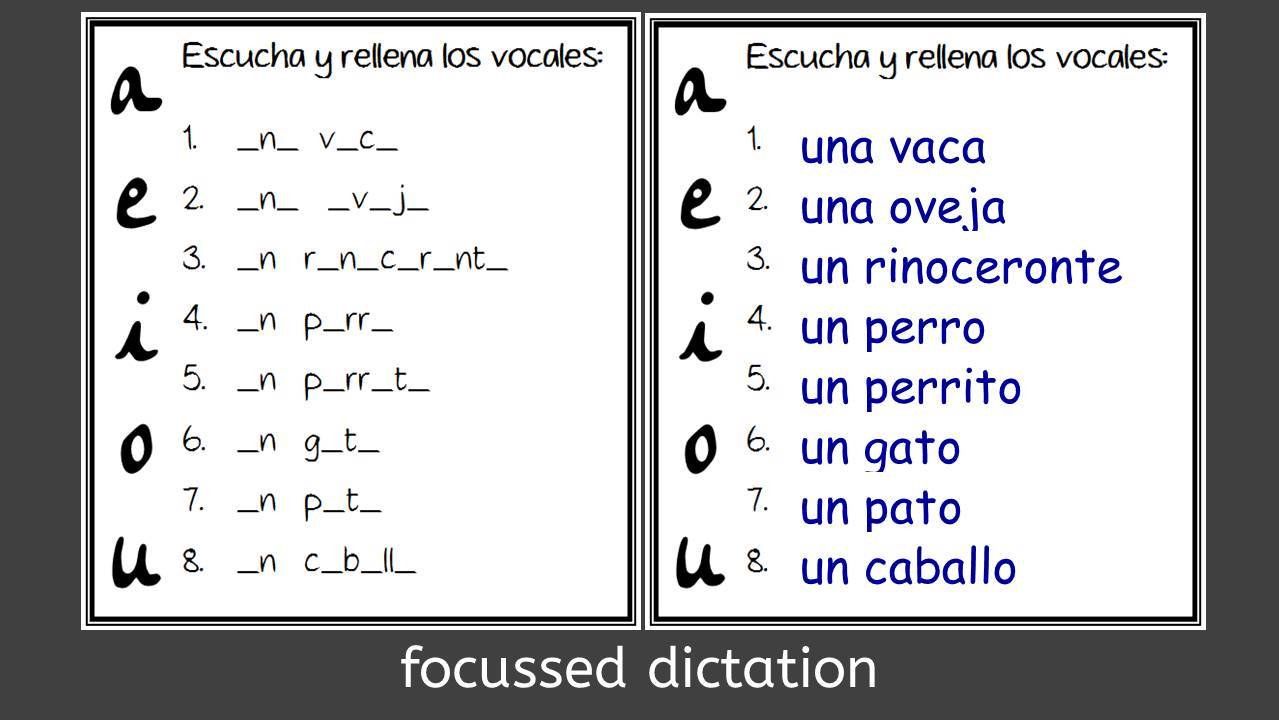
In the primary languages classroom dictation could certainly be used in this way and for the same reasons.  Children could practise writing the language-specific accented letters on their mini whiteboard and hold it up for you to see.  Writing words from memory (as specified in the Key Stage 2 national curriculum) would also work.  To practise phonics, children could listen to a L2 word and fill in the missing phoneme/grapheme.  

I don't explicitly practise spelling the vocabulary with the children (due to time constraints more than anything) but I can see how this could work in the initial stages of composition.  Spanish is a transparent language, and therefore spelling is not as much of an issue as it might be when the children are writing in English.  I am almost proud when the children mix up their b's and v's or miss off a silent h, as these are errors that Spanish children make.  The framework does say, however, that spelling difficulties increase the cognitive load (page 40).  So is this something to which we should be dedicating some time, especially for the more opaque languages like French, in order to facilitate more fluent writing later on?  I have written before about how English spelling can interfere with spelling in the new language, and have also blogged about some ideas for practising spelling with Key Stage 2 children.

The framework talks about morphology and etymology as important components of working on spelling (page 43).  Certainly when teaching Spanish I talk about the origins of words a lot (usually links to Latin and therefore to English) although morphology has a somewhat less prominent place in the primary languages classroom, simply because of the much reduced number of words that are being learned.

I have written before about using dictation in the primary languages classroom and compiled a list of ideas for dictation classroom activities.  My Spanish dictation publication is available here.

Talking for writing

The documents begins with a discussion of the importance of talk for writing, something that is already a feature of the national curriculum for English in primary schools.  From Reception, children should be taught to compose orally, in other words to say out loud what they want to write.  "In the early stages of learning to write, sentence-level composition should be practised orally" (page 8).

Talk is used to generate and discuss ideas for the writing.  Oral composition reduces cognitive demand when children do eventually write the sentence or phrase, as they have already had the opportunity to formulate their ideas and vocabulary and grammar choice.  They are able to test out ideas before they commit them to paper (page 49).

However it goes on to say (on page 14) that "Writing is not merely talk written down.  Learning to write involves developing control of language in a way that, increasingly, is different from everyday, conversational speech and must be explicitly taught."  This, I think, is where the teaching of English, the mother tongue for the majority of the children, differs from the teaching of the new language.  The language and structures that we practise orally tend to be the same as the sentences that the children will later write, and I think this continues until way into secondary school languages.  It will be some time before students can confidently speak conversationally, different to the language that they write.

Composition

Articulating and structuring ideas in written form is referred to as composition in the national curriculum.  Composition and transcription are summarised in the framework as "The Simple View of Writing". (page 16)  It says that proficient writing will not be possible without developing these two aspects.

Research has suggested (see page 19) that "planning, composing and rewriting a text is twice as mentally demanding as reading a complex text".  This is something that resonates with writing in the new language.  I think that sometimes, particularly if we are a visiting specialist teacher, we can underestimate just how difficult it can be for some children to produce sentences in the new language.

"An effective writer has to attend to numerous elements simultaneously. This can present an overwhelming challenge for pupils’ working memory, that is, their limited workspace for thinking, learning and remembering. This is particularly the case for novice writers. As they become more skilled with the individual components, they are more able to manage all of them but it can be overwhelming while they are learning. Writing should not be rushed: pupils should concentrate on the quality of their writing rather than producing large amounts of lower-quality text." (page 19)

The framework recommends beginning with sentences which can later be built into paragraphs.  It also recommends using visual prompts such as pictures from a story book and sentence stems.

Talking for writing and modelling responses before written composition takes place are crucial to success in English and also writing in the new language.  As the framework says: "Pupils who are expected to write with minimal preparation are unlikely to succeed." (page 57)  It breaks composition down into four steps:  Drafting, Revising, Editing, Sharing.

Before the first draft of writing in the new language is written, it is crucial that a typical response is modelled for the children, whether this is for a set of phrase or sentence drills or for a longer paragraph.  The framework says "Pupils need to have the whole process demonstrated for them and see 'the struggle, the thinking, the pondering, the messiness of it all - because most struggling writers believe good writers are born, not honed through practice'" (page 64).  

As the first step, the teacher takes the lead while the children observe the 'expert writer'.  This is the modelled writing or 'I do' phase.  The teacher thinks aloud, explaining why they are choosing specific language or structures.  After this comes the shared writing or 'we do' phase where the children build a text with the teacher.  I must admit that I begin with this phase - I don't compose a text myself and talk the children through how I am doing it.  Something to consider for the future I think.  When I build a text with the children, I show them how we can start simple and then embellish with conjunctions, intensifiers and other previously learned words.


You can see in these examples (for Year 4 and Year 6) that we started with basic sentences and then added to them to increase the complexity and the quality.  

The third phase is the independent writing or 'you do' phase, where the children use the two previous examples to create their own piece of writing.  The framework also suggests a fourth phase - guided writing - where the teacher works with a selected group of pupils, helping them to draft their writing while the rest of the class works independently.  I choose to circulate constantly around the class, addressing any misconceptions and answering questions as they arise.  Guided writing is something that I do with certain children but not formally and not usually sitting with them.  Children need frequent and timely feedback on their writing, and I choose to do this by moving around the room.

Writing across the curriculum

Writing skills are incorporated into many other subject areas in the primary timetable, and children are expected to use their English skills to write about what they have learned elsewhere in the curriculum.  The framework says that it is important that "the complexity of the task [in the other subject] matches their stage of development in writing" (page 86).  In other words, if children are writing in geography, the task they are given should enable them to write at the same level as they do in their English work.  This is something that is not possible in languages, the grammar, structure and complexity of which are usually at least a key stage behind the work in English, because of the starting point and the frequency of the lessons.  We can, though, embed many of the writing routines and models described in the framework into our subject.

"The power of writing as a means for thinking and remembering should be embedded throughout the curriculum." (page 86)  We can certainly play our part in this.

Transition

Secondary teachers will need to know how primary children have been taught to write, not only in English but also in their language lessons.  To facilitate a smooth transition, secondary teachers are advised to use some of the same strategies in their lessons.


There are clearly a lot of parallels that can be drawn between primary English pedagogy and methodology and what we do in the primary languages classroom.  I think it will help teachers - non-specialists, class teachers and specialists alike - to reflect on the recommendations of the framework and how they can enhance our teaching of writing in a language other than English.

Friday, 23 May 2025

Lengua de Signos Española (LSE)

https://www.colegiovelazquez.es/lengua-signos-aulas/

I've recently started teaching my final unit with Year 6 - Así soy yo. It starts off with quizzes about languages and then learning how to use the verb hablar to say who is speaking which languages. One of my Year 6s asked me if I knew about Spanish sign language, and I had to admit to her that I didn't know about it, but would find out.

Research revealed Lengua de Signos Española (LSE). There are some good websites and YouTube videos that show some of the different signs. This one is particularly primary-friendly and clear https://www.fundacioncnse.org/educa/bancolse/index.php#gsc.tab=0  Year 6 and I had fun yesterday signing the Spanish alphabet.

This website has a dictionary with the signing for a lot of words: https://fundacioncnse-dilse.org/index.php (I still can't find a sign for español or castellano though).

This YouTube video is one of a good series https://www.youtube.com/watch?v=f6FWFF4fEsg


You might find the signs useful for your multimodal or multisensory approach, when you need an action or gesture while practising vocabulary. It might be wise to give the sign for sacapuntas a miss though.... 😉

Sunday, 16 March 2025

Language World 2025 #LW2025

I returned yesterday from the 2025 Language World Conference with a head full of information and ideas, and a notebook full of notes.  Well, full-ish of notes, as there were some sessions (for example the ones I was chairing) that I decided to just listen to.

The title of my talk was A rich tapestry of adaptable lesson ideas!  (The theme of the conference prompted a lot of weaving and stitching analogies as well as AI-generated pictures of the same!)


I had time to talk about 20 different activities:
  1. Which one do I not say?
  2. Sentence builder bingo
  3. Listening Chests
  4. Pointing game
  5. Trapdoor/Cluedo
  6. Sit down when yours is different
  7. Working off the grid
  8. Guess my sentence
  9. Listen read write
  10. Rapping
  11. Dialogues
  12. Messing around with text
  13. Describing a poster
  14. Odd one out
  15. Analysing text
  16. Post-It grids
  17. Pair writing
  18. Pictogram sentences
  19. Dice roll activities
  20. Kim's game
You can read more about these activities and 100 others here.

Here are my notes from some of the other sessions I attended:


Monday, 11 March 2024

Dictation across the key stages #LW2024


On Saturday I attended day 2 of this year's Language World conference.  I gave a presentation about dictation, giving lots of ideas to use from Key Stage 2 (age 7-11) all the way up to Key Stage 4 (age 14-16) and beyond.

It was much easier to make a video for you in order to share it than to paste all the slides into this blogpost!  Here is the video:


Other links:


Friday, 9 June 2023

Point à la ligne: dictation in primary languages


Dictation is back on language teachers' radar for a couple of reasons.  Firstly, it features in the latest revamp of the GCSE specifications for MFL, which will be first taught in September 2024.  Secondly, last Sunday saw a world record breaking mass dictation on the Champs-Élysées.  I must admit when I first heard this news on Monday morning I was very jealous of the participants, and wished I could have been there!  I used to do a lot of dictations in French at secondary school, in preparation for the O level exam, and loved them.  I took French O level in 1985, which was actually the last year that students had to do a dictation.  That year we were also the first cohort to do a listening comprehension (from the reel-to-reel tape!)  I don't think we had had any practice of this beforehand.

I've had a look at some of my secondary school French books.  It's interesting to note the standard of the language that we were expected to write at that time, which was the spring term of 3rd year, a.k.a. Year 9 (age 13-14).  I had started learning French in the first year of middle school, age 8, and already knew quite a lot when I started secondary school at age 12 (in Year 8 - very odd three-tier system in Surrey in those days!), but it wasn't the same for all my classmates who had come from different middle schools.


And no, in the first dictée above, I don't have any idea what the reference to washing buildings is all about!  You can see that dictations were always negatively marked.  You started off with 20 marks (usually) and then as the person sitting next to you was checking what you had written, they would take off one mark for each error that you made.  I think we were allowed half a point for a missing or wrong accent.  Then our teacher checked them all and gave us our final mark.

I never experienced dictation in Spanish, having only started learning that language in the 6th form (age 16).  O level in Spanish was just listening comprehension for the listening component.  However it can be seen from the examples above just how much more complex dictation is in French compared to Spanish.  My first error was one of adjectival agreement - route is feminine, and therefore I should have written route fermée.  However, fermé sounds exactly the same as fermée, making it more than just an exercise in sound and spelling; it comprises also an important grammatical component.  It would be much more straightforward in Spanish, where the phoneme-grapheme link is much more transparent, and the difference between cerrado and cerrada can be clearly heard.

The pronunciation of French with its myriad of silent letters and homophones combined with its grammar makes dictation a difficult task.  There is a lot to think about.  With Spanish, on the other hand, as long as you know the phonemes and their corresponding graphemes, especially those that make Spanish different to English, you can make a pretty good attempt at it.  In fact the errors that our students make are likely to be similar to the errors that native speakers make when they first start writing.


This is part of a letter that was written to me by a 7 year old Spanish girl to whom I had taught English in Spain during my year abroad.  It can be seen that she wasn't sure which words had silent h and which didn't.  For example e recibido should read he recibido; te voy ha decir should be te voy a decir.  She also confuses b and v, which have the same sound, thus me ba muy vien should read me va muy bien.

Our students might experience similar difficulty with: 
  • the three 'th' sounds, represented by the three graphemes ce, ci and z
  • the "spitting sounds", represented by the graphemes ge, gi and j
  • ll and y, which mostly have the same sound
  • the hard 'k' sound, which can be represented by c and by qu
  • differentiating between r and rr
  • remembering the ñ!
  • remembering which vowels have written accents
Year 11 students will be expected to do dictation in their GCSEs from 2026.  This means that all our primary children, who will be taking GCSEs from 2028 onwards, will, presumably, be starting to do dictations in Year 7, as Key Stage 3 begins its preparation for Key Stage 4.  It makes sense, then, for us to start doing some simple dictation-style activities in primary.

There are three main types of dictation for us to consider:
  • dictation of single phonemes (in the form of a gap fill)
  • dictation of single words (more like a traditional spelling test)
  • dictation of a short text
It's interesting to see that the proposed questions at GCSE are a combination of these.  The first is Foundation Tier and the second is Higher Tier, and these are the sample questions from Pearson, who have released the first specification for the new French GCSE.


So there is some gap fill of single words and also some whole sentences, but nothing on the scale of the paragraphs that we used to have to do for O level.

As we do a lot of work on phonics in Key Stage 2, a good place to start is with individual phonemes and graphemes in the form of a gap fill.  This is a listening activity that I have done recently with Year 2.  All that they had to write was the correct vowel - A or O - to complete the word.  The listening and therefore the dictation was very focussed.


I have also done a similar activity with Year 4, but this time using all the vowels, and they could also use their grammatical knowledge to help them to distinguish between the five sounds.  The challenge is for the children to hear 'ee' and think i not e!


Something else that I think is worth our while is using the target language terms for the punctuation in dictations.  This will only serve to reinforce the work that the children are doing in English.  Here is an activity that I have put together today for one of my Year 4 classes, who are getting really good at giving opinions of food and drink, but still need to do a little bit more work on differentiating between me gusta and me gustan.  They are also very ambitious and have been asking how to say "He likes" and "We like".


The children will listen first without writing, then listen again and write in the correct opinion(s) for each sentence.  Then after we have checked the opinions they will listen again and add in the correct punctuation.  I am hoping that completing these sentences will provide them with some useful models for when they start their extended piece of writing soon.

Now to think of some activities that will suit my French beginners!

If you would like to read more about dictation, I recommend:
Let me know how you have tackled dictation in Key Stage 2!

Sunday, 11 December 2022

The place of the pillar of phonics in the Key Stage 2 Languages curriculum


Yesterday morning I delivered a 15 minute keynote session at the Teachmeet MFL Icons online event.  It was a great event to be a part of - packed with short, snappy presentations which covered all sorts of different topics.  This is my presentation in text form. The event is now available to watch online.

The national curriculum for Key Stage 2 (KS2 - age 7-11) Languages is not very long and it’s not as detailed as perhaps we would like. Its purpose of study and the aims sections are the same as for Key Stage 3 (KS3 - age 11-14), but the subject content is different.

In KS3 there is no explicit mention of phonics, although some of the attainment targets need knowledge of phonics and the sound spelling link to be able to do them. For example, students are required to “transcribe words and short sentences that they hear with increasing accuracy” and “speak coherently and confidently, with increasingly accurate pronunciation and intonation”. It is, however. mentioned explicitly in the KS2 national curriculum, implying that the main groundwork needs to be done in primary so that students can hit the ground running and achieve in KS3 and beyond.


The above is from the KS2 subject content introduction, and the orange highlights are mine.

First, we can teach any modern or ancient language (so we don’t teach MFL in KS2, but rather FL or just "Languages"). The ancient languages are excused the speaking and therefore the phonics. So children who do Latin in KS2 will be well prepared for modern European languages in KS3 in some ways, but not in others. The second point says “Teaching should provide a balance of spoken and written language”. Historically primary languages were more about speaking and tended to neglect writing, but writing is now a fundamental part of what we do. This is important for phonics, as it shows it’s just as important to be able to say the new sounds as it is to read them and represent them in writing accurately. The aims of the curriculum state that children have to use their knowledge of "phonology, grammatical structure and vocabulary" to enable them to understand and communicate. This is the first mention of the 3 pillars, and something that does not appear in the KS3 curriculum.


Above are the attainment targets that relate to phonics in the KS2 curriculum. It’s all about beginning and developing an understanding of the sounds in the new language and looking into the sound-spelling link. We start to develop accurate pronunciation and intonation, both so that children can speak accurately and be understood, and so that they can read aloud accurately. We are encouraged to use authentic resources such as songs and rhymes to help us to explore phonics, and to help us to make the sound spelling link. Songs and poems are mentioned briefly in KS3 but not with a view to explicitly exploring phonics.

The “3 pillars” of vocabulary, grammar and phonics was a term first coined by Ofsted in 2020, following the 2016 Teaching Schools Council Pedagogy Review of secondary languages.  They are now at the heart of the Ofsted inspection framework for languages.  If you’ve seen the leaked Ofsted aide-memoires for KS2 and KS3 languages, you’ll know that they are riddled with mentions of phonics. These 3 pillars have equal weighting and equal importance in the curriculum. The word “pillar” suggests that the three are separate entities, so be taught and learned in isolation, However we know that the three are inextricably linked and interwoven, and that you can’t teach one without touching on the others.


The more I’ve supported other schools with their curricula, the more I have come to realise that the 3 pillars are the Intent of our curriculum. They are what you set out to teach. The four modalities (Listening, Speaking, Reading and Writing), Language Learning Strategies (LLS) and Knowledge About Language (KAL) alongside culture are your Implementation – what you are going to use to teach your intent. Then your Impact is how you assess how well you’ve taught your intent.

So the first answer to the question I posed at the beginning is that the pillar of phonics is firmly embedded in the KS2 curriculum, where the onus is very much on primary teachers to cover phonics systematically and thoroughly, in all four years, so as to enable children to be successful once they enter KS3.

It’s important then that KS3 teachers are aware of what phonics their new Year 7s have covered in KS2. They need to ask, and KS2 teachers need to tell! Transition is so important. Year 7 teachers can’t make assumptions about what the children have done and how they might have done it. It will help them to hit the ground running if they can continue in KS3 the way that they learned in KS2, even if they are going to be gradually weaned off it.  The ASCL Transition Toolkit (available for French, Spanish, German and Chinese) is a good way to start off the conversation.  

If primary schools use a bought-in scheme, then phonics will be included in that scheme somehow, and each scheme will do phonics its own way.  Physical French Phonics and Physical Spanish Phonics are widely used by specialists and non-specialists alike. The idea is that each phoneme has a corresponding image, which in turn shows the child the action they have to do. The action then reminds them of the sound. Once the children are familiar with the actions and sounds, after lots and lots of repetition, you can use the actions as a quick and easy prompt to correct errors or misconceptions. The books are full of great resources and information. They would be useful for KS3 too, and people even use them with adults.


Phonics are best embedded in each lesson, particularly at the initial presentation and practice of vocabulary stage. I choose to teach them explicitly right from the start, not leaving it to chance that the children will notice what I want them to notice. Time is precious in the primary languages classroom, after all. I have started using phonics to introduce new vocabulary, so that the children are seeing the written word at the very first stage and therefore not using English phonics to approximate a spelling of the word in their head, and so that we draw attention to the tricky sounds right from the beginning.  Then when it comes to practising the vocabulary with flashcards and images and so on they have already seen the words and are familiar with the sounds. The next stage will be putting the vocabulary into phrases or sentences by way of a sentence builder or similar. Because they are happy with the pronunciation they can focus on the grammar and structure. So the first pillar, phonics, leads to more successful learning of the second pillar, vocabulary, which in its turn leads to increased confidence with grammar and structure.

When I teach phonics I break the words down into their phonemes, and we then practise sounding the words out before having a go at blending them. I often take the phonemes we have been practising and put them into new, unseen words to show that the phonemes are transferrable. For example bonjour gives us the sounds to work out mouton. The thing we want of course is for children to see a phoneme in a new word and know straightaway which sound it makes. For French in particular (Spanish is so much more straightforward!) I have cards with the graphemes on that we have been practising. I hold up a card and the children have to make the sound.

I hope then that you can see the important place that the pillar of phonics has in the KS2 curriculum, and how this work can and should be built on in KS3 and beyond. Of course there is much more that I could say but hopefully it has started the conversation.

Want to read more?  Here are the other blogposts I have written about phonics.