Showing posts with label ofsted. Show all posts

Wednesday, 15 March 2023

Substantive and disciplinary knowledge: what does it mean for Languages?

In 2021 Ofsted began publishing a series of curriculum research reviews.  The Languages Curriculum Research Review (Languages OCRR) was the fourth in the series, and was published in June 2021.

The first in the series was Science, which came out in April 2021.  It featured substantive knowledge and disciplinary knowledge.  This is an excerpt from the Science OCRR:

The terms also appear in the OCRRs for History, Geography and RE, while disciplinary knowledge only is mentioned in the OCRRs for Art and Design, and English.  There no mentions in the OCRRs for Computing, PE, Maths, Music or Languages.

These terms appear to be replacing the "knowing more and remembering more" maxim.  I have found out this week that it has permeated into other subjects, and I have heard anecdotally that it has come up in some recent Ofsted inspections.  Schools have already rewritten their curricula to accommodate the "3 Is" (Intent, Implementation and Impact), language teachers have had to factor in the 3 Pillars (Vocabulary, Grammar and Phonics), and schools are now being encouraged to revisit their curricula and reframe them in terms of substantive and disciplinary knowledge.  We will all need to think about what substantive knowledge and disciplinary knowledge look like in our subject.  

So what are substantive and disciplinary knowledge in Languages?

Christie Counsell, in her article Taking curriculum seriously, says that "Substantive knowledge is the content that teachers teach as established fact".  Disciplinary knowledge, on the other hand, "is a curricular term for what pupils learn about how that knowledge was established, its degree of certainty and how it continues to be revised by scholars, artists or professional practice."

She then goes on to say that "This substantive-disciplinary distinction works to differing extents and in very different ways across subjects. The disciplinary dimension is barely relevant, for example, in school-level modern languages."  It is possible that this may support its omission from the Languages OCRR.

Despite this, a Google search for "disciplinary knowledge in languages" reveals that a number of schools have already rewritten their subject paperwork to include mention of substantive and disciplinary knowledge, and it is clear that they have interpreted the two kinds of knowledge in a number of different ways.

I've been reading around the subject, and have put together a list of bullet points for each type of knowledge:

Substantive knowledge

Disciplinary knowledge

  • Teacher input
  • Focus on meaning
  • Vocabulary
  • Grammar
  • Phonics
  • The content that is to be learned
  • Carefully chosen and sequenced factual content
  • The facts
  • Rules and methods
  • “Knowing what”

  • Learner output
  • The big ideas
  • Thinking like a linguist
  • Thinking like a French/Spanish/German speaker
  • Practising the language
  • Using the language creatively
  • Asking questions
  • Planning
  • Evaluating
  • Presenting
  • Problem-solving
  • Critical thinking
  • Choosing and selecting
  • Making connections
  • “Knowing how to”

To put that into some context, I'll use a series of lessons I've recently completed with some Year 4 (age 8-9) beginners in French.  The substantive knowledge that I taught them was 10 animals with the indefinite article, including the phonemes in each word.  Then I taught them the difference between masculine and feminine nouns, and how to use the indefinite article to differentiate between the two.  Finally, as per the scheme of work we are using, I taught them je suis, which enabled us to practise short sentences such as Je suis un oiseau. and Je suis une souris.  I then wanted the children to take what they had learned and to apply it in their own work.  I gave them a bilingual glossary with many more animal words, and asked them to use their knowledge to write je suis sentences, and work out the correct indefinite article for each animal.  For this task they called on their disciplinary knowledge, applying the rules they had learned to solve a problem.

This shows how important it is to build into our schemes of work frequent opportunities for the children to demonstrate what they have learned, to be creative with the language, to "think like a linguist".

How does this picture of substantive and disciplinary knowledge fit in with yours?  All constructive comments welcome!

Finally, many thanks to Dr Gianfranco Conti for pointing out the similarities here with Krashen's Acquisition-Learning Hypothesis, which was a great help for me in getting my thoughts in order.

Wednesday, 23 June 2021

Should language learners be writing in books every lesson?


All teachers of languages have their lessons observed at some time or other.  It might be by Ofsted, by a school leader or by a colleague. It's quite common for a teacher of languages to be observed by someone who is not a language teacher or specialist, and who therefore has little or no knowledge of how a language should be taught.  Over the years I have heard from and about some of this latter group of language teachers (primary and secondary), who have been criticised because the learners did not write in their books during the lesson.  The assumption for some observers appears to be that learners should write in their books in every languages lesson.  Are they right?

I was taught and have always followed the rule that writing in books (not the same as all writing, as I will discuss later) should only take place once aural and oral practice has taken place, and the children's knowledge and understanding of the new vocabulary, grammar, phonics and structures are secure.

Over the last two days I have been searching for some kind of official documentation to back up this rule.  Unfortunately, there is nothing to be found.  However it's certainly worth noting (and thank you to Vincent Everett for pointing this out!) that neither is there any official documentation saying that learners should be writing in books every lesson.

So when should learners be writing, and how should they go about it?  Let's have a look at the evidence and the documentation that we do have.

I'm going to start with the documentation from Ofsted, since, like it or not, their inspection framework influences what we do in the classroom and how other professionals observe and judge our lessons.  Two weeks ago, Ofsted published Curriculum research review series: languages, "a review of research into factors that can affect the quality of education in languages".  Here are two excerpts:


The phrase "over time" is used in both these excerpts.  Ofsted have made clear that they are no longer expecting to see progress made in one single lesson, but are looking instead for planning and evidence of progress across a series of lessons.  As languages professionals, we know that it takes several lessons to introduce and practise thoroughly the new language before it is formalised in writing.  Personally, I can often go three or four lessons without children writing anything in their books.

Dr Michael Wardle, Ofsted's languages lead, said at Language World 2021 that "building blocks in each subject [should be] carefully sequenced and practised until sticky".  In other words, activities should be meaningful, in the right place in the sequence for a purpose.  They should not be tokenistic, which is how I would consider writing in a book every lesson merely to tick a box.  Dr Wardle has also said that the new curriculum and the new Ofsted framework is all about "knowing more and remembering more".  We should only plan a writing activity if it is going to help children to know more and remember more at a specific stage in the sequence of learning.  

There is further evidence on page 2 of the document Ofsted inspection - clarification for schools:

Ofsted recognises that no work in books does not mean that no learning has taken place, and it's clear that this should be shared by observers of any subject, not just languages.

There are, of course, mentions of writing in the National Curriculum programmes of study for languages.  According to the purpose of study for both Key Stage 2 and Key Stage 3, a balance between the spoken word and the written word must be struck:


In the aims of the programme of study, again for both key stages:

In Key Stage 2 subject content, we are required to offer a balance of oracy and literacy:

The word "appropriate" is crucial here - a writing activity must be appropriate to the sequence of learning and not just there because there is an expectation that writing in books must be done.  

We can also refer back to the Key Stage 2 Framework for Languages (a sadly technically obsolete but still very useful document, available here) for additional guidance as to the place of writing in the sequence of learning:


The inference here is that children will begin a unit of learning with speaking and listening, which will later be reinforced and further developed by reading and writing.  Oracy is seen as a foundation for literacy, in other words it comes first, and children move on to literacy when it is appropriate to do so.


Written work, therefore, is down to the judgement of the teacher, taking into account the age and experience of the children in the class.  It does not mention written work being done every lesson.  It's always important to consider the "big picture of learning", where you are in the sequence, and whether it is appropriate and meaningful for children to write formally (writing in books can be considered formal writing) at this time.

This further section from the Key Stage 2 Framework brings me to my next point:


On Twitter yesterday I had a response to my question from Ruth Swailes, an expert in the early years of education:

This alludes to James Britton's quotation from 1983: "Reading and writing float on a sea of talk", and the links to this can be seen clearly in the national curriculum for English for Key Stage 1 and lower Key Stage 2.  We always need to bear in mind how our learners have been taught previously, in primary as well as secondary, and to incorporate elements of those previous experiences in our lessons.  

Among the statutory requirements of the Year 1 (age 5-6) English curriculum are:


and in Year 2 (age 6-7), children should be taught to:


This is then extended into lower Key Stage 2 (Year 3 and Year 4, age 7-9), where children should be taught to:


In English, then, children are taught to discuss their compositions orally before recording them with a pencil and paper.  This strategy is good practice for language learning, and has also found its way into the primary languages classroom via Pie Corbett's popular Talk For Writing.  I would surmise that there are some English lessons in lower primary where writing in books does not take place, but where there is much discussion and rehearsal of what will be written at a future time.

As Janet Lloyd says, writing or composition can often be an invisible activity that doesn't actually involve physically scribing:


In the languages classroom we build up the learning gradually via a series of carefully planned activities.  We often show the written word early on, to assist us with sound-spelling link and phonics - we want learners' first stored image of the new word to be the correct one, and not one that is affected by English phonics.  We explicitly practise spelling via strategies like writing in the sky.  We might use sentence builders to drill the new vocabulary and the way in which it fits into our sentences.  We might "write" initially using letter cards or word cards, which are less threatening in the early stages and can be easily edited.  We also try out our first writing on mini whiteboards, which, again, can be easily edited.  Writing in books is often the last step, the summative activity, once everything else is secure, once children are confident with the new language and proficient in its use.

So, what is the answer to my initial question?  Should language learners be writing in books every lesson?  No.  Absolutely not.  Writing should take place at an appropriate and carefully planned point in the learning, as a meaningful step towards the objective.  If that means going several lessons without writing in books, so be it.  

If absolutely necessary, there are other ways of recording that the learning has taken place (although Ofsted have said that they don't expect to see it):
  • take photos of children speaking and stick it in their books
  • video children or record children speaking, attach it to a QR code and stick the QR code in their books
  • stick a sticker in the books on which is recorded the learning that has taken place
  • children complete a peer test or check activity, record the result on a post-it, and this is stuck in the book.

Sunday, 14 March 2021

Language World 2021: sketchnotes


This year's Language World was an all-online affair, which made the feel a bit different, but the sessions were of just as good a quality.  Here are my sketchnotes from the sessions that I attended:

Turn that frown upside down: practical tips to motivate learners in Key Stage 3 and beyond
Claire Wilson


British Council Language Trends 2021 - interim results
Vicky Gough and Ian Collen


The 20 Keys: Giving Grammar a new lease of life
Elena Díaz


Using CLIL and MFL strategies to maximise the curriculum for EAL learners
Jane Driver


International Partnerships and Exchanges
Vicky Gough and Brian Stobie


Multilingualism, language learning and social cognition
Professor Li Wei


Language learning: Learning from the past
Professor Nicola McLelland, Dr Simon Coffey, Dr Lina Fisher


A rich curriculum for all: the pressured yet pivotal position of languages
Dr Michael Wardle, HMI


The missing link: transition between KS2 and KS3
Suzanne O'Farrell, ASCL


Challenges and rewards in the CLIL unit design process
Dr Marie Petersen


Making connections between languages with translation skills for easier KS2-KS3 transition
Helen Stokes


Thursday, 16 July 2020

Primary Languages Conference: Pillars of Progression


Primary teachers and specialist teachers of primary languages are always looking for good quality CPD.  The online conference Pillars of Progression is a joint project from the teams behind the successful Northern Primary Languages Show (NPLS) and Southern Primary Languages Show (SPLS), and I am delighted to have been invited to speak about the pillar of vocabulary.

Here is more information about the conference and its sessions:


The conference will take place on Zoom.  If you're a member of the Association for Language Learning (ALL) it will cost you £5, if you aren't a member it's only £25.  

To book your place, go quickly to the online booking form, as places are limited.

See you there!

Saturday, 14 March 2020

Language World 2020: Harnessing the Hive Mind


I had a great time at this year's Language World conference in Manchester.  I spent yesterday and today in the company of old friends and new friends, attending inspiring sessions and generally putting the world to rights.

My session yesterday was Harnessing the Hive Mind.  If you couldn't be there (for various reasons!) here it is for you now:


What is the 'hive mind'?  According to the OED, it's “a notional entity consisting of a large number of people who share their knowledge or opinions with one another, regarded as producing either uncritical conformity or collective intelligence”.  My working definition for our context is here:


A lot of us in the primary sector are lone practitioners, and a lot of us can’t access CPD for various reasons, so using your online community, your personal learning network, is often the way to go.  

This image represents my personal learning network.  You will be hearing about how I have used them to harness the hive mind.  Members of LiPS (the Languages in Primary Schools Facebook group) are going to get the biggest mentions, hence the image.


Rather than list things that you could do, I’m going to tell you the story of how I’ve harnessed the hive mind during the last year or so in four different ways.  Hopefully this will give you some ideas of things that you could do or ways that you could contribute.

Joe Dale (@joedale on Twitter) and Noah Geisel (@SenorG) started the MFLTwitterati podcast, of which there are now 10 episodes.  I found Episode 4 (April 2019) particularly interesting.  Have a listen to the takeaway section, which features US Spanish teacher Martina Bex and her online Spanish magazine, Revista Literal.


I had a look at Revista Literal, and here’s an example of one of the pages.  The students’ writing is printed out and has a vocab list at the side, so that it becomes a reading resource as well as a celebration of writing.  I could immediately see how this model could be adapted for primary languages, to celebrate the writing that our children do, to raise awareness of the standards that children are reaching in Key Stage 2, and to give children the opportunity to write for a real audience.


I blogged about it the same day and shared the post to Twitter and to the LiPS Facebook group to see what others thought.  Reactions were overwhelmingly positive.

So, to start things off I put together a short survey on Google forms, which I blogged about and then shared the links for as before.  The responses indicated the direction that the magazine was to take – which Key Stages it should be for, how often it should be published, if the pieces of work should be originals or retyped, if children’s illustrations should be included, and if background information from teachers should be included.  After this there was a vote to establish the name of the magazine.  GDPR and safeguarding was a minefield to navigate.  Twitter friends especially were very helpful in this regard.


Then on 1st May last year I fractured my wrist.  I couldn’t do much, especially drive, so I couldn’t go to school.  But I could do one-handed typing, so I worked on the paperwork and asked people for feedback on that and the design, logo and layout.  I put together the web page and so was able to put out a call for the first submissions in May.

I published Issue 1 at the beginning of June.  The contents and guest language appear on the opening page.  The pages are numbered using the guest language.  The structure is based on Revista Literal, with vocabulary lists at the side of the page, and photographs (from pixabay.com) where the children don’t provide illustrations.


Teacher’s Corner follows the children’s work.  Teachers tell the story of how the pieces of work came to be.  They say how long the children have been learning the language and how long their lessons are, then describe the sequence of the teaching and learning leading up to this piece of work.  They describe the support that the children had, and say why they particularly like the pieces of work that they have submitted.


The final part of the magazine is Puzzle Corner, where the puzzles are about languages and you get the answers to the previous one from the previous issue.

The deadline for issue 5 is Thursday March 26th, so please visit the webpage for more information and to read previous issues if you'd like to celebrate your children's work in this way.


Phrases of the day were conceived to give language teachers some meme-type picture resources to use and to display.  The first ones were phrases that I chose, but then I asked people via Twitter, LiPS and Secondary MFL Matters if there were any they’d find useful.  I did them in French, Spanish and German using the Canva app.  I published one a day in each of the three languages from 11th March last year until 5th July.  They’re all on the website (see the links on the homepage) if you want to download and use any of them.  There are a lot of classroom instructions and phrases, and also examples of plurals, adjectival agreement and so on.


The phrases of the day morphed into the #LanguageLinks, which started on 5th July last year, and there’s been a new one every day since, on the Light Bulb Languages Twitter, Facebook page and also on the new Instagram page.  Every week or so I upload a batch to the website.  They’re in French, Spanish, German and Italian. 

The links are something I’d thought about for a while, and which I had blogged about, in the context of improving English vocabulary.  I find it difficult to teach another language without comparing the words and structures in the new language with English.  For example, colours are often one of the first things that we teach new learners, and with my classes I look for clues, tips and hints that will help us to remember the words.  One of the most common ones is remembering blanco/blanc by thinking of the English word blank.  Quite often these clues, tips and hints lead us to high quality English vocabulary that I recommend to my students that they use.  In recent weeks we have mentioned azure, stupendous and phantom. 


This also links very well with the curriculum for English, where there is a big emphasis at the moment on improving and building English vocabulary.  The links are designed to stimulate interest in other languages while building English vocabulary and showing links to help students to remember the new words.


The L2 word on each poster is a translation of the first English word.  Then the second English word is linked to the L2 word (sometimes they are cognates but not always).  The two English words are always linked in some way.


Lots of people have sent me their ideas for links, for which I’m very grateful as my own ideas are starting to run a bit dry.  If you have any ideas I’d love to hear them!  I’ve also been sent a lot of pictures of the posters on display in different schools and colleges, which is great.

In November last year I saw this tweet from Samara Spielberg, who is a teacher in New York.  She asks colleagues to write short texts which incorporate certain set phrases, verbs and structures. Then her students read and analyse them before using them as a model for their own work. 


The following is a close-up of one of the texts that Samara made. I could see straightaway that this was something that could be adapted for Key Stage 2, with different teachers contributing texts to make a teaching resource.


I had just started gender with my beginner Year 4s, and decided to crowd-source some texts for them to use as a writing stimulus.


I put together a sample text with the key language that I wanted to use, and asked colleagues via my blog and via LiPS to contribute.


This is the resulting resource which I worked on with my Year 4s.  We looked at the genders of all the nouns mentioned and used a glossary to find out the meanings.  We then used the colour coding to help us to collaboratively build a text on the board.  Then I let them loose with a dictionary to write their own.  They had to make a list of their nouns and genders first, and then build them into their text.


This is an example of the work produced.  The majority of the children enjoyed using the colour coding to help them to build their sentences.  Colouring blocks like this was more successful than writing in colours, mainly because yellow writing doesn’t show up!

I did a similar thing for French.  All these resources are on Light Bulb Languages.


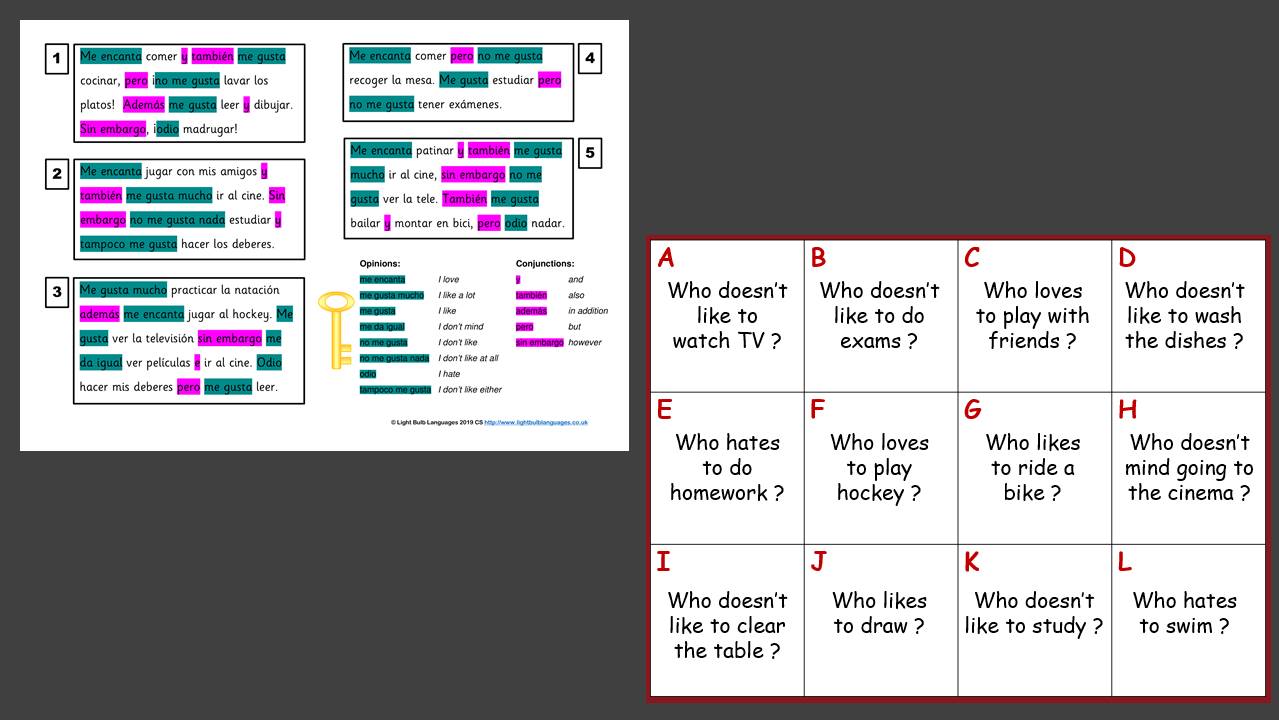
This is one to practise opinions of infinitives for Year 6.  We did this activity with it.  There are lots of other possibilities for texts like this – if you can think of one you’d like, let’s do it!


Deep dives won’t have escaped your attention.  As they’re new this academic year there’s been a lot of brainstorming and sharing on the forums and on social media.


In September a number of us received this in a marketing email from ilanguages.  I posted it in LiPS as I thought it would be of interest to members of the group in the light of the new Ofsted framework.  Jane Birtwhistle and I decided to post one of the questions each day for people to contribute their responses so that we could all help each other out.  Over the seven days of the seven questions there were a lot of really helpful contributions.  Of my three schools, two of them at the time were expecting Ofsted imminently, and the third, an outstanding school, was potentially going to get one of the special visits for languages, history and geography.  So these responses were very useful for me.  I went through the responses and pulled them together in a document, which I posted back into LiPS.  It meant that each member would have the basics which they could then shape to their own school.  The document covered the 3 Is and more.  All the posts can be viewed by searching the hashtag #ofsteddeepdive in LiPS.

I made the information specific to my school and shared it with my headteacher. This all led to a positive few weeks for me at school.  We had a “meet the governors” day, where a team of the governors spent the day in school talking to the children and also the leaders of various subjects and projects and so on.  Because my headteacher knew I had been doing this work into the 3Is and other aspects of leading the subject, she asked me to come to speak to the governors about Spanish.  During the meeting, the governors asked me about CPD, and came to the conclusion that other staff would benefit from some input on languages.  So in January I did a staff meeting for Spanish.  This is the message I shared about it on LiPS afterwards.


This is a brilliant example of what people can do when they all put their heads together.  More than one person has said that in their school languages are leading the way with this.  Maybe it looks like it's just me blowing my own trumpet but this could be you!


So as you can see I’ve had no qualms about using my online contacts and personal learning network for my own ends, but I have shared the outcomes with others as well.

What can you do?  How can you harness the hive mind to enrich your offering to your students or to make a resource that will be of use to lots of colleagues?


When spider webs unite, they can tie up a lion – together we are invincible!