Showing posts with label vocabulary. Show all posts

Thursday, 13 November 2025

Minimum core content for Key Stage 2 Languages


ChatGPT's take on my musings about the core content!

The Curriculum and Research Review 2025 (CAR) was published last week on 5th November.  I have already written at some length about what it means for primary languages.

The first of the two recommendations for primary languages was:

a minimum core content for French, German and Spanish would provide greater clarity and consistency, especially for non-specialist teachers.  Covering commonly occurring phonics, vocabulary and grammar, this should align closely with the content and teaching approaches at secondary and thus build more securely the foundations of knowledge for success at Key Stage 4 and beyond more securely.  This should support a smoother transition into Key Stage 3. .... With a shared understanding of what constitutes 'substantial progress' in a language, secondary schools would be better equipped to build on students' prior learning.

The Government has agreed to put this into place.  I have been pondering what this "minimum core content" will comprise.  The second sentence of the above quotation is, I think, important: "Covering commonly occurring phonics, vocabulary and grammar".  I would argue that it needs to be more far-reaching than this and not just vocabulary, grammar and phonics.

Here are my thoughts so far on what I think should be in the minimum core content:

Intercultural Understanding (IU)

Children need to have an understanding of the language that they are learning and how it fits into the global picture.  We need to encourage curiosity about world languages and where they are spoken, and we need children to appreciate that other languages may be different, but they are not bad, wrong, or strange.  All languages are valid.  I think that children should be able to:

  1. recognise that there are hundreds of languages spoken across the world, and that most people are not monolingual
  2. name other world languages and say where they are spoken
  3. explore and investigate language families and their roots
  4. talk about the languages spoken in their school and their classroom
  5. name the countries which speak the language that they are learning
  6. know some basic facts about the countries where that language is spoken
  7. explore and investigate special days and celebrations in some of those countries
  8. find out about social conventions and daily life in some of those countries
Writing systems

I have written before about writing systems (for example here) and the importance of children's familiarising themselves with the writing system of the new language prior to attempting any writing in it.  I think that children should be able to:
  1. write diacritics accurately
  2. name the different diacritics in the language that they are learning
  3. understand the difference that those diacritics makes to the individual letter or word (this of course links nicely to phonics)
  4. write accurately any punctuation marks of the new language that differ from English
  5. understand the rules for capitalisation in the language that they are learning
Dictionary skills

If children want to be able to personalise their speaking and writing and extend what they want to say outside of the parameters of the core content, it is important they know how to use a bilingual dictionary effectively, whether it be online, paper-based, or a more simple bilingual glossary.  This will also of course cross the curriculum to English, and the two subjects will be able to work hand in hand on alphabetical order and finding the correct definition.  The ability to use a dictionary effectively will also support new Year 7s, especially if they are learning a language that they didn't study at primary school.

Should we push for an online bilingual or even multilingual dictionary for Key Stage 2, where children can work between English and their curriculum language, but also between other "foreign" languages?  What a great resource that would be!

Language Learning Strategies

In my opinion, Key Stage 2 is the time to embed what it means to be a language learner, and what children can do to optimise their learning time and their understanding.  For example, I think that children should be able to:
  1. look at the face of the person speaking and listen attentively
  2. compare the new language with English or with other languages that they know
  3. use context and tone of voice to deduce meaning
  4. use different techniques to memorise language
  5. use physical responses and gestures/actions to aid in the learning process
Phonics

It's worth noting first of all that phonics in French is much more complex than it is in Spanish or German.  I teach just Spanish currently, and have usually covered all the important phonemes by February of Year 3.  After that it is constant repetition and practice, as I introduce all new vocabulary phonics first.

There are many more phonemes for French, but having said that, the last time I taught French (2022-2024) I managed to cover the following phonemes in 2 years:

j, /ə/, u, i/y, ê/è/ei/ai, r, on, un, ô/au, é, ou, ss/ç, s/z, in/im/ain, an, ch, oi, eu, silent h, and silent final letters

We repeated many of these multiple times, and gradually introduced the phonemes as we met them in new vocabulary.  So I think it would be doable over four years, as long as the phonemes were carefully planned into the scheme of work units.  I can't think of many other phonemes that would need to be included for French.

For Spanish: a, e, i, o, u, b/v, ce/ci/z, -d, ge/gi/j, silent h, ll, ñ, qu, r, rr, gue/gui

I don't know enough German to be able to put a list here.

Thinking about the sentence in the quotation from the CAR above that says "this should align closely with the content and teaching approaches at secondary", I anticipate that activities such as dictation and reading aloud, new arrivals to languages GCSEs, will make their way into Key Stage 2 in a more formal way to aid phonics practice.

Vocabulary

It is generally agreed that by the end of Year 6, children will have reached level A1 of the Common European Framework.  The estimated vocabulary size is between 500 and 1000 words to reach this level.  Given the time restraints to which we are subject in Key Stage 2, 500 seems reasonable.  This would work out at about 125 words per year over Key Stage 2, or an average of 3 or 4 new words per week.  This seems doable.

It is likely that the vocabulary list will be informed by word frequency, as has happened in the secondary sector,  and which is also a feature of some primary schemes of work now.  The verbs will be important - you can't make a sentence without them after all - and the chosen nouns will need to be relevant to the experiences and interests of children age 7-11.  I think that this will be a good opportunity to include here the themes and topic areas which might be commonly included in lower Key Stage 3 but are too immature for them, as well as the lists of words that would be useful for new Year 7 students to have under their belt in order to hit the ground running in secondary.  Other aspects of vocabulary, such as days and months, link well to other topics in the primary curriculum such as Romans.

My suggestions for vocabulary are:
  1. basic greetings and saying your name
  2. titles e.g. Señora, Monsieur
  3. common first names from the target-language speaking countries
  4. some commonly used classroom instructions, to support target language use in secondary
  5. saying how you feel (answering the question How are you?)
  6. numbers to 100 (admittedly more complex for French than for Spanish and German)
  7. colours
  8. other basic adjectives, e.g. of size and shape
  9. days of the week
  10. months of the year
  11. items in the pencil case (very important for younger children!)
  12. animals / pets
  13. members of the family
  14. planets (links to Year 5 Space topic)
  15. opinions (saying what you like/don't like/love/hate)
Grammar


The ASCL Transition Toolkit (link to Spanish overview) was put together by ASCL, the British Council and the Association for Language Learning.  When we were compiling it, we took the brief statements in the Programme of Study and unpicked them to see what would actually be involved.  I use the toolkit every year to inform the secondary schools what my Year 6s have done, and I think that it makes a good starting point for these discussions.  I also unpicked the grammar from the Programme of Study and put it in these mind maps.

It's worth noting at this point that the terminology of certain grammatical points is different in the English curriculum and the Languages curriculum, for example articles vs. determiners and possessive adjectives vs. possessive pronouns.  This reset of the curriculum might be the opportunity for some more joined-up thinking across the curricula for "native" and "foreign" languages.

My suggestions for grammar to cover these points are:
  1. notion of grammatical gender
  2. nouns (patterns, how they are affected by grammatical gender)
  3. determiners (definite and indefinite articles + numbers)
  4. plural forms
  5. adjectival position
  6. adjectival agreement
  7. question words
  8. conjunctions (and, but, however)
  9. intensifiers (very, quite)
  10. subject pronouns (although not used a great deal in Spanish)
  11. first three persons (I, you, he/she/it) of the high-frequency irregular verbs to be, to have, to do/make, to want, to go
  12. first three persons of commonly used regular verbs such as to play, to speak, to listen, to eat, to drink, to like

Do you agree with this list?  
What would you add?  
Would you take anything out?  

Let me know in the comments.

Monday, 10 February 2025

Which one did I not say?


Recently I've been doing a lot more listening with my classes before we start speaking (here's why)  This activity can be done before you start the speaking, or afterwards as a recap.

I've called it "Which one did I not say?" for want of a better name!  I say all of the words that we are practising (not in any particular order) except for one.  The children look at the grid on the board while listening, and then have to tell me which one I didn't say.  It requires a lot of focussed and careful listening, and I am always impressed that they get the right answer - I'm not convinced I would be able to!

So far I've used it for single words, as in the example above, which is for Year 4 (age 8-9).  However I think it could be used with any age or experience of learner, and could be used with short phrases or even sentences rather than just words.

It is a low-prep idea, but I'd recommend preparing it in advance, so that you know what you've said!  I jot them down on a sticky note or make lists like this:


Monday, 30 October 2023

Sentence Builder Bingo


I'm always on the lookout for more ways to drill and practise vocabulary and structures.  During the summer holiday I had the idea of using sentence builders to play bingo with.

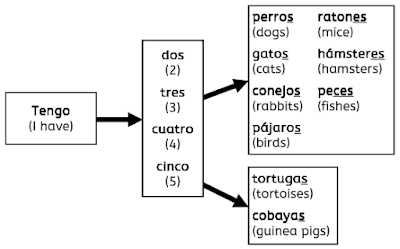
One unit of learning that I have used it with is Pets, in particular saying that you have more than one pet.  I used the bottom half of this sentence builder:


and drew up the above grid as my checklist so that I knew which sentences I had said.

Altogether with this sentence builder it's possible to make 36 sentences.  I asked Year 4 to choose 5 sentences and write them in their books.  Then I read out the sentences one by one in a random order.  I repeated each one twice, just in case, and then went straight on to the next one.  The children needed to listen carefully and constantly check their sentences, ticking off any sentences they had that I said.  When they had ticked off all 5 of their sentences they had to call out "Bingo" and then to check I asked them to read their sentences back to me.  I used my grid to check they were right.

We then continued until most children had heard their sentences.  Some children were frustrated at the end because they had missed one of their sentences and so didn't get bingo.  I did point out, though, that they had heard and identified 4 out of their 5 sentences, so not to get hung up on just one.

The classes that I tried this with said that they enjoyed it.  I liked it because they got to hear over 60 sentences all in one go.  

You may well have been playing this game for ages!  I don't remember having heard it from anyone else.

Friday, 8 September 2023

Listening Chests


One of my schools was extended recently and has increased from single form entry to 1.5 form entry.  This year, for the first time, there are 45 children in Year 2 and 45 in Year 1.  Also for the first time, there is a mixed age class - Year 1/2 - alongside Year 1 and Year 2.  Previously I have always taught "pure" Year 1 and Year 2, so now have had to formulate a new scheme of work with 2 cycles, to cater for the mixed class.  I'm teaching it to all of Key Stage 1.

I'm beginning with a brand new Pirates unit, using my maxim of "the usual in an unusual way".  The children in current Year 2 can already count to 10 and know 6 colours, but the new Year 1s only started Spanish this week.  This term we will be learning greetings, saying your name, numbers to 10, and 11 colours, using Pirates as the theme.  Therefore the Year 1 children will learn what they need to, and the Year 2 children will recap some learning and learn something new, using a different context to before.

I've had to think of some different activities to usual for this reason.  One of them is Listening Chests.


I'm going to give each pair of children one of these cards with treasure chests on.  Definitely 4 chests for Year 2, 3 for Year 1 and we'll see how the mixed class gets on.

Let's use colours as an example, and 3 chests.  Ask the children to tell you which chest the colour red is in.  Then you say 3 colours: amarillo, rojo, azul.  You said rojo second, therefore the colour red is in the middle chest.  The children listen and point to the chest where the colour is.

This can be used for all sorts of different language areas.  I can see it being useful for phonics: show children a grapheme, then say 3 different phonemes or words, and they have to say which chest the grapheme is in.

You also don't need a special chests card to do this activity.  It could be as simple as the children quickly drawing 3 boxes on their mini whiteboard and using those instead.  A low tech and low prep activity.

If you are interested in my Pirates unit for Key Stage 1, I have already uploaded the first resources:


Sunday, 18 June 2023

What's connected?


The other day, while looking for something else, I reminded myself of the sadly-no-more interactive activity maker Sugarcane.

My favourite of their activities was What's Connected.  Here's an example:


Once you had entered your data set, it would choose 12 random words from it and then ask you to find links amongst them with the word at the top.  There were usually 3 different links to be found.  For example, the links here with ventana are una, la and window.  The more columns you had in your data set, the more links were possible.

I've been pondering making some versions of this activity to use as starters, as it makes students think about the detail of the words and phrases that they have been learning and the relationships between them.  The first unit of work that I thought of to use was my Year 4 unit involving opinions of food and drink in Spanish.  

First of all I created my data set in the form of a table in MS Word:


Then I needed to make a random selection.  I started off my putting the data set into a Flippity Randomiser but found that the selection it generated wasn't really random enough!  So instead I pasted the data in a list into an online random picker, which worked better.  I also used this to select the "lead word".

I created a template in PowerPoint and entered the information.


I'm thinking of asking the children to write on their mini whiteboards any links they can find, before showing them the answers.  All the children should be able to find at least one link.

This format would also suit adjectival agreement as well as verb paradigms and tenses.  Can you think of an area of language that you would like an activity like this for?  Let me know in the comments.


Thursday, 23 March 2023

Presenting new language - an update years later!


In February 2010, I wrote a blogpost here about presenting and practising new vocabulary.  At the time I had been in the primary classroom for a term and a half.  Now, 13 years later, I can see that my practice has morphed into something different, and something that I think is more effective.


This paragraph explains it a little more:


Reading and reflecting on this article has caused me to modify the way that I introduce new vocabulary and then get the children to move towards saying it out loud.

Here is what I now do, and I am definitely seeing the benefits, with better pronunciation and recall from both my more experienced Spanish learners and my beginner French learners.
  1. I present the new vocabulary via Physical French/Spanish Phonics.  My PowerPoint slides show the words, the sounds that make them up, and image to show what it means.  We sound the words out, repeating each one at least 3 times.  We don't blend them at this stage, although I do hear some learners quietly saying the words.

  2. On a new PowerPoint slide I put all the words in a numbered grid, along with the images to again show meaning.  I say the words firstly in order and then randomly, and ask the children to point to them on the screen.  Engagement is always good and it is a quiet activity.  Here's an example of a grid:


    The pointing game could be used as an alternative for this, and would be a useful resource for further practice later.

  3. Next we use the numbers for listening practice.  I say the word and the children have to tell me which number it is.  It's also a good way to practise numbers!  We cycle through all the words probably two or three times.

  4. Next it's time for the children to start saying the words.  We use "don't repeat until I click".  I say the words in order, but the children aren't allowed to repeat them back until I click my fingers.  I give them a good few seconds to mentally rehearse the words first.

  5. Finally we do some choral repetition in the usual way.
We repeat some of these steps the following lesson, and gradually reduce the amount of practice that we have to do.

Do you have any other go-to activities that you do at this initial "getting to know the words before saying them" stage?


Friday, 11 February 2022

Physical description: Spanish crowdsource


Following the success of previous crowd-sourced text resources, I'd like to try another, with your help.

I would be very grateful if you could write some sentences using the language that you can see in the tables at the top of this post.  If you don't want to add your real name, a pseudonym or nickname would be fine.

You can add your sentences here in a comment, or email them to me.

¡Muchas gracias!  These will be so useful for my Year 5s who are grappling with adjectival agreement and position.   I will, of course, share any resulting resources.

This will be my contribution:


Friday, 10 December 2021

Language Show 2021


The presentations from this year's Language Show have now been uploaded to YouTube.  You can watch my minibooks and vocabulary sessions:


Wednesday, 10 November 2021

Physical Spanish Phonics


When I trained as a secondary MFL teacher in 1994-95, phonics were not mentioned.  We were not trained how to teach the sound-spelling link, and, indeed, it wasn't expected.  Those were the days when students were supposed to just absorb the different phonic and pronunciation rules.  It was clear, especially when preparing Year 10 and Year 11 students for the oral components of their modular GCSEs, that this didn't work.

Then in 2000 I was invited to be part of a working group in Sunderland LA, looking at the findings of the Invisible Child report by David Buckland, Jeff Lee and Glenis Shaw.  David Buckland came to spend a day with us to discuss it.  (NB the date of the CILT publication of the report says 2001, but we were definitely already discussing it in January 2000.)  

In the group we formulated listening strategies, to break down and demystify the often impenetrable audio recordings that we find ourselves obliged to use, and reading strategies, in particular the analysis of texts.  We also decided that phonics, the sound-spelling link, was very important for building confidence for the "invisible children" and in fact for all.  I still have the posters that we compiled for French, Spanish and German, to display in classrooms, for example this one for that Spanish sound that we can't write in English!

Since then, I've always endeavoured to include some phonics in my lessons.

Phonics are an integral part of the Key Stage 2 programme of study for Languages.  What exactly does it expect us to do?
  • (in the aims of the programme of study) "... continually improving the accuracy of their pronunciation and intonation"
  • (in the subject content introduction) "using their knowledge of phonology, grammatical structures and vocabulary"
  • "explore the patterns and sounds of language through songs and rhymes and link the spelling, sound and meaning of words"
  • "develop accurate pronunciation and intonation so that others understand when they are reading aloud or using familiar words and phrases"
I had always tried my best to achieve these objectives, even going so far as to create my own resource for Spanish.  But I was never completely happy with how it was going in class.

In the Languages in Primary Schools Facebook group, there had been a lot of chat about a publication called Physical French Phonics, which was proving popular for teaching French phonics, something that is of course a lot more complex than Spanish.  

Then last year, Jenny Bell, Sue Cave and Jean Haig published Physical Spanish Phonics, which I have to say has revolutionised the way I teach phonics, and has vastly increased the children's knowledge of sounds and their confidence with pronunciation.

The idea is that you have a image which represents a sound, and which also gives you an idea of what that grapheme sounds like, for example someone biting into an apple for the "a" sound.  Then that picture and phoneme/grapheme are accompanied by an action.  I then take one of our words (the months, most recently, for Year 4) and represent each sound using the images.  We then look at the images, say the sounds and do the actions for each individual sound before then blending them to make the word.

This approach has been particularly successful for the very low ability children, who often get left behind and who might find the sound-spelling link most difficult.  Using this process they can easily sound out and then blend the words.  It is also clearly contributing to a significant increase in confidence for all the children.

With Year 4 I have been using Physical Spanish Phonics to sound out and blend the months, prior to putting the months into our sentence builder which puts together birthday sentences:

By the time the children see this, they already know the numbers (from the previous Year 4 unit), the word mi (from Year 3) and the word es (from Year 3).  So knowing the sounds of the months, which we have just practised in isolation with the sounds and then by reciting them in order, is confidence-building, and allows us then to move quickly into the meaning and structure of the sentences.

I gave my Year 4s a challenge this morning, after we had practised the months and their sounds some more.  I showed them the words viña, ceño, jabalí and cerezas, accompanied by the Physical Spanish Phonics images, and asked them to work with their partner to work out how to say these words, none of which they had ever seen before.  Their pronunciation was beautiful.

I asked Year 4 to tell me what they thought of working on phonics in this way:
  • "It helps a lot."
  • "It helps me to work out words easily."
  • "If I get stuck I can look at the pictures."
  • "It makes me concentrate."
  • "If you're joining in with everyone and you're a bit lost you can look at the pictures and listen to the others."
  • "I take it in a bit more."
  • "When I do the actions I can say the words better."
If you're looking for a way to teach phonics in Key Stage 2 or even early Key Stage 3, I definitely recommend Physical Spanish Phonics.  I really like how the actions allow you to see exactly who is putting in the effort, and how the actions also give you a shorthand to use to correct mispronunciations in a quiet and non-threatening way.  To refer back to the programme of study, it helps me to explore, develop and continually improve the children's pronunciation. Why not give it a try!


Wednesday, 23 June 2021

Should language learners be writing in books every lesson?


All teachers of languages have their lessons observed at some time or other.  It might be by Ofsted, by a school leader or by a colleague. It's quite common for a teacher of languages to be observed by someone who is not a language teacher or specialist, and who therefore has little or no knowledge of how a language should be taught.  Over the years I have heard from and about some of this latter group of language teachers (primary and secondary), who have been criticised because the learners did not write in their books during the lesson.  The assumption for some observers appears to be that learners should write in their books in every languages lesson.  Are they right?

I was taught and have always followed the rule that writing in books (not the same as all writing, as I will discuss later) should only take place once aural and oral practice has taken place, and the children's knowledge and understanding of the new vocabulary, grammar, phonics and structures are secure.

Over the last two days I have been searching for some kind of official documentation to back up this rule.  Unfortunately, there is nothing to be found.  However it's certainly worth noting (and thank you to Vincent Everett for pointing this out!) that neither is there any official documentation saying that learners should be writing in books every lesson.

So when should learners be writing, and how should they go about it?  Let's have a look at the evidence and the documentation that we do have.

I'm going to start with the documentation from Ofsted, since, like it or not, their inspection framework influences what we do in the classroom and how other professionals observe and judge our lessons.  Two weeks ago, Ofsted published Curriculum research review series: languages, "a review of research into factors that can affect the quality of education in languages".  Here are two excerpts:


The phrase "over time" is used in both these excerpts.  Ofsted have made clear that they are no longer expecting to see progress made in one single lesson, but are looking instead for planning and evidence of progress across a series of lessons.  As languages professionals, we know that it takes several lessons to introduce and practise thoroughly the new language before it is formalised in writing.  Personally, I can often go three or four lessons without children writing anything in their books.

Dr Michael Wardle, Ofsted's languages lead, said at Language World 2021 that "building blocks in each subject [should be] carefully sequenced and practised until sticky".  In other words, activities should be meaningful, in the right place in the sequence for a purpose.  They should not be tokenistic, which is how I would consider writing in a book every lesson merely to tick a box.  Dr Wardle has also said that the new curriculum and the new Ofsted framework is all about "knowing more and remembering more".  We should only plan a writing activity if it is going to help children to know more and remember more at a specific stage in the sequence of learning.  

There is further evidence on page 2 of the document Ofsted inspection - clarification for schools:

Ofsted recognises that no work in books does not mean that no learning has taken place, and it's clear that this should be shared by observers of any subject, not just languages.

There are, of course, mentions of writing in the National Curriculum programmes of study for languages.  According to the purpose of study for both Key Stage 2 and Key Stage 3, a balance between the spoken word and the written word must be struck:


In the aims of the programme of study, again for both key stages:

In Key Stage 2 subject content, we are required to offer a balance of oracy and literacy:

The word "appropriate" is crucial here - a writing activity must be appropriate to the sequence of learning and not just there because there is an expectation that writing in books must be done.  

We can also refer back to the Key Stage 2 Framework for Languages (a sadly technically obsolete but still very useful document, available here) for additional guidance as to the place of writing in the sequence of learning:


The inference here is that children will begin a unit of learning with speaking and listening, which will later be reinforced and further developed by reading and writing.  Oracy is seen as a foundation for literacy, in other words it comes first, and children move on to literacy when it is appropriate to do so.


Written work, therefore, is down to the judgement of the teacher, taking into account the age and experience of the children in the class.  It does not mention written work being done every lesson.  It's always important to consider the "big picture of learning", where you are in the sequence, and whether it is appropriate and meaningful for children to write formally (writing in books can be considered formal writing) at this time.

This further section from the Key Stage 2 Framework brings me to my next point:


On Twitter yesterday I had a response to my question from Ruth Swailes, an expert in the early years of education:

This alludes to James Britton's quotation from 1983: "Reading and writing float on a sea of talk", and the links to this can be seen clearly in the national curriculum for English for Key Stage 1 and lower Key Stage 2.  We always need to bear in mind how our learners have been taught previously, in primary as well as secondary, and to incorporate elements of those previous experiences in our lessons.  

Among the statutory requirements of the Year 1 (age 5-6) English curriculum are:


and in Year 2 (age 6-7), children should be taught to:


This is then extended into lower Key Stage 2 (Year 3 and Year 4, age 7-9), where children should be taught to:


In English, then, children are taught to discuss their compositions orally before recording them with a pencil and paper.  This strategy is good practice for language learning, and has also found its way into the primary languages classroom via Pie Corbett's popular Talk For Writing.  I would surmise that there are some English lessons in lower primary where writing in books does not take place, but where there is much discussion and rehearsal of what will be written at a future time.

As Janet Lloyd says, writing or composition can often be an invisible activity that doesn't actually involve physically scribing:


In the languages classroom we build up the learning gradually via a series of carefully planned activities.  We often show the written word early on, to assist us with sound-spelling link and phonics - we want learners' first stored image of the new word to be the correct one, and not one that is affected by English phonics.  We explicitly practise spelling via strategies like writing in the sky.  We might use sentence builders to drill the new vocabulary and the way in which it fits into our sentences.  We might "write" initially using letter cards or word cards, which are less threatening in the early stages and can be easily edited.  We also try out our first writing on mini whiteboards, which, again, can be easily edited.  Writing in books is often the last step, the summative activity, once everything else is secure, once children are confident with the new language and proficient in its use.

So, what is the answer to my initial question?  Should language learners be writing in books every lesson?  No.  Absolutely not.  Writing should take place at an appropriate and carefully planned point in the learning, as a meaningful step towards the objective.  If that means going several lessons without writing in books, so be it.  

If absolutely necessary, there are other ways of recording that the learning has taken place (although Ofsted have said that they don't expect to see it):
  • take photos of children speaking and stick it in their books
  • video children or record children speaking, attach it to a QR code and stick the QR code in their books
  • stick a sticker in the books on which is recorded the learning that has taken place
  • children complete a peer test or check activity, record the result on a post-it, and this is stuck in the book.

Sunday, 13 June 2021

Let's play darts!


This morning I took part in #ShareStuffSunday on Twitter, offering minibooks, making a flag and the LiPS Listening Project.

I had a look through the other tweets, and was very interested in this one from the multi-talented Jasmine Kay (have a look at her Etsy shop!)


I could see straightaway that this was something that could be easily adapted to use in the Languages classroom.  Indeed, Jasmine says that she has used this activity in her French teaching.  I can see it being used for things that need drilling, in other words for phrases or sentences which are repetitive in structure.  It could be another activity to do using sentence builders.

I like how the completed dartboard will provide quick feedback to the teacher as to how many questions each child has got right, and children will like it as it involves colouring in!

For differentiation purposes, children could try to complete the questions without support, and could look at their books, wall displays or knowledge organisers for support.

Thinking about what my classes are doing at the moment, I've made a example of the dartboard activity for my Year 4 unit ¿Tienes hambre?


For further feedback for the teacher, I've used four different levels for the questions, and use a quarter of the dartboard for each level:

Level 1: 1, 18, 4, 13, 6
Level 2: 10, 15, 2, 17, 3
Level 3: 19, 7, 16, 8, 11
Level 4: 14, 9, 12, 5, 20

It should be easy to see at a glance which quarter and therefore which levels children have coped well with.

Monday, 3 May 2021

The Frayer Model


The Frayer Model is a graphic organiser of information which was developed by Dorothy Frayer and her colleagues at the University of Wisconsin in 1969.  It is intended to support students as they analyse vocabulary in an engaging way.  This webpage has a good overview of the model.

This visual representation comprises 4 boxes:
  • Definition: defining the concept, word or term
  • Facts: describing its essential characteristics.  When I was creating my examples, I found it difficult to differentiate between Definition and Facts.  However Facts is sometimes shown as Characteristics, which I think makes the difference clearer.
  • Examples: providing examples of the concept or word
  • Non-examples: knowing what a concept or word isn't helps to define what it is.  This box is sometimes shown as Common Errors or Misconceptions, which are sometimes more suitable.
I first found out about Frayer Models thanks to a tweet by @i_teach_things:


Seeing how useful they can be for English, maths and science, I decided to have a go at creating some for Languages.  

The first one I did was for Spanish accents:


Spanish accents are pretty simple compared to French, and I was able to fit them all on one Frayer Model.  However, having done further examples for the French accents (like the cedilla one above) I think it's better to have one single concept per Frayer Model.  Then the text can be bigger and the information clearer.

Languages Frayer Models can be used as display resources or for information for students.  I think there would also be value in students using the format to demonstrate their understanding of key grammatical terminology and core vocabulary, perhaps as part of the revision process.


Tuesday, 16 March 2021

Frequency dictionaries


There has been a lot of talk in recent days on Twitter and in the Facebook groups about word frequency.  This has arisen from the release of the proposals for the new languages GCSE (read Steve Smith's blog for excellent in-depth analyses of the proposals) which mention a vocabulary for Foundation Tier of 1200 high-frequency words, and 1700 for Higher Tier.  I also mentioned word frequency during my presentation at Language World 2021.  I was telling the story of my new scheme of work for Key Stage 2 Spanish, where I checked the frequency of the vocabulary I included.

I have been using the Routledge Frequency dictionaries, which you can see in the picture above (the Spanish one proudly bearing the sticky note which marks the end of the numerical list and the beginning of the alphabetical list).

Some people were asking how these frequency lists were arrived at.  The preface to the Spanish version (the one I have used the most) gives as sources for the Routledge lists:

  • the corpus, of 20 million words from fiction and non-fiction texts, the internet and transcripts of spoken language
  • words from all 21 Spanish-speaking countries
  • recent language (the words for this edition were collected in 2014-15)
Most telling, I think, are the subtitles of the dictionaries.  The Spanish one is A Frequency Dictionary of Spanish: Core Vocabulary for Learners", thus acknowledging that learners and users will want to use other words outside this list of 5000 to say what they want to say, depending on their interests.

As well as the main numerical and alphabetical lists of the highest frequency 5000 words in the language, the dictionaries also contain some useful lists of different groups of words, such as this list of French animals:


Animals are of great interest to primary children, yet many of the animal words that we teach are relatively low frequency and indeed outside the top 5000.  They are usually accompanied in speech and writing, however, by much higher frequency words, such as determiners and key verb forms.

I have also been seeing some interesting links between word frequency and culture.