Showing posts with label spanish. Show all posts

Friday, 4 September 2026

International Translation Day resource packs


It's well known in the languages community that 26th September is European Day of Languages, but did you know that 30th September is also an important day for languages?

30th September each year is International Translation Day.   30th September is also the feast day of St Jerome, who in 405 AD completed a translation of the Bible into Latin from Hebrew.  For this reason, St Jerome is the patron saint of translators.

International Translation Day honours language professionals worldwide for breaking down barriers, enhancing global dialogue and connecting countries and cultures.  It was adopted by the United Nations, where it is used to highlight global diplomacy, peace and development.

Each year, there is a theme, and for 2026 it is "The power of being understood".

These resource packs aim to introduce students to different aspects of translation and interpreting, and also to practise translation in the run-up to the GCSE examination. All the French and Spanish used is from the Edexcel vocabulary lists for Foundation Tier, unless otherwise specified. Vocabulary that is not in the Foundation Tier lists is glossed on the resources. 

Each of the 10 resources in each pack also has a page of notes, information and an answer key for the teacher. These resources will be most suitable for higher ability Key Stage 3 students (age 11- 14) and for Key Stage 4 students (age 14- 16). They can be used in class as part of a lesson, but would also be ideal for enrichment activities and language clubs.

You will find the French resource pack here, and the Spanish resource pack here.


Friday, 14 August 2026

European Day of Languages Resource Pack


I've written a few times about European Day of Languages and language days before, giving ideas and links to help with celebrating those days in school.

After teaching my last ever lesson as a classroom teacher on July 22nd, I have finished my first "retirement" project which is a resource pack for European Day of Languages.

It contains 40 resources, which you will be able to print off and use straightaway.  There will be something to suit all learners, from Key Stage 2 (age 7-11) to Key Stage 4 (age 14-16).  You know your learners best, and will be able to choose something to suit them.  There are some resources in French and Spanish, but the majority are in English about languages from all over the world, so will suit learners of any language other than English.

Here are screenshots of the introduction and contents, to give you an idea of what's in the resource pack.  I hope you like it, and that it helps you in your preparation and planning for European Day of Languages and other language days.


Saturday, 16 May 2026

Ideas for a French or Spanish Day


It's the time of year when primary schools are planning French Days, Spanish Days, days for other languages or indeed international days.  Schools are also starting to think about European Day of Languages in September.  Posts looking for advice and ideas for these sorts of days are common on the primary social media groups.

I've pulled together lots of ideas, mainly from the Languages in Primary Schools Facebook group (LiPS), so many thanks to everyone there who has posted ideas in the past.  I thought that having everything in one place would be helpful.

The main thing that I think should be borne in mind when planning a French Day or Spanish Day is that 'French' is not just France, and 'Spanish' is not just Spain.  It is advisable to incorporate as many  as possible of the countries where the language is spoken.  It is also advisable to steer clear of stereotypes such as berets and onions for French and a Mexican sombrero for Spanish.

If it's a French day you're organising, you must read this blogpost by Jane Birtwistle.  It's full of great ideas and pictures.  These activities I have listed have French and Spanish (the languages that I teach) in mind, but they can be adapted for other languages or for international days.

Francophone and Hispanophone countries around the world

  • Each class is allocated a country where the language is spoken, and the children 'travel' to each classroom to do a different activity.  The children have a passport, which they could design and make (a minibook would work really well), and they can be given a stamp or sticker in their passport to show they have been to that country.
  • Each class is allocated a country where the language is spoken.  The children dress up in the colours of that country's flag.  They could also dress up as a famous person from that country.
  • Each class is allocated a country where the language is spoken, and prepares a presentation about it.  They could find out where it is, label its cities, find out about famous people from there and its traditional music.  They could write about it in English, creating postcards, tourist brochures, poems or descriptive writing.

Food

  • Have a café serving typical foods.  Older pupils can be waiters and children can design the menus.  Invite parents, governors and other people from the school community.
  • Ask the school catering staff if they can make a special dinner menu for the day.
  • Ask supermarkets to donate food.  They like to have community links.
  • Taste some foods from the countries where the language is spoken.

Cities and Landmarks
  • Have an Eiffel Tower building competition.  Children can use all sorts of materials, such as spaghetti and marshmallows, Lego, rolled up paper and masking tape.
  • Recreate the Pont des Arts in Paris and its padlocks.  Children could write a message on their padlock.

Cultural events
  • Learn about the French Fête Nationale on 14th July (Bastille Day) and its celebrations.
  • Learn about celebrations in Spain such as San Fermín and La Tomatina.  If you are feeling brave you could recreate these in some way!

Theatre


Films

  • Show an appropriate film that is set in a country where the language is spoken, or a familiar film in the foreign language with or without subtitles in English.

Literacy
  • Read a story book in the language
  • Learn a poem
  • Create calligrams using some foreign-language words.

Music
  • Learn a song
  • Have a mini Eurovision-style song contest, where each class learns a song in the foreign language and performs it for the rest of the school.

  • Create artworks in the style of an artist from a target-language speaking country.  For French try Matisse, Monet, Seurat, Rodin or Dégas.  For Spanish try Miró, Gaudí, Picasso or Frida Kahlo.
  • Create a whole-school artwork, where each child contributes a small tile.

Sport, outdoor activities and physical activity
  • Play traditional sports from the target-language countries, such as pétanque and boules for French.  Handball is popular in many European countries but almost unheard of here.
  • Have a team competition where each team has the name of one of the countries where the language is spoken.  Have an opening ceremony like the Olympics.
  • Play playground games from the target-language countries.
  • Have a treasure hunt or scavenger hunt.
  • Hold a mini Tour de France or Vuelta a España with bikes, trikes or scooters.
  • Learn a traditional dance.

Language Challenges

Here is an infographic that ClaudeAI created:


Sunday, 18 January 2026

Primary Spanish Workbooks


In September last year I started using custom-made workbooks in my Key Stage 2 lessons.  Previously (for sixteen years!) each child had an A4 exercise book.  I would arrive at school early to be able to get onto the photocopier to produce lots of separate sheets, which I would then have to trim, give out to the children, and hope that they would stick it into their books.  

Their exercise books turned into glorified scrapbooks, which often looked scruffy, as the sheets were often either not stuck in, or stuck in crooked.  We also ended up doing little writing actually on the exercise book page itself.  There was also the issue of children losing sheets or not having sheets because they had been absent.

I suggested to both my headteachers that I should trial using photocopied workbooks instead, and fortunately they agreed.  Each child would have all the resources they needed all in one place, the workbooks would look neater than the exercise books, and the expense of producing the workbooks would be less than buying class sets of exercise books and funding my photocopying habit.

So far the workbooks have been a great success.  The children have the security of knowing everything that they need for the unit is in one place, knowing how far along in the unit we are and what is coming next.  It certainly makes my life easier too, and saves copying, trimming and sticking time.  The only issue we have with neatness is sometimes we have to re-staple some of the booklets.  I'll definitely be continuing to use them - I don't know why I didn't think of it before!

I teach a Spanish mixed-age curriculum in Key Stage 2 in both my schools, so the workbooks I have made so far are for that, and can be found on the webpage at the top of each unit.  I have also made editable copies of the workbooks available in my Sellfy store.  You can see an example of one of them at the top of this post.

Many thanks to the members of the Languages in Primary Schools Facebook group for their hints, tips and thoughts about using workbooks.

Saturday, 17 January 2026

Flippity Randomisers

I have to admit that I use Flippity Randomiser a fair bit in my lessons.  I've been using it for different purposes.  

For example:


With this Randomiser, I generate sentences for the children to translate into English.  They use their sentence builders for support if necessary.  If the children have their own devices, they can have the link to generate sentences to help their partner to practise.

This week my Year 5s and Year 6s (age 9-11, mixed age curriculum) have enjoyed an activity using this Randomiser:


We were just starting to create short sentences using En mi pueblo hay / no hay.  I asked the children to write a sentence using their sentence builder.  There were a possible 16 sentences to choose from.  Then I rolled an English sentence using the Randomiser, and the children had to check to see if it generated the same sentence as theirs but in translation.  If they got the same sentence, I asked them to tell me their original Spanish sentence so that we could all hear the translation.  A very simple activity, but they enjoyed it!

A third way I've used the Randomisers is to check sentences for errors.

I use this one with Year 5 and Year 6 to practise adjectival agreement.  We roll a sentence, and then the children consult their sentence builders.  They check to see if the sentence is correct.  If it isn't, they have to work out the corrections that are needed.  As we work out the corrections, we nudge the rolls around so that the sentence reads correctly.  At this point, I just want the children to practise using their sentence builders, practise reading along one horizontal line to get a correct sentence, and look carefully at the spelling of the adjectives.

How do you use Flippity Randomisers?

Are there any other Flippity tools that you enjoy using?


Saturday, 22 November 2025

Advent colouring books


The latest additions to the resources in my Sellfy store are Advent colouring books for French and Spanish.

The colouring books are good for you!  They contain no chocolate, and the colouring in will promote mindfulness and lower stress levels.  You will also learn about 24 ways in which the Christmas period is marked and celebrated in France and in Spanish-speaking countries.


Find the French one here and the Spanish one here.


Have a look at my other Sellfy Christmas resources here, and there are lots of free Christmas resources on Light Bulb Languages.

Friday, 21 November 2025

Suno songs


A couple of weekends ago I attended the Association for Language Learning Online Conference and was reminded of Suno, the AI app which will create songs for you.

Suno has the potential to be a game changer for language teachers.  We know how well songs can work to fix language in students' memory in a fun way, but it's often hard to find a suitable song that practises the language that we want to practise.

With Suno, all you have to do is to type in your lyrics, decide on the genre of song that you would like it to create, and click on the Create button.  Each time it will create two different songs.  You are given 50 credits each day, and each pair of songs costs 10 credits.

I have tried creating lyrics in ChatGPT, with some success.  It's difficult to get lyrics that are simple enough for primary learners.  In the Spanish planets song, for example, ChatGPT created the lists of planets and their descriptions, but I created the chorus myself.  Also as a chorister/musician myself, I am quite picky about the songs that I eventually choose!

I have downloaded the songs as mp3s, and then converted them to mp4s in Canva, using an image file with the lyrics as the background.  I have uploaded them to my YouTube channel, where they are in the playlists Spanish songs and French songs.

The children at my schools have enjoyed the songs so far.  Year 6, usually too cool to sing in hymn practice, loved the Spanish planets song!

If you'd like to create your own songs, I'd recommend using a small pot of vocabulary and making them repetitive.  Putting question forms in is also a good opportunity to practise those.


You might also be interested in reading about Music and Languages.

Monday, 6 October 2025

Dialogues


In September I began teaching unit 1 of Cycle A of my mixed age Spanish scheme of work (we started with Cycle B last year - don't ask).  Lesson 1 was all about saying hola and adiós, saying our name using soy... and introducing the question ¿Quién eres? 

The learning was brought together towards the end of the lesson using a simple dialogue, as seen above.

Here's how we used it:

  • Using escuchad y repetid (listen and repeat) we practised each line several times, going through the whole thing twice.  When I use more complex dialogues I split some lines into chunks to start with.  The children were very good at copying my intonation.
  • We discussed the meaning of each part.
  • We read all the dialogue all together three times.
  • We split the class in half - by tables and then girls/boys - and performed the dialogue in teams, half the class being person A and the other half person B, then swapping roles.
  • I asked the children to practise the dialogue with their partner.  We talked about what they might change in the dialogue when speaking as themselves.
  • While they were practising (I only gave them a few minutes) I circulated to help as necessary and to listen in.
  • Quite a few pairs of children in each class volunteered to perform their dialogue in front of the class.
Practising a dialogue enables children to ask and answer questions, engage in conversations, speak in sentences and speak with increasing confidence, as required by the Key Stage 2 national curriculum for Languages.  It also enables children to speak an extended passage of the language, in this case at the end of the first lesson of the term.  

We revisited the dialogue in the following two lessons.  A highlight was a Year 3 beginner reciting the entire dialogue perfectly to his class teacher and me in the corridor, with excellent pronunciation and intonation.

Dialogues like this will work with most topic areas and most levels of language.  I recommend giving them a try!

Friday, 3 October 2025

The usual in an unusual way


This year in both my schools I have Year 3, Year 4 and Year 3/4 classes. For that reason I have had to devise a mixed age, two-year scheme of work. All three classes are working on the same curriculum (Cycle A of the scheme of work) this year. Because I have Year 4 children with one year of formal Spanish learning in the same class as Year 3 children who are beginners, I have had to seek a different context in which to introduce basic greetings, saying your name and first phonics, so that everyone can learn something new.


I chose the context of animals and the continents that they come from. This means that I can use soy instead of me llamo for saying their name (something new for the Year 4s) and then reuse soy in sentences such as Soy de Europa.


I chose the animal vocabulary and the first names so that they cover all the main phonemes/graphemes that we cover in Key Stage 2 Spanish, and also ensured that there was a good spread of names ending in -o, names ending in -a and names ending in neither for our first look at grammatical gender.


This video is designed to play at the beginning of a lesson while the children are getting ready, to introduce them to the animals and to begin to show them which continents the animals come from.


Do you adapt your scheme of work to cater for a range of student experience of language learning? Do you do the usual in an unusual way?

Friday, 23 May 2025

Lengua de Signos Española (LSE)

https://www.colegiovelazquez.es/lengua-signos-aulas/

I've recently started teaching my final unit with Year 6 - Así soy yo. It starts off with quizzes about languages and then learning how to use the verb hablar to say who is speaking which languages. One of my Year 6s asked me if I knew about Spanish sign language, and I had to admit to her that I didn't know about it, but would find out.

Research revealed Lengua de Signos Española (LSE). There are some good websites and YouTube videos that show some of the different signs. This one is particularly primary-friendly and clear https://www.fundacioncnse.org/educa/bancolse/index.php#gsc.tab=0  Year 6 and I had fun yesterday signing the Spanish alphabet.

This website has a dictionary with the signing for a lot of words: https://fundacioncnse-dilse.org/index.php (I still can't find a sign for español or castellano though).

This YouTube video is one of a good series https://www.youtube.com/watch?v=f6FWFF4fEsg


You might find the signs useful for your multimodal or multisensory approach, when you need an action or gesture while practising vocabulary. It might be wise to give the sign for sacapuntas a miss though.... 😉

Tuesday, 27 August 2024

Nouns, opinions and descriptions with a PSHE/RSE twist

I first got to know the work of Elise Gravel when I came across Monstres en vrac in Montréal ten years ago.  When I was in California last week, I popped into a branch of Barnes & Noble to have a look at their Spanish section.  Considering how bilingual California is, it was a smaller section than I expected.  I purchased one book: El rosa, el azul y tú by Elise Gravel.  It's also available in French as Le rose, le bleu et toi !

The book offers us opportunities to discuss self, relationships and gender stereotypes with children, while also covering areas of language such as nouns and their gender, opinions, and adjectives and adjectival agreement.

For examples, here are some nouns which we could show to children without the images.  They could investigate the phonics and use their dictionaries to find the meanings.  They could also work out the grammatical gender of each noun.  Then, as is suggested at the top of the page, we could ask the children to sort them into "Things for girls", "Things for boys" and "Things for everyone".  The resulting discussions will have strong links to the PSHE/RSE curricula.

Another example is opinions, which can be approached as a true/false activity as suggested on the page.

Elise Gravel also offers some free posters on her website.  Among them there are two useful Spanish ones:


They show examples in practice of adjectival agreement and could be a starting point for discussions about gender stereotypes.

This book and these resources give an interesting twist to commonly taught grammar, and would give Key Stage 3 teachers a way of doing the usual in an unusual way for their new Year 7 students who have different experiences of language learning.

I would recommend speaking to your headteacher and/or PSHE coordinator before using these ideas in your lessons.

Monday, 11 March 2024

Dictation across the key stages #LW2024


On Saturday I attended day 2 of this year's Language World conference.  I gave a presentation about dictation, giving lots of ideas to use from Key Stage 2 (age 7-11) all the way up to Key Stage 4 (age 14-16) and beyond.

It was much easier to make a video for you in order to share it than to paste all the slides into this blogpost!  Here is the video:


Other links:


Sunday, 18 June 2023

What's connected?


The other day, while looking for something else, I reminded myself of the sadly-no-more interactive activity maker Sugarcane.

My favourite of their activities was What's Connected.  Here's an example:


Once you had entered your data set, it would choose 12 random words from it and then ask you to find links amongst them with the word at the top.  There were usually 3 different links to be found.  For example, the links here with ventana are una, la and window.  The more columns you had in your data set, the more links were possible.

I've been pondering making some versions of this activity to use as starters, as it makes students think about the detail of the words and phrases that they have been learning and the relationships between them.  The first unit of work that I thought of to use was my Year 4 unit involving opinions of food and drink in Spanish.  

First of all I created my data set in the form of a table in MS Word:


Then I needed to make a random selection.  I started off my putting the data set into a Flippity Randomiser but found that the selection it generated wasn't really random enough!  So instead I pasted the data in a list into an online random picker, which worked better.  I also used this to select the "lead word".

I created a template in PowerPoint and entered the information.


I'm thinking of asking the children to write on their mini whiteboards any links they can find, before showing them the answers.  All the children should be able to find at least one link.

This format would also suit adjectival agreement as well as verb paradigms and tenses.  Can you think of an area of language that you would like an activity like this for?  Let me know in the comments.


Thursday, 15 June 2023

Kung fu punctuation


Last week I wrote a post about doing dictation in the primary languages classroom.  Yesterday I tried out the dictation activity that I mentioned, with my very keen Year 4 class (age 8-9) who are happy to try anything.  


I wanted them to listen and write in the opinion verbs, and then listen again and write in the correct punctuation.  The completed sheet will give them some good model sentences to use for their own extended piece of writing.  

They did well with the opinions generally.  When it got to the question form in number 3 a couple of the girls were frantically whispering to each other.  I asked if they were OK, and one said "But we don't know what Te gustan means."  I asked if it was necessary to know at this stage what it meant, or if they could write it down correctly using their well-practised phonics.  Needless to say they wrote it down correctly, and the fact that I said it with question intonation, and that we added question marks later, meant that they could work out the meaning.  It has made me reflect, though, on how I train them to do dictation, and how important it is for them to have words that the children already know.  (I should add that they had seen and heard the question form quite a few times in lessons, including in our minimal pairs listening!)

I was aware when planning the lesson that we hadn't ever worked on punctuation in Spanish before, other than practising writing upside-down punctuation at the beginning of Year 3, and my nagging them about full stops all the time!  I was also aware that we work a lot on the S and the G of SPaG (Spelling, Punctuation and Grammar, for the uninitiated) but not much on the P.  Our national curriculum for primary says that we need to show how the new language is different from or similar to English, and punctuation is another way of doing this while reinforcing English.

I remembered that back in the day I had heard at a languages conference from - I think - Jo Rhys-Jones about Kung fu punctuation.  If you google it, there are lots of websites, resources and videos that will tell you more about it.  It was first devised by Ros Wilson as part of the Big Writing model for English.  Essentially, you make the shapes of the punctuation marks in a Kung fu style, while making Kung fu noises.  So primary languages 101, actions and making noise!


We used these 6 punctuation marks.  The semi-colon didn't feature in the dictation, but it made sense to learn it alongside the colon.  By the way, aren't the Spanish names for colon and semi-colon so much more sensible than English!  Here are the moves we did for each one:

Full stop: Punch out with right hand and shout Ha!
Comma:  Make a swooshy comma shape with the left hand and shout Shi!
Colon / Semi-colon:  These are a combination of the full stop and comma, so Ha shi! for the semi-colon and Ha ha! for the colon.
Question marks:  For the upside-down question mark, first a punch with the left hand for the dot (Ha!) and then for the shape of the question mark a line downwards, then another line out to the left and a last down and to the right (Shi shi shi!)  So a zig-zag question mark rather than a curved one.  The 'normal' question mark is a reversal of this with the right hand.
Exlamation marks:    For the upside-down one, punch with the left hand for the dot (Ha!) and then draw a line downwards (Shi!)  Reverse it with the right hand for the 'normal' exclamation mark.  (The teacher will have to do these backwards when facing the children!)

We learned and practised the moves, then I called out the Spanish names for the punctuation and the children had to do the right moves.  This meant that when they heard them in the dictation they knew what to write.

This would be useful also for reading aloud, where the children read the text aloud and do the Kung fu punctuation where appropriate.  They could also read out a text with no punctuation, adding the Kung fu punctuation that they think fits the sentence best.

Year 4 enjoyed this activity, probably because it was so different, and went out to break saying Ha! and Shi! to each other.  We certainly got a weird look from the caretaker when he walked past the classroom!

Friday, 9 June 2023

Point à la ligne: dictation in primary languages


Dictation is back on language teachers' radar for a couple of reasons.  Firstly, it features in the latest revamp of the GCSE specifications for MFL, which will be first taught in September 2024.  Secondly, last Sunday saw a world record breaking mass dictation on the Champs-Élysées.  I must admit when I first heard this news on Monday morning I was very jealous of the participants, and wished I could have been there!  I used to do a lot of dictations in French at secondary school, in preparation for the O level exam, and loved them.  I took French O level in 1985, which was actually the last year that students had to do a dictation.  That year we were also the first cohort to do a listening comprehension (from the reel-to-reel tape!)  I don't think we had had any practice of this beforehand.

I've had a look at some of my secondary school French books.  It's interesting to note the standard of the language that we were expected to write at that time, which was the spring term of 3rd year, a.k.a. Year 9 (age 13-14).  I had started learning French in the first year of middle school, age 8, and already knew quite a lot when I started secondary school at age 12 (in Year 8 - very odd three-tier system in Surrey in those days!), but it wasn't the same for all my classmates who had come from different middle schools.


And no, in the first dictée above, I don't have any idea what the reference to washing buildings is all about!  You can see that dictations were always negatively marked.  You started off with 20 marks (usually) and then as the person sitting next to you was checking what you had written, they would take off one mark for each error that you made.  I think we were allowed half a point for a missing or wrong accent.  Then our teacher checked them all and gave us our final mark.

I never experienced dictation in Spanish, having only started learning that language in the 6th form (age 16).  O level in Spanish was just listening comprehension for the listening component.  However it can be seen from the examples above just how much more complex dictation is in French compared to Spanish.  My first error was one of adjectival agreement - route is feminine, and therefore I should have written route fermée.  However, fermé sounds exactly the same as fermée, making it more than just an exercise in sound and spelling; it comprises also an important grammatical component.  It would be much more straightforward in Spanish, where the phoneme-grapheme link is much more transparent, and the difference between cerrado and cerrada can be clearly heard.

The pronunciation of French with its myriad of silent letters and homophones combined with its grammar makes dictation a difficult task.  There is a lot to think about.  With Spanish, on the other hand, as long as you know the phonemes and their corresponding graphemes, especially those that make Spanish different to English, you can make a pretty good attempt at it.  In fact the errors that our students make are likely to be similar to the errors that native speakers make when they first start writing.


This is part of a letter that was written to me by a 7 year old Spanish girl to whom I had taught English in Spain during my year abroad.  It can be seen that she wasn't sure which words had silent h and which didn't.  For example e recibido should read he recibido; te voy ha decir should be te voy a decir.  She also confuses b and v, which have the same sound, thus me ba muy vien should read me va muy bien.

Our students might experience similar difficulty with: 
  • the three 'th' sounds, represented by the three graphemes ce, ci and z
  • the "spitting sounds", represented by the graphemes ge, gi and j
  • ll and y, which mostly have the same sound
  • the hard 'k' sound, which can be represented by c and by qu
  • differentiating between r and rr
  • remembering the ñ!
  • remembering which vowels have written accents
Year 11 students will be expected to do dictation in their GCSEs from 2026.  This means that all our primary children, who will be taking GCSEs from 2028 onwards, will, presumably, be starting to do dictations in Year 7, as Key Stage 3 begins its preparation for Key Stage 4.  It makes sense, then, for us to start doing some simple dictation-style activities in primary.

There are three main types of dictation for us to consider:
  • dictation of single phonemes (in the form of a gap fill)
  • dictation of single words (more like a traditional spelling test)
  • dictation of a short text
It's interesting to see that the proposed questions at GCSE are a combination of these.  The first is Foundation Tier and the second is Higher Tier, and these are the sample questions from Pearson, who have released the first specification for the new French GCSE.


So there is some gap fill of single words and also some whole sentences, but nothing on the scale of the paragraphs that we used to have to do for O level.

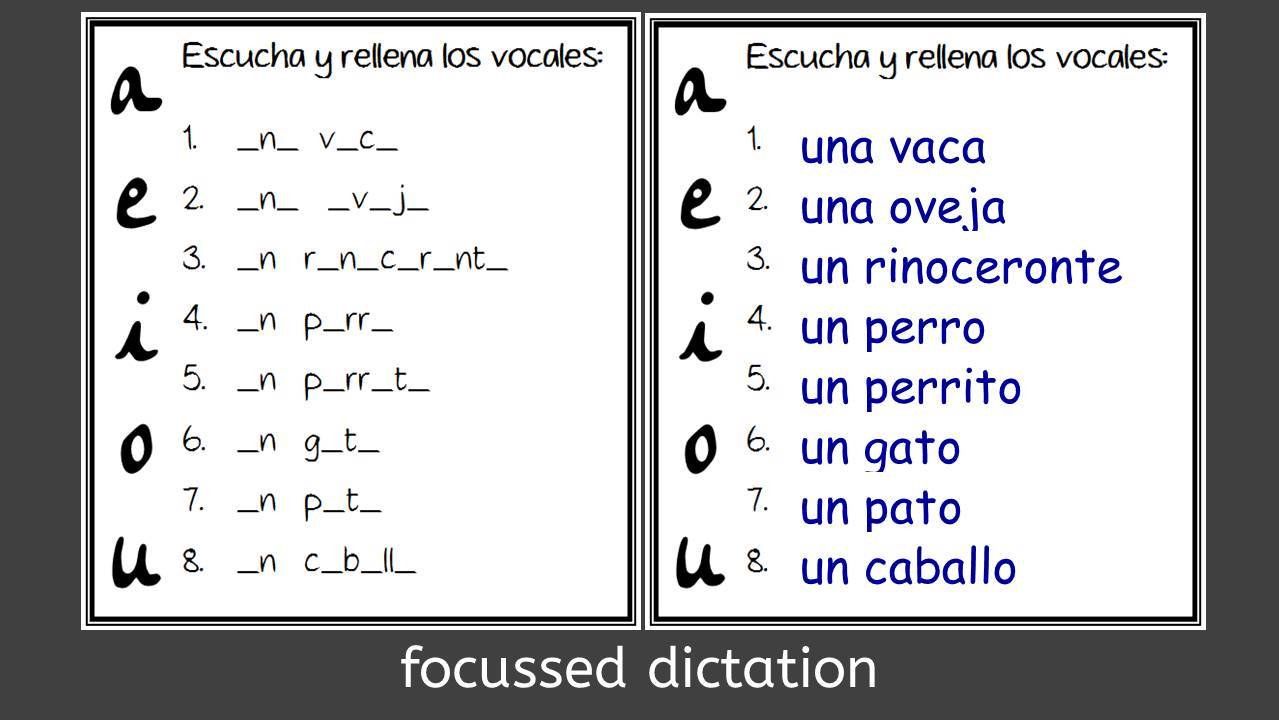
As we do a lot of work on phonics in Key Stage 2, a good place to start is with individual phonemes and graphemes in the form of a gap fill.  This is a listening activity that I have done recently with Year 2.  All that they had to write was the correct vowel - A or O - to complete the word.  The listening and therefore the dictation was very focussed.


I have also done a similar activity with Year 4, but this time using all the vowels, and they could also use their grammatical knowledge to help them to distinguish between the five sounds.  The challenge is for the children to hear 'ee' and think i not e!


Something else that I think is worth our while is using the target language terms for the punctuation in dictations.  This will only serve to reinforce the work that the children are doing in English.  Here is an activity that I have put together today for one of my Year 4 classes, who are getting really good at giving opinions of food and drink, but still need to do a little bit more work on differentiating between me gusta and me gustan.  They are also very ambitious and have been asking how to say "He likes" and "We like".


The children will listen first without writing, then listen again and write in the correct opinion(s) for each sentence.  Then after we have checked the opinions they will listen again and add in the correct punctuation.  I am hoping that completing these sentences will provide them with some useful models for when they start their extended piece of writing soon.

Now to think of some activities that will suit my French beginners!

If you would like to read more about dictation, I recommend:
Let me know how you have tackled dictation in Key Stage 2!