Dictation is back on language teachers' radar for a couple of reasons. Firstly, it features in the latest revamp of the GCSE specifications for MFL, which will be first taught in September 2024. Secondly, last Sunday saw a world record breaking mass dictation on the Champs-Élysées. I must admit when I first heard this news on Monday morning I was very jealous of the participants, and wished I could have been there! I used to do a lot of dictations in French at secondary school, in preparation for the O level exam, and loved them. I took French O level in 1985, which was actually the last year that students had to do a dictation. That year we were also the first cohort to do a listening comprehension (from the reel-to-reel tape!) I don't think we had had any practice of this beforehand.
I've had a look at some of my secondary school French books. It's interesting to note the standard of the language that we were expected to write at that time, which was the spring term of 3rd year, a.k.a. Year 9 (age 13-14). I had started learning French in the first year of middle school, age 8, and already knew quite a lot when I started secondary school at age 12 (in Year 8 - very odd three-tier system in Surrey in those days!), but it wasn't the same for all my classmates who had come from different middle schools.


And no, in the first dictée above, I don't have any idea what the reference to washing buildings is all about! You can see that dictations were always negatively marked. You started off with 20 marks (usually) and then as the person sitting next to you was checking what you had written, they would take off one mark for each error that you made. I think we were allowed half a point for a missing or wrong accent. Then our teacher checked them all and gave us our final mark.
I never experienced dictation in Spanish, having only started learning that language in the 6th form (age 16). O level in Spanish was just listening comprehension for the listening component. However it can be seen from the examples above just how much more complex dictation is in French compared to Spanish. My first error was one of adjectival agreement - route is feminine, and therefore I should have written route fermée. However, fermé sounds exactly the same as fermée, making it more than just an exercise in sound and spelling; it comprises also an important grammatical component. It would be much more straightforward in Spanish, where the phoneme-grapheme link is much more transparent, and the difference between cerrado and cerrada can be clearly heard.
The pronunciation of French with its myriad of silent letters and homophones combined with its grammar makes dictation a difficult task. There is a lot to think about. With Spanish, on the other hand, as long as you know the phonemes and their corresponding graphemes, especially those that make Spanish different to English, you can make a pretty good attempt at it. In fact the errors that our students make are likely to be similar to the errors that native speakers make when they first start writing.
This is part of a letter that was written to me by a 7 year old Spanish girl to whom I had taught English in Spain during my year abroad. It can be seen that she wasn't sure which words had silent h and which didn't. For example
e recibido should read
he recibido; te voy ha decir should be
te voy a decir. She also confuses b and v, which have the same sound, thus
me ba muy vien should read
me va muy bien.
Our students might experience similar difficulty with:
- the three 'th' sounds, represented by the three graphemes ce, ci and z
- the "spitting sounds", represented by the graphemes ge, gi and j
- ll and y, which mostly have the same sound
- the hard 'k' sound, which can be represented by c and by qu
- differentiating between r and rr
- remembering the ñ!
- remembering which vowels have written accents
Year 11 students will be expected to do dictation in their GCSEs from 2026. This means that all our primary children, who will be taking GCSEs from 2028 onwards, will, presumably, be starting to do dictations in Year 7, as Key Stage 3 begins its preparation for Key Stage 4. It makes sense, then, for us to start doing some simple dictation-style activities in primary.
There are three main types of dictation for us to consider:
- dictation of single phonemes (in the form of a gap fill)
- dictation of single words (more like a traditional spelling test)
- dictation of a short text
It's interesting to see that the proposed questions at GCSE are a combination of these. The first is Foundation Tier and the second is Higher Tier, and these are the sample questions from Pearson, who have released the first
specification for the new French GCSE.
So there is some gap fill of single words and also some whole sentences, but nothing on the scale of the paragraphs that we used to have to do for O level.
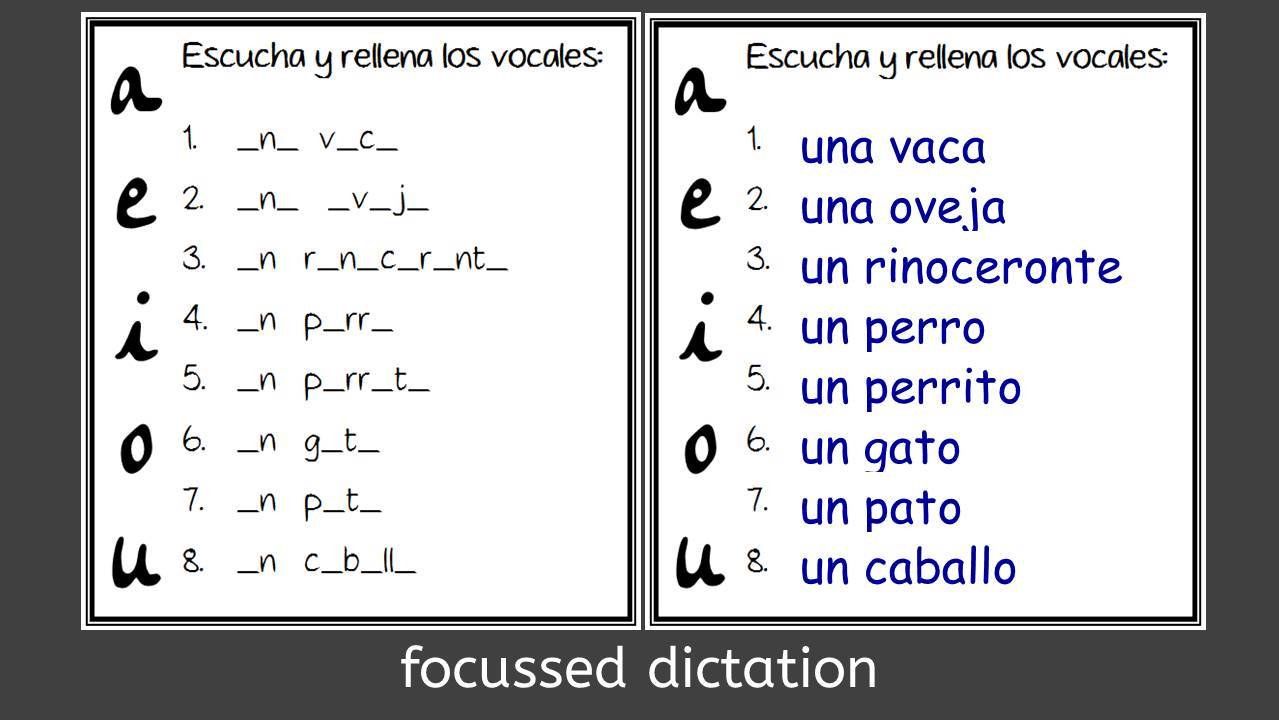
As we do a lot of work on phonics in Key Stage 2, a good place to start is with individual phonemes and graphemes in the form of a gap fill. This is a listening activity that I have done recently with Year 2. All that they had to write was the correct vowel - A or O - to complete the word. The listening and therefore the dictation was very focussed.
I have also done a similar activity with Year 4, but this time using all the vowels, and they could also use their grammatical knowledge to help them to distinguish between the five sounds. The challenge is for the children to hear 'ee' and think i not e!
Something else that I think is worth our while is using the target language terms for the punctuation in dictations. This will only serve to reinforce the work that the children are doing in English. Here is an activity that I have put together today for one of my Year 4 classes, who are getting really good at giving opinions of food and drink, but still need to do a little bit more work on differentiating between me gusta and me gustan. They are also very ambitious and have been asking how to say "He likes" and "We like".
The children will listen first without writing, then listen again and write in the correct opinion(s) for each sentence. Then after we have checked the opinions they will listen again and add in the correct punctuation. I am hoping that completing these sentences will provide them with some useful models for when they start their extended piece of writing soon.
Now to think of some activities that will suit my French beginners!
If you would like to read more about dictation, I recommend:
Let me know how you have tackled dictation in Key Stage 2!